
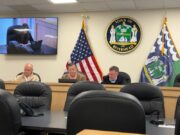










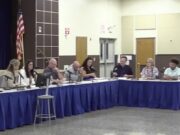






Long Island Science Center representatives returned to Riverhead Town Hall Thursday with a detailed explanation for the long delays in redeveloping the nonprofit’s East Main Street building, but several Town Board members sounded no more convinced than they were a week earlier that the project will move forward in time to fit into the town’s downtown redevelopment plans.
Appearing at a work session after missing the board’s previous meeting on the issue, the science center’s team said the project remains active but has been slowed by a complicated mix of reimbursement-based grants, bridge-loan requirements and the need to coordinate stormwater, access and construction timing with the neighboring town square and hotel projects.
The centerpiece of the update came from project architect Jordan Rogove, a principal at DXA Studio, who attended by Zoom. Rogove said the project team has concluded the redevelopment must proceed in phases rather than all at once, with a first phase focused on opening about 4,000 square feet on the Main Street side of the building and a second phase to follow later.
The goal, he said, is to open the first phase this fall.
“While there might not be appreciable visible progress, behind the scenes our team is really juggling a lot of moving pieces, a lot of variables and a lot of coordination between different requirements for different aspects of the lending,” Rogove told the board.
He said the first phase would allow the science center to “open the doors, turn on the lights and have a presence within the building,” while the rear portion of the building would remain available as a staging area for a later second phase.
Rogove said the project team expects to be ready by the end of this month or early next month to begin more substantive coordination meetings with the town on what he described as several “critical path” issues, including temporary and permanent stormwater handling, soil retention, easements, work permits, emergency egress and integration with the town square project.
He said the team intends to amend an earlier filing to reflect the smaller first phase and hoped to get revised plans into the building department within weeks.
But after several minutes of technical explanation, Supervisor Jerry Halpin cut in, saying the board needed “the bottom line” and wanted to know how long it would be before construction actually begins.
That question framed much of the discussion that followed, as council members Joann Waski, Ken Rothwell and Denise Merrifield sharply challenged the science center team over what they said has been years of delay, repeated redesigns and a lack of visible progress on the site at 111 E. Main St.
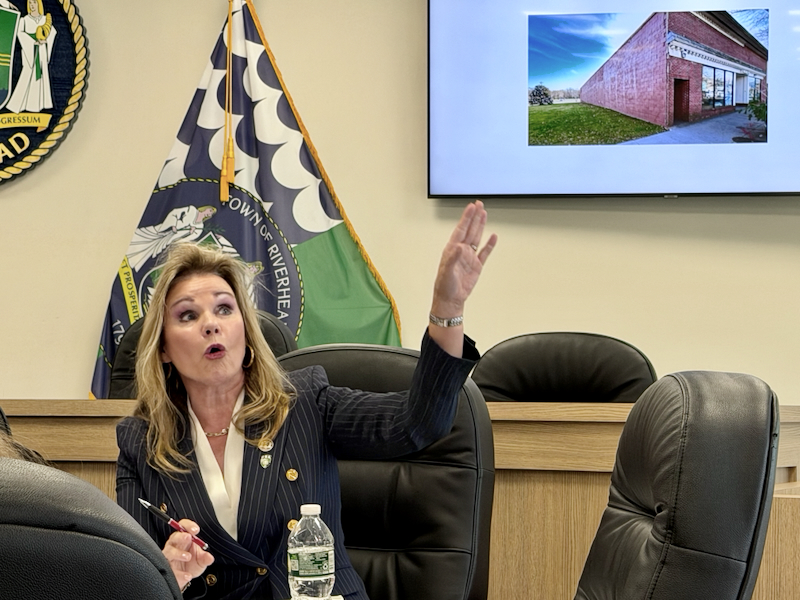
Merrifield, who came prepared with notes and a timeline of past iterations of the project, repeatedly pressed the science center’s representatives on what she characterized as shifting plans and unmet promises. She argued that the current proposal differed materially from what the board was shown last year and said the building remains vacant, blighted and out of step with the town’s vision for the downtown town square project.
“You’re here today to address the failures of the so-called science center, to move forward,” Merrifield said. “Ms. Kempner,” she said, addressing the grant-writing consultant for the nonprofit, Christine Kempner, a former director of the Riverhead Town Community Development Agency, “you were here a year ago and told us — assured us, not just told us, assured us —… that this would be ready in the summer of ’25 and it’s not,” she said. “It’s not only not ready, but the plan that was presented as phase one last year is now entirely different from the phase one plan presented at the work session Thursday.
“You are going to need not only building permits, but site plan approval,” Merrifield said. “You never went to the planning department for site plan approval at all, all year long, nothing… “You submitted the plans for this phase one back in May of 2025, and that was it. Nobody ever heard from anybody again, as to seeking building permits, seeking site plan meetings…None of that was done for an entire year,” Merrifield said.
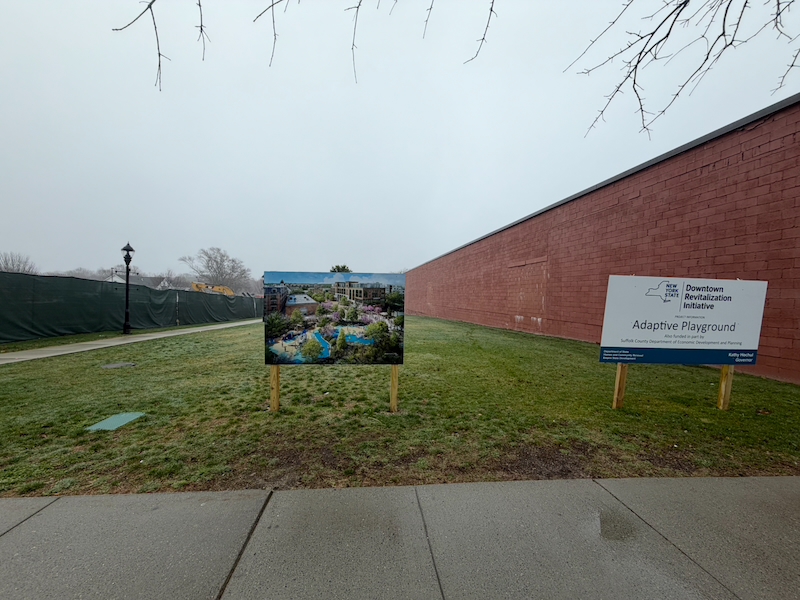
“Let’s stop calling it the science center. It is not a science center. It has never been the science center. When it was purchased, it was never opened as a science center. It’s remained vacant and blighted for six years now, with nothing,” Merrifield said.
“This dilapidated, blighted, vacant building, is all that has existed at 111 Main Street, from 2019 when it was purchased by the not-for-profit, until today. That is a disgrace,” Merrifield said.
The building was going to be “a real activation,” she said, “and it’s still nothing. In fact, what I’m hearing right now is you’re having substantial financial problems. We know for a fact that your Jump Smart grant is ending in June. That’s a million dollar grant you will not be able to utilize, because that’s a reimbursement grant, and you don’t have site plan approvals or building permits. You’ll never be able to utilize that money by June of this year.”
Rothwell said the Town Board is responsible to the taxpayers. “So as much as I like to say, I’d love to have the science center here, the plans that were put forth five years ago were amazing, and then they got scaled back, and they got scaled back, but for five years, nothing has been done,” he told the group. “So at a certain point we have to decide, like, how long do we as elected officials allow a dilapidated health hazard building to remain down there with nothing taking place, and us not taking action? I feel like we’ve been put on notice by our own fire marshals and our own building department, and they’re saying it’s time.”
Rothwell also questioned the group’s motives. “Are you simply a real estate holdings company?” he asked, wondering aloud whether the nonprofit was holding onto the building in the hope of selling it for a large profit after the development of the town square increases the site’s value. “Are you going to turn around and market and sell it for twice what you bought it for? Is that the intention? And that’s why you’ve decided not to put any money or work into it?” Rothwell noted that the building had been listed for sale by board member Larry Oxman’s real estate agency.
“You’re saying that we’ve done nothing is really not true at all,” said Oxman, who also joined the meeting by Zoom. “We put a new roof on the building. We were in the process of taking out the old sheet rock, and the town gave us a stop work order,” he said.
“Because you didn’t have permits to do that, sir,” Merrifield interjected.
Waski said the town’s patience has run out. “I think that what this board is trying to say is that we are frustrated with the lack of moving this forward. It’s too long. As Councilwoman Merrifield said, time’s up. We cannot continue to go in this direction. Our downtown deserves more. The residents of the town deserve more. And as far as I’m concerned, I’m finished kicking the can down the road,” Waski said.
Rothwell, while making clear he supports the science center as an institution, questioned whether the nonprofit’s current approach is financially workable and suggested the organization may need to reconsider its business model if it cannot secure the funding necessary to complete the project.
He said the issue is no longer whether the science center is a worthy organization, but whether this particular redevelopment plan is realistic.
Only Councilman Bob Kern appeared inclined to give the project more time. Kern said he understood some of the hurdles the team described and said he hoped the science center could get its filings in place and begin moving.
The tone turned tense at times, particularly during exchanges between Merrifield and construction manager Alex Lipsky, who disputed some of the board members’ characterizations of the building’s condition and the project’s lack of progress. Lipsky said the project team has been working to assemble financing and address the town’s concerns and argued that the first phase, as now proposed, would address issues the board has raised about the building facade, access and environmental conditions.
Still, the central problem for the science center was clear by the end of the meeting: after years of delays, board members wanted proof of progress, not another explanation of why progress has not yet materialized.
The latest clash came just one week after several board members signaled they were ready to move forward with condemnation of the property after science center representatives failed to appear at a prior work session.
Now the issue is moving from rhetoric toward formal action.
A resolution on the Town Board’s Tuesday, April 7 agenda would affirm the town’s prior authorization to acquire the property at 111 E. Main St. for general municipal purposes. The draft resolution states that the board previously suspended acquisition efforts in reliance on representations by the owner, but now finds that the owner has failed to proceed with redevelopment of the property.
The resolution would authorize the town attorney to take steps necessary to pursue acquisition, including securing updated appraisals, surveys, engineering reports and title work, and would also authorize the reengagement of outside counsel.
Halpin’s posture Thursday appeared more guarded than that of Merrifield and Waski, but he gave little indication that Rogove’s presentation had eased the board’s concerns. He said the science center would be placed back on the work session agenda next week and suggested that if the board decides to allow the project to continue, the organization would need to be accountable on a much more frequent basis.
The science center’s representatives insisted the project is still viable and that the behind-the-scenes work has been substantial, even if it has not yet translated into visible construction.
For several members of the Town Board, though, the issue has shifted from whether the science center is a good idea to whether the town can continue waiting for a project that remains long on plans and short on completed work.
By the close of Thursday’s meeting, that question appeared headed for an answer as soon as Tuesday night.
The survival of local journalism depends on your support.
We are a small family-owned operation. You rely on us to stay informed, and we depend on you to make our work possible. Just a few dollars can help us continue to bring this important service to our community.
Support RiverheadLOCAL today.
