





















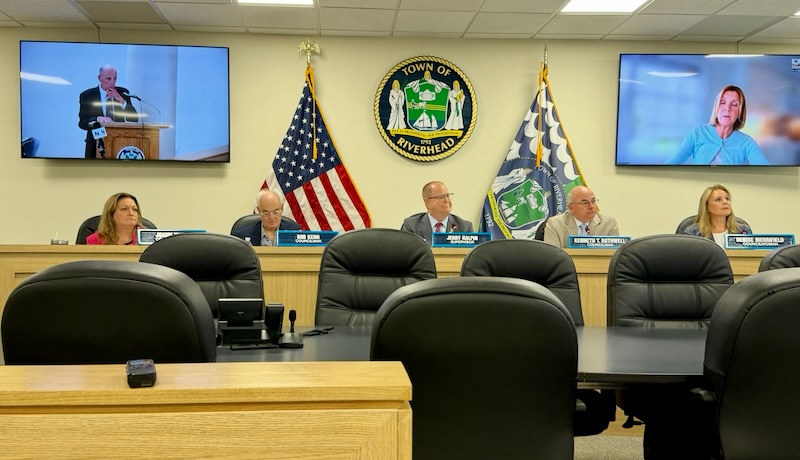
Riverhead Town Board members repeatedly defended a proposed eminent domain taking of the former Swezey’s building Wednesday night during a contentious public hearing that exposed sharp divisions over the future of downtown redevelopment, the town square project and the Long Island Science Center’s stalled plans for the property.
The nearly three-hour hearing on the proposed condemnation of 111 E. Main St. frequently blurred the line between public testimony and board debate, with board members openly rebutting critics, questioning speakers and arguing the merits of the taking from the dais.
Town officials argued the long-vacant building is a critical piece of the town square project and must be brought under town control to ensure proper flood mitigation and “activation” of the downtown public space. Opponents countered that the town had failed to identify a specific public use for the property and accused officials of using eminent domain powers to advance broader redevelopment interests.
“This is not about the science center,” Council Member Joann Waski said during the hearing. “This is about 111 East Main Street.”

The hearing was held under New York’s Eminent Domain Procedure Law, which requires municipalities to hold a public hearing before condemning private property. No decision was made Wednesday on whether to proceed with condemnation. The board voted at the end of the hearing to close oral testimony while leaving the record open for written comments for 10 days.
The property was purchased in 2020 by A Place for Learning Inc., a nonprofit corporation that operates as the Long Island Science Center, for a proposed downtown science center and planetarium project. Town officials initially supported the plan enthusiastically as part of the broader downtown revitalization effort.
Community Development Director Dawn Thomas outlined the town’s case for acquisition in a lengthy presentation tracing more than 30 years of downtown revitalization planning.
Thomas said the town square project — now advancing with millions in state funding and a planned hotel development by master developer J. Petrocelli Riverhead Town Square LLC — depends on activating both sides of the new public gathering space.
She said the science center’s original 2020 proposal for a roughly 24,000-square-foot facility with a planetarium, restaurant, gallery and retail uses facing the square aligned with those goals. But she said the project repeatedly shrank over time and failed to advance despite years of extensions and support from the town.
“What came to light at that meeting, and through further research, was that the entity was experiencing financial difficulties and could not promise that the funding was available,” Thomas said, referring to an April work session where the science center presented revised plans.
Thomas said the building remains “vacant, deteriorated, substandard and blighted” and argued the latest proposal — which she said would renovate only a portion of the structure while leaving a blank wall facing the square — would undermine the success of the public project.
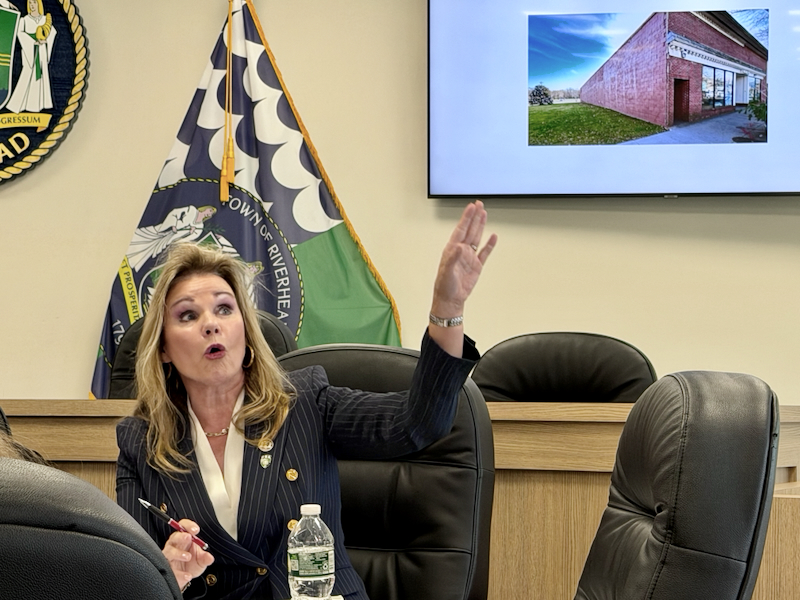
Environmental consultant Jeff Seeman said the parcel is also critical to the town’s flood mitigation strategy for the south side of Main Street.
“One parcel would cause the other parcels to continue to flood unless they’re all systemically raised and the infrastructure provided,” Seeman said.
He said the town square, hotel project and East End Arts campus improvements are all being designed as an integrated flood mitigation system responding to repeated downtown flooding and rising groundwater conditions.
“If all other development took place and that was not integrated now or soon into the future, that building would flood,” Seeman said.
Much of the public testimony focused less on flood mitigation and more on concerns about the town’s use of eminent domain, the value of the science center in the community and the broader redevelopment strategy surrounding the town square project.
Several speakers questioned whether the town had identified a sufficiently specific public purpose for the taking. The hearing notice published by the town stated the proposed acquisition would be “for general municipal purposes.”
Downtown Riverhead resident and Heart of Riverhead Civic Association President Cindy Clifford said she understands that “just saying this is for public use is not going to cut it” in the eyes of the court.
Clifford said the science center will “enhance our downtown revitalization,” asking “hasn’t that been the great goal all along?” She said the facility is “an interesting and active magnet” that “will draw visitors from the aquarium, bring residents downtown, result in the long-promised foot traffic and town square ambience.”
Former Riverhead Town Supervisor Laura Jens-Smith said the process felt “premature” and argued the science center purchased the property with the town’s encouragement as part of downtown revitalization efforts.
“If conversations have already occurred regarding alternative private development opportunities for this site, then those discussions are highly relevant to this hearing and should be publicly disclosed,” Jens-Smith said.
Others questioned whether the town was attempting to replace one private owner with another preferred private developer.
“The question in front of this board is not really should we seize this parcel,” Baiting Hollow resident Desmond Wong said via Zoom. “The question is why does every problem in this downtown have the same solution?”
Wong criticized the town’s agreements involving the town square project and Petrocelli development interests, including the earlier acquisition of the former Craft’d property.
Colin Tooker of Riverhead asked what the eminent domain process was going to cost.
“I don’t know. We don’t have an appraisal on the property yet,” Town Attorney Erik Howard replied.
Tooker and other members of the public questioned how the process works and how town taxpayers would be expected to cover the cost.
Howard said the board was holding the hearing “to receive information from the community and from the people who have spoken on behalf of the town,” and would decide whether to proceed after considering the hearing record and after receiving an appraisal.
Claudette Bianco of Baiting Hollow said the board did not appear sufficiently concerned about the cost to taxpayers.
“I don’t hear a lot of concern from you about how much this is going to cost us to do this,” Bianco said. “I’m not saying it’s a beneficial program or it’s not. I’m not for it, I’m not against it.” She said residents are already struggling with rising taxes.
Board members said the acquisition would be funded from town reserves and that the money could later be restored to fund balance if the town eventually sold the property for redevelopment. No estimate was provided for acquisition costs, appraisal fees, outside counsel fees, court costs or other expenses associated with the condemnation process.
Aquebogue attorney Ron Hariri repeatedly attacked the town square redevelopment process and warned the board about potential taxpayer liability from eminent domain litigation.
“You owe us a proper plan, including the costs, including the timing, and including what the ultimate result will be,” Hariri said.
Questions about cost and timing also undercut the town’s urgency argument. If the board proceeds, the town would still need to complete the condemnation process, acquire title, market the property, evaluate prospective purchasers and negotiate a redevelopment agreement before any new project could move forward.
Several speakers urged the board to continue working with the science center rather than moving forward with the condemnation.
Representatives from civic organizations and residents described the proposed downtown science center as a unique educational and cultural asset that could itself become a destination drawing people downtown.
FRNCA President Angela Huneault said the science center’s environmental justice programs provide science education and environmental monitoring opportunities for local students and communities.
Others argued the project complements the town square vision rather than conflicting with it.
Board members supporting the condemnation repeatedly argued the science center has had ample time to advance the project but failed to demonstrate financial viability.
Council Member Kenneth Rothwell said the board gave the organization additional time in 2025 after it presented revised plans and promised progress.
“How long do you want us to wait?” Rothwell asked during one exchange. “Five years? Ten years?”
Rothwell and other board members emphasized the struggles of downtown businesses waiting for promised revitalization and increased foot traffic from the town square project.
“We owe it to those businesses,” Rothwell said. “We promised revitalization.”
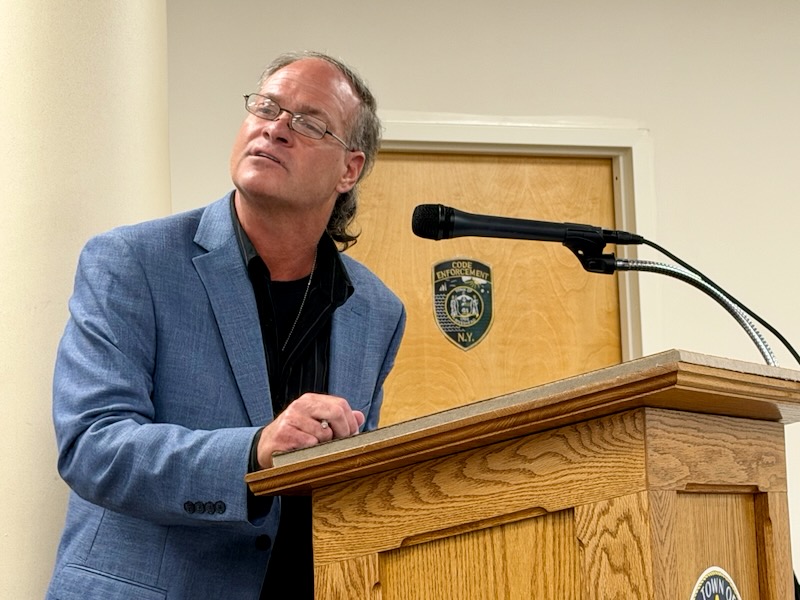
A local contractor, Jimmy Cartisano of Facility Construction Service, said his company performed work at the building and remains unpaid. He said his firm filed a mechanic’s lien against the property and said another lien is forthcoming. County records show a lien filed by Facility Construction Service on Nov. 20, 2025 in the amount of $13,867.
Peter Timmons of Wading River spoke in support of condemnation, saying the building “may have had potential as a science center six years ago” but had never become one.
“It’s never been a science center, and it isn’t one today. The building remains a dilapidated, vacant blight on Main Street, and it just so happens that it’s smack dab in the middle of where the activation is supposed to be happening that everybody’s been speaking about for the town square,” Timmons said.
He described a lack of progress over the past year after the board agreed not to proceed with eminent domain in April 2025.
“It is insane to allow the science center group more time to continue this farce,” Timmons said.
Timmons is Council Member Denise Merrifield’s husband, a relationship that was not disclosed during the hearing. After Timmons spoke, Clifford returned to the podium and asked who he was. Supervisor Jerry Halpin said Timmons had stated his name before speaking and asked Howard whether the board was required to “read it back.” Howard said no. Board members did not identify Timmons or his relationship to Merrifield, instead saying speakers were required only to state their name and hamlet of residence.
“Every resident has an opportunity,” Rothwell said.
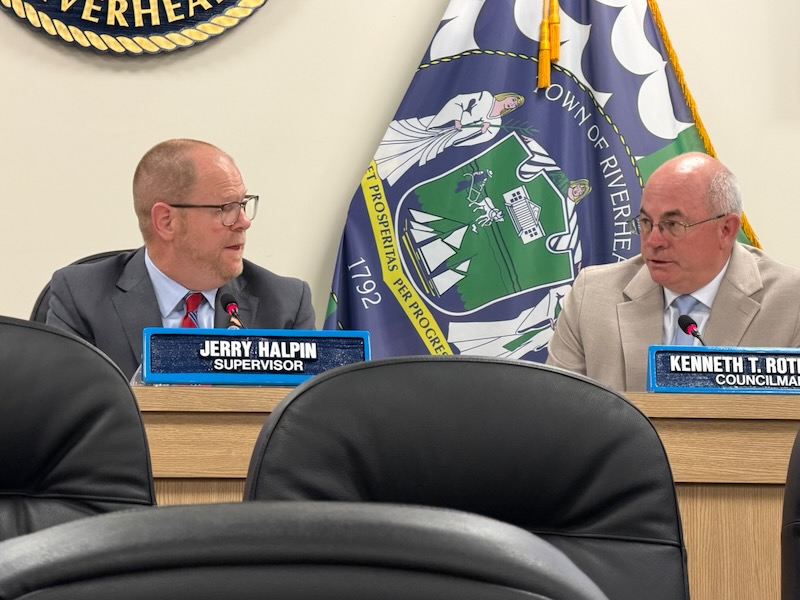
While most board members strongly defended moving forward with condemnation, Halpin publicly expressed discomfort with the process.
“I do not believe eminent domain is a card to be played unless there is a specific absolute need for that,” Halpin said.
Halpin said he was disappointed with the lack of progress at the building but acknowledged the passion surrounding the project and concerns about downtown revitalization.
Rothwell and Council Member Bob Kern and pushed back, noting the board had already delayed condemnation efforts once before in hopes the science center project would proceed.
Under New York law, the Town Board will have up to 90 days after the hearing record closes to decide whether to move forward with condemnation proceedings.
Town special counsel Frank Isler said that if the board proceeds, the town would obtain an appraisal, make an offer based on fair market value and file a petition in State Supreme Court seeking authority to acquire the property.
If approved by the court, title to the property would transfer to the town while any disputes over compensation could continue in litigation afterward.
Correction: This article has been amended to correct the attribution of a statement by Council Member Joann Waski that was incorrectly attributed to Council Member Bob Kern.
The survival of local journalism depends on your support.
We are a small family-owned operation. You rely on us to stay informed, and we depend on you to make our work possible. Just a few dollars can help us continue to bring this important service to our community.
Support RiverheadLOCAL today.
