





















The buckled sections of the walkway at Grangebel Park will be removed as soon as a grant is approved by the Federal Emergency Management Agency, which is expected within two weeks, according to town engineer Ken Testa.
Testa said barrels were being placed Friday to discourage people from traveling over the raised spots. He said the town hasn’t begun work on the walkway for fear of jeopardizing the FEMA reimbursement.
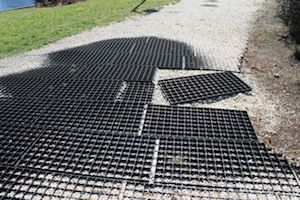 What happens after the walkway is removed is still up in the air. Testa said grading of the ground underneath may be necessary. He said he suspects it is the ground itself that is pushing the plastic paving grids up, possibly a result of the water that is allowed to leach through the stones into the ground saturating it and freezing during the winter.
The leaching is what the state Department of Environmental Conservation required to prevent runoff from flooding the adjacent river, but Testa said the agency has been cooperative in allowing the town to consider a special type of asphalt as a replacement. The choice is that or another paving system with gravel filling, but Testa said he is wary of using another such system in a location that is so susceptible to flooding. Superstorm Sandy left the area underwater and pieces of the grid floating.
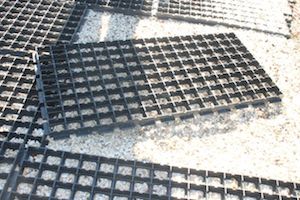 The Geoblock2 system used at the park was installed by Terry Contracting of Riverhead under a $1.37 million site improvement contract for the park. Terry Contracting’s bid amount for the paths was $98,000, at $7 per square foot. The system originally specified for the paths was Gravelpave2, which features a fabric-mesh bottom underneath the grids.
According to the website of its manufacturer, Presto Geosystems of Appleton, Wis., Geoblock2 is a turf paver, not a gravel paver.
Presto Geosystems also manufacturers a product intended as a gravel paving system similar to the Gravelpave2 called out by the town’s bid specifications. Like the GravelPave2 system, GeoPave has a fabric mesh backing designed to hold the stones intact.
Presto Geosystems director Bill Handlos said the product used by Riverhead’s contractor said the material is slightly less expensive than GeoPave, but declined to quote costs. The price paid by the town’s contractor would have been set by the local distributor, Handlos said.
Bob Terry of Terry Contracting did not return a call for comment.
Testa said the town’s contract allowed the contractor to substitute “an approved equal,” which he said was authorized by consulting firm Dunn Engineering of Westhampton Beach and approved by the town. A representative at the firm said several engineers who worked on the project have since retired but that he would look into how the decision was made.
 The town engineer cited a lack of history with the paving systems as a possible cause of any confusion about what was best suited for the walkway, which had to be bicycle-friendly.
Testa was also skeptical whether a mesh-bottomed system would have fared any better. He noted the deteriorated state of the parking lot at the county’s Peconic River Canoe Launch, which uses a plastic grid paving system with a mesh bottom that is severely damaged. While that location bears vehicle traffic, Testa said he’s wary of the consequences of using any plastic paving system in an area prone to water saturation, especially in Grangebel Park where the water’s velocity can be significant.
In an interview last month, Testa acknowledged that the pavers uses in Grangebel were problematic even before the park was flooded by Sandy. He said the plastic sheets buckled when they expanded in the heat.
“It became a hump,” Testa said of the plastic sheets.
The town tried cutting pieces out to allow for expansion and re-anchoring the matting, Testa said.
Supervisor Sean Walter said he doesn’t believe any plastic paving system is appropriate for the park, given its proximity to water. He said the park improvement contract predates his administration, but he doesn’t think what was specified or what was used was right for the park.
The manufacturer has offered the town a more durable product at a “greatly reduced price” once they heard about the situation at Grangebel Park, Testa said, but due to the location’s vulnerability to water he is leaning toward what he called imprinted asphalt. While more expensive than a paving system, it gives the appearance of red brick and is much more durable.
The walkway’s removal would leave the town with 14,000 square feet of crushed stone. Testa said some of it could be used as a base for the asphalt and possibly to line either side of the paths to form leaching strips where runoff can enter the ground.
“We don’t want to do this and have a similar problem,” said Testa. “Whatever we end up doing, we’re going to do it right.”
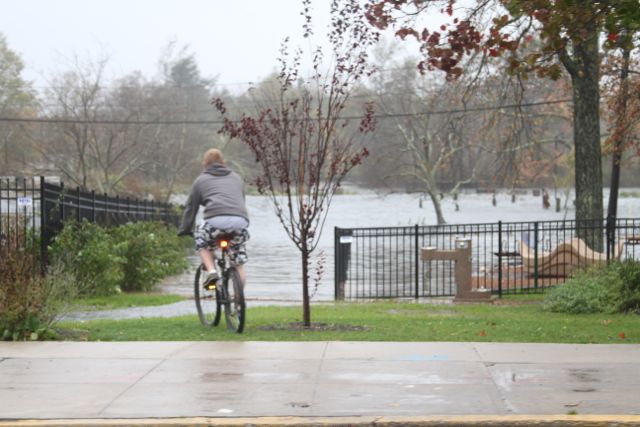
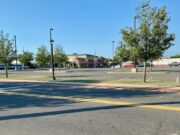
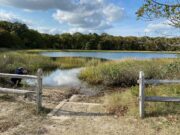
Photo captions, from top: 1.,2.,3. Walkways in Grangebel Park last month. 4. Parking area at Peconic River Canoe Launch on West Main Street. RiverheadLOCAL file photos by Denise Civiletti. 5. View of Grangebel Park from West Main Street after Superstorm Sandy left the park under water. RiverheadLOCAL file photo by Emil Breitenbach Jr.
The survival of local journalism depends on your support.
We are a small family-owned operation. You rely on us to stay informed, and we depend on you to make our work possible. Just a few dollars can help us continue to bring this important service to our community.
Support RiverheadLOCAL today.
