














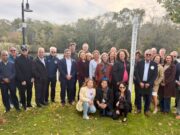







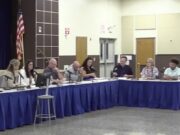





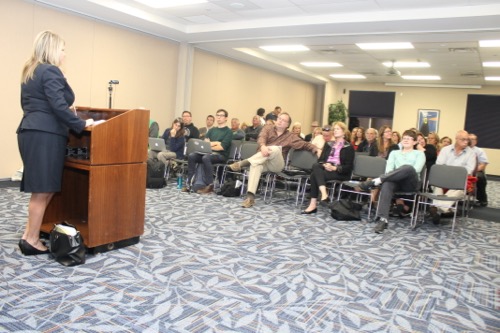
The three town supervisor candidates took turns answering questions about environmental issues posed to them by North Fork Environmental Council president Bill Toedter last night hosted by the N.Y. League of Conservation Voters last night at the Suffolk County Community College Culinary Arts and Hospitality Center in downtown Riverhead.
Unlike other candidate forums, the NYLCV event questioned each of the candidates in the meeting room one at a time, so they could answer questions posed “without distraction or debate,” Toedter said. Each candidate was asked the same questions and each had the opportunity to make both opening and closing remarks.
Supervisor Sean Walter (C) was up first, followed by challengers Anthony Coates (D) and Jodi Giglio (R).
TOPIC: WATER QUALITY
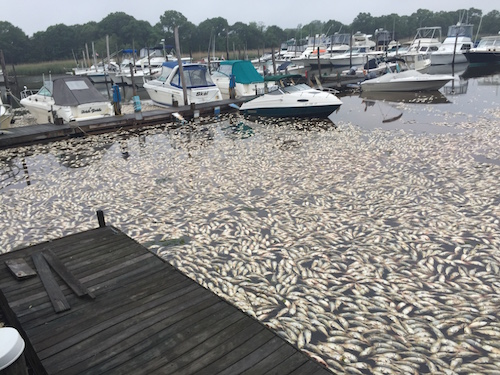
Question: What would you do to address septic issues and to reduce the use of pesticides and fertilizers by the public in Riverhead and by the Town of Riverhead and how do you propose to engage the East End towns to collectively address this water quality issue?
Sean Walter
- Pledged to stop fertilizing the grass along Peconic River.
- Advocates sewering the area south of Peconic Bay Boulevard from Aquebogue to the town line in Laurel, but says it remains uncertain whether that’s best accomplished by an extension of the town’s existing sewer district or by a “series of package plants” serving neighborhoods.
- Willing to look at building a new sewage treatment plant in Laurel to serve both Riverhead and Southold.
Anthony Coates
- Emphasizes educating the public on “best practices” because the nitrogen pollution affecting our bays is a result of human behavior.
- Would “prod the county” to adopt septic system improvements.
- Says while sewering is needed in some places, “that also sets off a warning bell” about its potential impact on development density.
Jodi Giglio
- Says she proposed and had adopted legislation requiring property owners within the watershed areas to upgrade their sanitary systems if they’re doing any work on their homes.
- Proposed legislation limiting fertilizer-dependent vegetation in new subdivisions.
- Proposed clearing limits on lots two acres or larger in new subdivisions.
- Says East End towns should get together and look to buy organic fertilizer for all their facilities.
TOPIC: SEWAGE TREATMENT
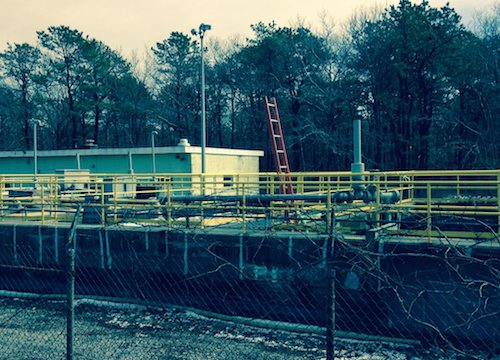
Question: As the host community for the regional treatment plant, do you believe Riverhead should re-examine the rate structure so the current users and any expansion of the Riverhead sewer system pay their fair share to expand reuse options and improve the Peconic’s water quality? At the same time, what steps wilL you take to ensure that any sewer expansions do not threaten the loss of open space and critical habitat to development as well as increase overall nitrogen loading thereby reversing the gains?
Sean Walter
- Says the town has re-examined its regional scavenger waste plant rate structure, did away with the scavenger waste tax on Riverhead properties and increased the tipping fees at the plant, because Riverhead contributes only about 20 percent of the waste treated there.
- Says he sought to expand the town’s sewer district to Riverside, “but that is taboo and I got in trouble.”
Anthony Coates
- Yes, people should pay their fair share. Whenever you talk about new sewer systems, crafty developers would be poised to come in for more density.
- Says the town should make sure it’s “tightened up all the loopholes” in its zoning so that increased sewering wouldn’t bring increased development
Jodi Giglio
- Says the town will have to raise fees charged at the scavenger waste plant.
- Says the county facilities in Riverside should come off the town’s sewer district — “they should have their own treatment plant” — so the Riverhead sewer district can be extended into the residential areas of Riverside.
LIGHTNING ROUND: YES OR NO
1. Do you support the proposed the proposed amendment to the community preservation fund which would allow up to 20 percent collected monies be used for water quality?
Sean Walter – Yes
Anthony Coates- Yes
Jodi Giglio – Not sure
2. Do you support resubmission of an application to NYS for the designation of Main Road from 105 to the east as a rural corridor?
Sean Walter – Not sure
Anthony Coates- Yes
Jodi Giglio – Yes
3. Would you introduce legislation that would phase out single-use plastic bags in the Town of Riverhead?
Sean Walter – No
Anthony Coates- Yes
Jodi Giglio – No
TOPIC: SHORELINE PROTECTION
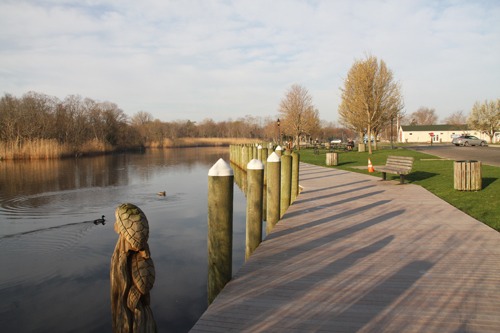
Question: What steps will you take to protect our shores and coastal properties as well as marine ecosystems and would you commit to adopting a local waterfront revitalization plan?
Sean Walter
- “I’d say yes, but I haven’t seen the LWRP. I think the devil is in the details.”
Anthony Coates
- “I support the governor’s resiliency plan.”
- Says the issue is regional in nature and “it would be silly to ignore a regional approach.” He therefore “would absolutely participate with our neighbors” in the LWRP.
Jodi Giglio
- Says she would commit to adopting an LWRP.
- “It’s important to identify any potential hazards that would occur in the Peconic Estuary and watershed areas to our rivers and the nitrogen loadings and I think that an LWRP is something that works in the Town of Southold and it actually isolates and focuses on those properties that are situated on the water and addresses those issues with upgraded treatment systems once they’re approved and proven effective, then that’s the way to go and the LWRP is very effective in carrying out those measures.”
TOPIC: FLYBOARDING
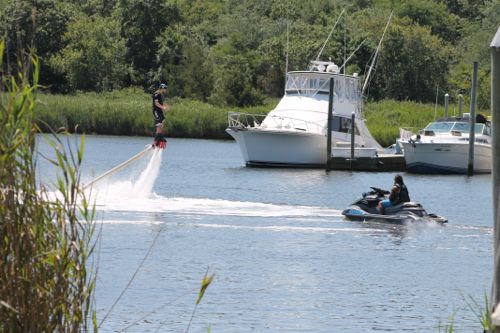
Question: Where do you stand on flyboarding?
Sean Walter
- “I knew it was a stupid idea. It should not have happened in the Peconic River for a lot of reasons.”
Anthony Coates
- “With all the problems — economic and environmental and all the rest —
the three most talked-about topics this year were medical marijuana, flyboarding and beer bracelets. That’s pathetic.” - Says he’s “dead-set against flyboarding next to the estuary.”
- Says flyboarding wouldn’t have even been considered by the town board had it been brought “by a different individual or a different group.”
- “I’m embarrassed that we spent so much time talking about it.”
Jodi Giglio
- “I voted yes on legislation to push it out to the bay.”
TOPIC: CLEAR-CUTTING VEGETATION
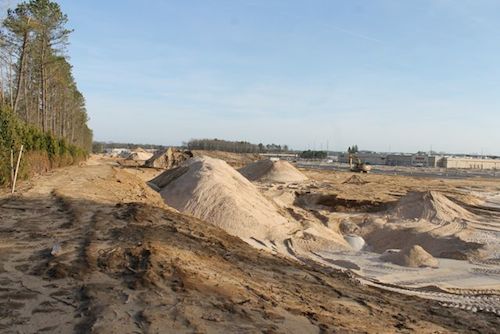
Question: Do you believe that vegetation protection beyond that which is regulated by the DEC and Conservation Advisory Council regulations is necessary and if so, what would you propose to effectuate such protection?
Sean Walter
- Advocates “tree ordinances” that ban clear-cutting. Said he had already asked the town’s building and planning administrator to draft legislation to do this, but cutbacks in the planning department have required him to spend time reviewing site plans, so it hasn’t moved forward.
Anthony Coates
- “I favor dealing with it at the outset” as part of site plan approval.
Jodi Giglio
- “Yes I believe that right now within the Calverton Camelot subdivision at the former Grumman facility there is a requirement for natural vegetation to remain and I think that’s important.”
- Says the town has already adopted legislation requiring natural buffers remain existing between commercial developments and residential developments.
- “I think it’s important that the town look at clearing plans and look at restricting the amount of clearing that could occur on a lot and also that the fertilizer-dependent vegetation be limited.”
TOPIC: CLIMATE-SMART COMMUNITIES

Question: If elected, would you join efforts and support meaningful policies and actions to allow the community and government to achieve transformative goals, reducing CO2 emissions and other pollutants and would you not grant a permit to any new fossil fuel peaker plant in Riverhead?
Sean Walter
- “LI has to answer this question for itself. Is solar so critical that when we have such a small land base that we’re willing to take out signficant portions of agriculturally productive property and put it into solar?”
- Caithness provides 10 percent of LI’s power on a 20-acre parcel, he said, while solar farms require much more land to produce much less power.
- He noted that so-called solar farms have generated public outcry.
- “We don’t have a lot of space left.”
Anthony Coates
- “The answer is yes… We just don’t adhere to scientific reality in this town.”
Jodi Giglio
- Says she brought a wind energy proposal to the town board after being part of the Suffolk County Planning Commission’s efforts to study wind energy, and got legislation adopted to allow windmills on parcels of two or more acres.
- Says she brought legislation forward to allow fast-tracking for solar on residential properties.
- As for a fossil-fuel powered peaker plant, she said, “Energy generation is a big problem on the East End. The blackouts that we have are a problem, a significant problem. A peaker plant may be necessary.”
TOPIC: WIND POWER

Question: Would you support the reform of the tower law to allow for more wind power?
Sean Walter
- Says the town tried to do a windmill at the sewage plant property but it wasn’t cost-effective.
- Says he supports off-shore wind power.
Anthony Coates
- Says he’s not sure what the tower law says but “I would absolutely support more wind power.”
Jodi Giglio
- “Absolutely. I supported the turbine at the STP which would have cut back on electricity significantly — by nearly 25 percent. I think that it’s important to look at all of that especially for municipal facilities.”
TOPIC: SOLAR POWER

Question: Would you support solar arrays on the dump and municipal buildings?
Sean Walter
- “Done.”
- Says the town has been pursuing solar arrays at EPCAL and has a contract with a company to install solar arrays on the town’s capped landfill.
- “Assuming LIPA gets out of their own way and builds transfer stations, when they do that we will have these project connected.”
Anthony Coates
- “We have a behemoth of property at EPCAL. Why isn’t a big chunk of that being used for solar?”
- “There’s a transaction on the supervisors’s desk that would have brought us as much as $9 million a year in lease income” from a solar farm at EPCAL. “Imagine $9 million a year in relatively benign use, no traffic, no blight.”
- “The town has sort of fiddled. GG has talked about it for more than a year.
The town board will often say the right things but there’s not follow-through.” - “I’m all in favor of using the power of the sun to plug Riverhead’s budget gap.”
Jodi Giglio
- “We put out an RFP for solar activities on the landfill but it was not cost-effective. It was cost prohibitive to actually get that power from the landfill into a transmission line from the landfill.”
- It’s important to consider solar anywhere, on any piece of land. We should be exploring it on the runways at the EPCAL subdivision… and in other areas as well.”
- Says she supports it “for consumption on farmland” on up to 10 percent of the site.
TOPIC: MUNICIPAL SOLID WASTE
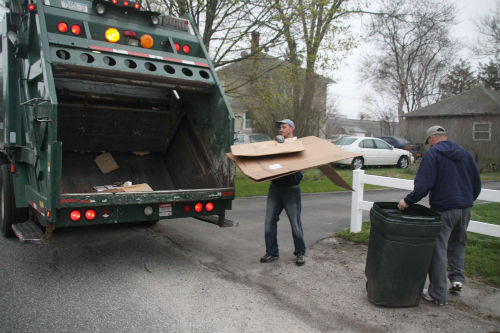
Question: How can the town better dispose of its MSW — perhaps a waste-to-energy plant — and improve recycling, perhaps going to a “single-stream” system?
Sean Walter
- Says he will not support a waste-to-energy plant.
- Says single-stream recycling has merit.
- When Riverhead last negotiated its carter contract, Brookhaven Town, which went to single-stream, is not.
Anthony Coates
- “I hear WTE plant and clang-clang-clang, warning bells go off. We don’t want an incinerator here in our town.”
- “Single stream in Brookhaven has worked well, increased recycling. There are
good policies happening around us, but not here.”
Jodi Giglio
- Says Riverhead is currently collecting $30,000 a year for its recyclables, but says, “We’re collecting less and less money on recyclables as the years go on.”
- “I think that it’s important that we work on recyclables and that we figure out the best way to do it and if single-stream recycling is the best way to do it then we should do it.”
TOPIC: DUMPING AT EPCAL
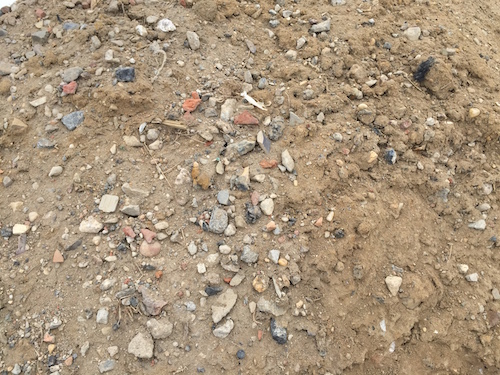
Photo: Peter Blasl
Question: Recently a case of dumping of asbestos at EPCAL – who’s responsible and what can we do to prevent such episodes in the future on other town properties?
Sean Walter
- “It shouldn’t have happened. It was s stupid decision. Councilwoman Giglio decided she was going to get some material for free to build the bike path. She worked with the highway superintendent. The town board said before you do anything, make sure you go thru the DEC to make sure the material is acceptable. It turns out before that conversation was had with the Town Board it was already dumped on the runway.” He says he found out about it from the town engineer at a department head meting.
- “It was taken from an unpermitted facility at about the same time we had the Roberto Clemente Park incident. I immediately called the DEC to let them know.”
- Says the town retained an environmental consultant to test the material and it was contaminated with some pesticides, but was not as bad as the contamination in Islip. The town was able to dispose of it at the Brookhaven landfill.
- “Sometimes people do bad acts. It never should have been dumped there.”
- “Somewhere along the line the highway superintendent got blamed for it. I don’t think it was the highway superintendent’s responsibility.”
- “The moral is, it’s very rare that you get something for free.”
Anthony Coates
- “One of my opponents has her office at EPCAL and holds court there. I don’t know who her clients are. She won’t tell you and that’s a big problem. There’s also a couple thousand cars parked outside the window of that office there. There’s a lot of bad things going on at EPCAL.”
- He called for more police patrols there and a “code enforcement sweep.”
- “EPCAL is a place that’s ripe for mischief.”
- “I don’t understand why we didn’t get to the bottom of that. I don’t understand how it happened… I’m sorry I just don’t buy what my opponent had to say. She
she sat mum at six weeks worth of meetings knowing that that material was there.” - “I’m sorry but my opponent’s fingerprints are all over it.”
Jodi Giglio
- “The highway superintendent has repeatedly in the media accepted and acknowledged that that was his responsibility for the dumping and I worked with him to try and get the material off the property.”
IN CLOSING
Below are transcripts of the candidates’ closing statements.

Sean Walter:
I want to thank you very much for having me come out here. You know what? I think I’m — I look at my track record as an environmentalist — I can’t even believe I said it. I always tell people I’m a conservationalist along — I’m a conservationalist along the lines of Teddy Roosevelt.
I think I’ve got a pretty good track record. I think I’ve been pretty open to things the environmental community has asked of me and of the town and I think I’ve responded accordingly in a very positive way.
I think the biggest thing that we’ve done but for Bill’s letter on EPCAL is that we really listened to the community to subdivide that property at EPCAL. If I’m fortunate enough to get re-elected, I will continue that open dialogue.
I honestly love nothing more than the dialogue between communities…environmental communities civic organizations it doesn’t matter because in that debate, because in that debate, not only can a debate be morally stimulating — no that’s not right — stimulating, but great ideas come out of those debates. The debates I’ve had with the environmental community have made this town a much better place.
We used to be known as the little town that couldn’t. You never hear that any more.
There’s so many exciting things happening right now. And yet we’ve done some great things with the sewage treatment. We didn’t talk about our well water treatment, our systems, solar we did touch on. We’ve done so many great things to preserve the environment and work together. I look forward to continuing hopefully over the next two years.
Anthony Coates:
For me, this is my favorite time of the year here. There’s the silver of winter in the sky, the ocean and the sound are a deep blue. For me this is the best time of year. Cleo, my girlfriend in the second row there, every morning she takes our dog Joe, he’s a retired guide dog, some of you may know him, and they go to the corner of Sound and Roanoke. That’s her best place. All of you have a best place. That’s where you like to be. That’s why we’re here in Riverhead.
The control of the commons doesn’t belong to the corporations or the private sector. It belongs to the people and that’s what the environmental movement is all about. In 13th Century England, in London, if you burned coal it was a capital offense. You could actually be executed for burning coal. The code of Justinian called environmental rights human rights. Part of the Magna Charta deals with access to fisheries. For a long, long time we’ve seen the need to preserve the environment that enriches us. And there’s Riverhead. And I don’t think we have a great record on the environment here. I don’t think we’ve done what we can to protect this area. I don’t know when they’re coming for your best place. Cleo’s best place and special place may be the terminus of a pipeline devised to go from EPCAL to Northville which one of my opponents has said was an exciting idea.
The fight for the environment is a daily struggle and I think you want to know something about the person that’s at the other end.
I lobbied for the bottle bill, for the bigger better bottle bill. I worked for NYPIRG. I worked on legislation in Albany and Washington to protect our environment and in the old days when the first Macintoshes came out I sat there pecking at the keys to bring the lawsuit that stopped the garbage barge from coming to New York.
I’ve been there for these fights, for a long, long time and before they get to your special place I think you want to know that someone’s a watchdog and an eyes and ears that’ll protect this town and that’s what I hope to bring to the job as supervisor.
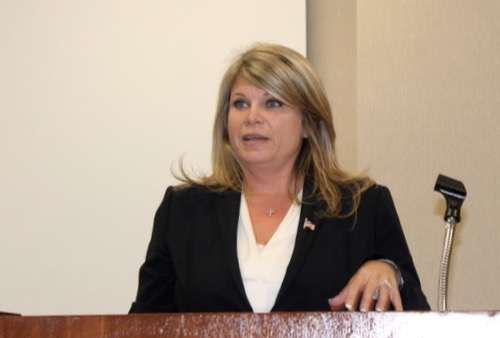
Jodi Giglio:
I think that there’s a balance between development and the environment.
I agree with the master plan. I don’t believe it’s necessary to spend another million dollars or two million revising the master plan throughout the town. I think it’s served its purpose. I think the two-acre zoning for residential, the limited commercial on Route 58 corridor, not extending west past the LIE or east past 105 seems to be working. I think the master plan seems to be working. So that’s why I‘ve supported any zone change or sewer district extensions, rejected them, that have come before the town board because it is important that we keep our nitrogen levels down in the Peconic River. As liaison to the Peconic Estuary Program I’m working with them right now on a rain garden and an education program on the riverfront and in downtown and we hope to have that completed hopefully by the end of next summer.
We’re going to get things done and we’re going to educate people.
I think that education is a key thing when it comes to stormwater pollution prevention. And I think that we’ve done a good job as far as putting out pamphlets educating the public and educating the people on water consumption and what they can do to help mitigate and stop using so much water and so I look forward to working with the environmental community and bringing forth good ideas that better our environment.
The survival of local journalism depends on your support.
We are a small family-owned operation. You rely on us to stay informed, and we depend on you to make our work possible. Just a few dollars can help us continue to bring this important service to our community.
Support RiverheadLOCAL today.
