

























Thousands of Long Island residents from El Salvador who have been living legally for decades in the U.S. will see their lives change dramatically after the Trump administration announced yesterday the decision to terminate their Temporary Protected Status (TPS) designation — a humanitarian program where immigrants are exempt from deportation because they are fleeing from natural disasters, war and other conditions and can’t return to their countries safely.
“Horrible, absolutely horrible,” said Sister Margaret Smyth of the North Fork Spanish Apostolate of the program that is now scheduled to end by Jan. 9, 2019. “This is likely to create a state of panic, people are going to be wondering what happens to their families and themselves and what it means,” she said.
Carlos Reyes, a TPS holder and native of El Salvador, who first came to the U.S. 24 years ago said that although he saw the announcement coming, it has been “devastating.”
“Maybe this is not the end of all my dreams, but it feels like it. The preparation of everything, the things I have achieved in this country, being a good, productive citizen, all my effort and sacrifice, is it worth it?,”
Now a Suffolk County bus driver and owner of two homes, Reyes recalls the dire situation when he escaped his country and immigrated to the U.S. as a 16-year-old.
“My country was at war. There was no hope,” he said. “As a teenager, I looked up to America as the land of dreams and opportunity, and that dream came true when I was able to come here and buy my house, have a license, and become an American in all but status.”
The statement issued by the Secretary of Homeland Security Kirstjen M. Nielsen says that the decision to terminate TPS for El Salvador was made “after a review of the disaster-related conditions upon which the country’s original designation was based and an assessment of whether those originating conditions continue to exist as required by statute.”
The announcement continues saying that “based on careful consideration of available information, including recommendations received as part of an inter-agency consultation process, the Secretary determined that the original conditions caused by the 2001 earthquakes no longer exist.”
Local immigrants and immigrant advocates argue that the situation in many of these countries has not ameliorated, and that poverty, lack of infrastructure, gang violence and other issues still affect these countries in significant ways. A summary that is supported by research done by the Center for Migration Studies think tank and other organizations.
“I understand TPS has always been a temporary protection,” Reyes said. “But how can I go back to El Salvador? It is a matter of life and death, it’s dangerous there…I don’t know how to function in a country that is dominated by violence and gangs.”
“I don’t know where would I go, but El Salvador would be the last place I would return to,” Reyes said. “That I know for sure.”
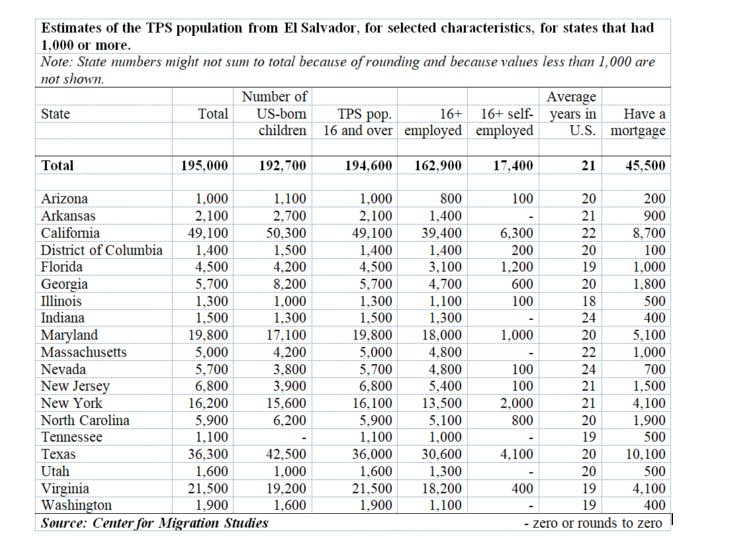
According to CMS , there are around 16,200 Salvadoran TPS holders that will be affected in New York alone — and nearly 200,000 nationwide — but the impact will be far-reaching and go beyond those directly affected. By ending the TPS program, CMS said that “about 61,000 mortgages would suddenly be in jeopardy,” and it will “force hundreds of thousands of long-term U.S. residents, including 273,200 U.S.-born children and 67,800 who were brought here as children, to move to a country that cannot safely and successfully reintegrate them.”
Smyth, who works closely with immigrants from Central America, agrees.
“They may have fled an earthquake nearly 20 years ago, but in the interim there is extortion, violence and other things in El Salvador that require protection from,” she said.
Signed into law 27 years ago by Republican President George H.W. Bush and approved for El Salvador in 2001, this program was initially meant to be a temporary solution for thousands, and unlike other immigration petitions like asylum, it does not permit recipients to apply for permanent residency or citizenship.
“Our government created this process by allowing TPS to keep going and going without offering any other solutions and it’s beyond cruel to take away everything now,” Smyth said.
According to a CMS report published last year, “88 percent of Salvadoran TPS beneficiaries work, large numbers are homeowners, they have 192,700 U.S. citizen children, and have lived in the United States (on average) for 21 years.” Also, “relatively few live in poverty, about 27,000 are self-employed job creators, a high percentage speaks English, and 16 percent have attended college.”
Now, immigrant advocates say, is the time for Salvadorans TPS recipients to keep informed and reach out to professionals who can assist them. The government issued an 18-month delay to allow for an “orderly transition” to leave the country or to find another immigration remedy.
“With heavy hearts we stand by our Salvadoran brothers and sisters affected by this devastating decision in solidarity,” SEPA Mujer staff attorney Cristina Ceron said.
“Nevertheless, we urge those directly affected by this decision to reach out to reputable attorneys and organizations to determine if they are eligible for any other existing immigration remedy,” she said. “We will continue to work and advocate for this community. La lucha sigue.”
Immigration experts said that other options like asylum, applying for permanent residence through U.S. citizen children who are over 21 years old, being married to a U.S. citizen and other options may be available on a case-by-case basis. Only those who have prior orders of deportation may be at risk, which in the case of Salvadoran TPS holders is minimal due to the strict requirements of the application they had to renew periodically every 18 months.
“It is our responsibility to educate the entire community about how difficult this is,” said Smyth. “It’s not easy to navigate the immigration system. I was in Federal Plaza in Manhattan a couple weeks ago and they were handing out appointments for early 2020.”
Reyes, who is now preparing for 2019 by selling his two homes and looking for a good lawyer, said that the key this year will be to look for allies who unite their efforts for all the DACA and TPS recipients who have been affected.
And although he siad this decision feels to him like it was politically motivated, he emphasized that this year is an election year and that people will vote for those who support immigration reform no matter in which side of the aisle they are on.
“I will keep hoping that something positive will happen and Congress will act and give a permanent solution to those who have demonstrated our value as citizens,” he said.
Smyth said that “it was time to take a deep breath” and that by helping those affected, we would also help the country as well.
“These are people who have been living legally here for many years,” she said. “It’s time to show we are not in the business of breaking families and destroying lives.”
The National TPS Alliance will hold a meeting this Friday at 7 p.m. at 238 Horton Avenue in Riverhead to talk about this decision.
The survival of local journalism depends on your support.
We are a small family-owned operation. You rely on us to stay informed, and we depend on you to make our work possible. Just a few dollars can help us continue to bring this important service to our community.
Support RiverheadLOCAL today.
