













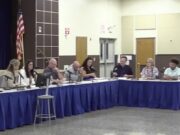






Representatives of three innovative technology companies interested in coming to Calverton Aviation and Technology’s development at the Calverton Enterprise Park discussed their plans with the Riverhead Town Board this morning.
The companies were part of a presentation made by Christopher Kent, the attorney for the Triple Five affiliate.
Members of Triple Five could not attend today’s meeting because of the Jewish holiday Sukkot, Kent said. “They are not working this week,” he said.
Jens-Smith reminded Kent that the choice of this meeting date was his, not the town’s. The holiday, she said, has “existed for thousands of years” and should not have come as a surprise.
One of the companies, Launcher, is already using the EPCAL taxiway for testing of the miniature rocket engines it’s developing. Launcher founder Max Haot said once the rocket engines — which are currently being designed in Brooklyn and, since 2017, tested at EPCAL — are in commercial production, he hopes to manufacture them at Calverton Aviation and Technology’s site.
“We hope to rent aviation-ready manufacturing space at EPCAL and also raw land where we can build a more permanent testing facility,” Haot told the board.
The liquid-fuel rocket engines will launch small satellites into space, he said. No rockets will be launched in Calverton, Haot said. Rocket launches on the East Coast can only take place at Cape Canaveral on Florida and two other coastal sites in the Southeast, he said.
Launcher has so far raised $3.7 million of the $10 million it needs for the development phase, Haot said. It has won a small Defense Department grant and as a result was eligible to apply for a larger DOD grant; it will learn the fate of that application within a few weeks, Haot said.
“This is a great place for an aerospace company,” Haot said. “The talent is here — or they want to move back here.”

Another company, Unique Electric Solutions, is manufacturing kits to retrofit diesel commercial vehicles to run on electricity.
The retrofit program is a pilot program funded by New York State Energy Research and Development Authority (NYSERDA), said UES president and CEO Joseph Ambrosio. The company is retrofitting 15 trucks for use in New York City and 16 for California.
The eventual goal is to convert 66% of UPS’s fleet to electric power. A converted UPS truck was parked outside Riverhead Town Hall today.
The company, which currently has 10 employees, plans to grow to about 50 employees and will need a 50,000-square-foot building.
“CAT would be perfect for us,” Ambrosio said.
The third company, ULC Robotics, is currently headquartered in the Hauppauge Industrial Park, where it has owned a 20,000-square-foot building for 16 years and is in the process of buying a 12,000-square-foot building, company CEO Gregory Penza said.
ULC is developing VTOL (vertical take-off and landing) fixed-wing, unmanned aircraft for use in the wind energy industry.
The aircraft will be used to inspect welds on offshore wind turbines. They will also be used to observe protected species, such as whales and dolphins, in the exclusion zones around wind turbine construction sites. Currently that’s done by a people with binoculars in a boat, Penza said.
“We believe we can do that job much better,” he said.
The aircraft has a 10-foot wingspan and is powered by a three-pound hydroelectric engine.
“This is about a $5 million project to develop this and then deploy it,” Penza said. It would involved 28 to 30 pilots and support staff of about 25 people. “That group will service the 9,000 MW of wind energy the governor wants to build,” he said.
“We won’t be using the runways,” Penza said. “We are interested in the land around it” for test flights, he said. The company would require a facility of 25,000 to 50,000 square feet to manufacture the aircraft and train the pilots.
“Our company is growing like mad,” Preza said. “We are doing $37 million in sales this year and expect to do $100 million in sales within five years,” he said.
“These companies are ready to go,” Kent said. He said CAT has interest in the site from many other companies that are not prepared to go public before CAT has title to the site.
The transfer of the 1,644 acres being purchased by CAT can’t happen until the town gains approval of an subdivision dividing the site into eight lots, three of which are being purchased by CAT. Final approval won’t be granted by the town planning board, until the Suffolk County health department approves the subdivision and the State Department of Environmental Conservation approves wetlands and Wild Scenic and Recreational Rivers Act permits.
Frank Isler, the town’s outside counsel handling the subdivision, said those approvals could take another five to six months to obtain.
David Lazer, the town’s other outside counsel — hired to advise the board on EPCAL contract issues — pressed Kent for CAT’s prospective timeline for the development, starting with the date of closing.
CAT will fulfill all of its obligations under the contract, Kent stated.
“You know this town has been down this road many a time,” Supervisor Laura Jens-Smith said. “They say they can do it, but when it comes to putting a shovel in the ground —“
“This is different,” Kent said. “They were all single projects.
This is a collaboration.”
Jens-Smith disagreed. “It’s a single developer. Let’s look at it like its a mall,” she said.
“It’s irrelevant. That’s ridiculous,” Councilman Tim Hubbard interjected.
“No, it’s the same business model,” Jens-Smith answered. “It’s a single developer and you get people to come in. It’s the same model but a new field for Triple Five, so that’s why we are optimistic but cautious.”
The supervisor said the town is also concerned about Triple Five’s financial position.
“We know that Triple Five has leveraged some of their other properties for the American Dream mall in New Jersey,” she said. “They have the $5 billion project in Miami and some issues in China,” she said. “As a town we need to be able to see that this is a viable project and they have the wherewithal to carry it out.”
Hubbard said he disagreed with the supervisor’s analogy to a shopping mall, “but I agree we need to be assured of their financial ability.”
Kent disagreed. “We don’t need to go through that again,” he said. “We had that in the Q&E.” He referred to the process by which a municipality determines whether an applicant is “qualified and eligible” under state Urban Renewal Law, in order to buy or lease property in a designated urban renewal zone.
“A lot has changed since then,” Jens-Smith said. “Their financials have changed significantly.” She said the contract requires the purchaser to provide updated financials.
Councilman James Wooten said in his 12-year tenure on the town board, “we’ve never been where we are today,” despite the town having spent “probably close to a million dollars on the environmental impact study and habitat plan.”
Kent said the CAT plan is “a generational project” that will attract hi-tech innovation companies for years to come. It’s not something that’s going to happen overnight.
David Panetta, of Cushman and Wakefield, the real estate firm representing the town in the sale, said, “As an investor, you don’t want to finish this in 20 years, you want to finish it in 20 months.” While that’s not realistic, he said, “there’s a lot of demand for the property if it gets to the point where it will move forward.”
Correction: This story has been amended to correct the misidentification of the town’s outside counsel, Frank Isler. He was incorrectly identified as Frank Yakaboski.
The survival of local journalism depends on your support.
We are a small family-owned operation. You rely on us to stay informed, and we depend on you to make our work possible. Just a few dollars can help us continue to bring this important service to our community.
Support RiverheadLOCAL today.
