



















Calverton Aviation & Technology will attend another public information session with the Riverhead Industrial Development Agency to discuss plans for the EPCAL site, the Riverhead IDA announced in a press release issued last night.
The session, which the Riverhead IDA said it requested, is “intended to provide an opportunity for the CAT team to describe its proposed financial structure for the acquisition and development of the project, as well provide an opportunity to demonstrate their market presence,” the Riverhead IDA said in the press release.
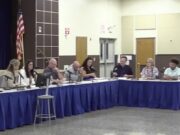
The public information session will take place on Wednesday at 5 p.m. at Riverhead Town Hall, 200 Howell Avenue, Riverhead. The meeting is open to the public and will be limited to two hours. A public comment period will be provided, the IDA said. This will not be the Riverhead IDA’s public hearing on the application, which will be held at a later date.
The public information session can also be viewed live on the town’s website here.
Participants may also attend using a zoom link. Email the IDA office director@riverheadida.org by close of business on Monday for log-on instructions. You must include your name, address and phone number within the email, the IDA said. Pre-registration is only required for those attending virtually.
Calverton Aviation & Technology is a single-purpose limited liability company formed in December 2017 to purchase 1,644 acres of vacant, industrially zoned land within the enterprise park from the Riverhead Community Development Agency for $40 million.
The purchase agreement between the town and CAT required the town to subdivide the land it owns inside the enterprise park — totaling more than 2,100 acres and including Veterans Memorial Park, a 9-mile recreation trail, Grumman Memorial Park and other parcels in municipal use — in order to complete the sale. The town was unable to complete the subdivision due to regulatory issues with the State Department of Environmental Conservation.
The project is now before the Riverhead Industrial Development Agency, which is reviewing CAT’s application for tax exemptions in connection with its $245 million phase-one construction at the site.
The application is in front of the Riverhead IDA now, prior to subdivision, site plan and other approvals ordinarily required before building permits can be issued, because the town was unable to subdivide the land, preventing any of those other permits from being issued. The town’s community development agency, as landowner, is a co-appplicant.
The contract of sale between the town and CAT included a clause that allowed either party to cancel the deal if the town was unable to obtain final subdivision approval by May 20, 2020. Town officials decided not to cancel, saying their outside legal counsel — who negotiated the contract — advised the town not to attempt to exercise the right to cancel because it would only lead to years of litigation. Officials have declined to provide additional details, citing confidentiality of legal advice.
The town and CAT in February 2022 agreed to a contract amendment that requires the town to convey title to all of its property inside the enterprise park to the Riverhead IDA, if the IDA approves CAT’s application for financial assistance. CAT would pay the town the balance of the purchase price and would pursue the subdivision at its own cost, town officials said last year. Once the subdivision is obtained, the IDA would transfer the 1,644 acres to CAT and the remaining acreage back to the town. The IDA would then enter into lease and project agreements with the town and CAT that would detail the parties’ obligations prior to the title transfer.
The Riverhead IDA’s transaction counsel for the CAT project, Phillips Lytle, has hired an accounting firm to review the applicant’s records and help the Riverhead IDA decide whether the applicant’s business plans are feasible and will advance the IDA’s mission to grow jobs and tax base in the Town of Riverhead.
When it presented its development plans for the site at a Riverhead IDA board meeting last September, CAT included air cargo use for the two runways, which are part of the sale. Those plans, including more than 8 million square feet of logistics and distribution buildings along both runways, caused controversy in the local community, which pushed back on the idea of an air cargo facility in Calverton. Town Board members, who authorized joining CAT in the IDA application but said they were not aware of any air cargo use when they did so, have recently said they oppose air cargo at the site. CAT representatives initially said the company was not planning a cargo jetport at the site and their application was misunderstood. At an IDA public information session on Aug. 10, CAT representatives said one of their consultants erroneously referred to that use during last September’s presentation. CAT representatives maintain that the company will not pursue an air cargo use.
Vetting of CAT’s finances has long been a sticking point for the town and a source of concern for residents critical of the deal. The Calverton sire is in a designated Urban Renewal Area. State law allows a municipality to sell or lease land in a designated Urban Renewal Area without a bidding process or appraisal if the municipality determines that the proposed buyer or tenant is a “qualified and eligible sponsor,” as per the state law.
The state law does not set forth criteria for the determination, but says that the determination shall be made pursuant to rules adopted by the municipality. Riverhead Town’s adopted rules and procedures for making a “qualified and eligible sponsor” determination require the town to find that the project sponsor has “demonstrated ability to finance the acquisition and development” of specific project proposed ” of the proposed project “including the review by the CDA of pro forma financial statements for the proposed project, including sources and uses of funds, certified personal and corporate financial statements of the applicant sponsor, financial commitments of participating lenders, proposed security for the project” and more.
CAT submitted a letter from its accountant stating that it has at least $40 million cash to buy the property and also letters from financing companies stating they were interested in financing the development. CAT refused to submit certified personal and corporate financial statements, citing privacy concerns and the company’s status as a privately owned entity.
Nevertheless, the Town Board on Nov. 8, 2018 voted 3-2 to approve CAT as a qualified and eligible sponsor, with board members who supported the decision saying they were satisfied with the financial information CAT was willing to provide. Council Member Tim Hubbard is the only current member of the Town Board who was on the board at the time; he voted in support.
Once the “qualified and eligible” determination was made, the town could sign the purchase agreement with CAT. The agreement itself had been negotiated in 2017 and was approved by the Town Board at its last meeting of that year in a 3-2 vote with support from two outgoing members of the board: Supervisor Sean Walter, who had just lost his re-election bid, and Council Member John Dunleavy, who was term-limited. The third vote in support was Council Member James Wooten, who was in the middle of his last term on the board and was precluded by the town’s term limit law from running again in 2019. Hubbard and then-Council Member Jodi Giglio, cast the two votes against the deal.
The Dec. 19, 2017 vote to approve the contract came on the heels of the disclosure that Triple Five was involved in the $40 million land deal initially negotiated by the town with Luminati Aerospace. The town had signed a letter of intent with Luminati Aerospace in April of 2017 to sell the land to Luminati Aerospace or a wholly owned subsidiary of Luminati Aerospace. At the time, Luminati Aerospace founder Daniel Preston claimed to have major technology investors that would help Luminati attain its goal to bring internet service to unserved areas of the planet with unmanned solar- and wind-powered aircraft that Preston, who held himself out as an aeronautical engineer, said could achieve “perpetual flight.”
By summer of 2017, Luminati’s ability to raise capital for its plans came into question, and NYC billionaire John Catsimatidis announced his interest in backing Luminati. Catsimatidis negotiated with Luminati for at least three months, according to statements made by a Catsimatidis spokesperson and was still negotiating with Luminati as of early November 2017. The town, meanwhile, was negotiating a purchase agreement with Luminati’s attorney, town officials said.
It is not clear when Luminati’s negotiations with Catsimatidis ended or when Preston/Luminati brought Triple Five into the deal. Town officials said on Dec. 12, 2017 they had learned a week earlier that Catsimatidis was not going to be involved in the deal — and there would be a joint venture with Triple Five Ventures instead. Papers forming Calverton Aviation and Technology were recorded in Delaware on Dec. 13, 2017. The filing for “Triple Five Real Estate I,” the limited liability company that owns 75% of CAT, shows it was formed Dec. 18, 2017.
According to CAT’s application to the Riverhead Industrial Development Agency, Triple Five Real Estate I is a limited liability company 100%-owned by Fundco International Limited, which in turn is 100%-owned by Global Investco Limited, which is owned 100% by Justin Ghermezian, vice chairman of Triple Five and son of Triple Five Chairman Nader Ghermezian. Justin Ghermezian is CAT’s chief executive officer.
Triple Five is a family-owned conglomerate based in Edmonton, Alberta, Canada, best known for its development and operation of mega-malls. It owns and operates the West Edmonton Mall in Alberta, the Mall of America in Minnesota and American Dream Mall in New Jersey. Another massive Triple Five retail and entertainment complex, American Dream Miami, remains in the planning stages for Miami-Dade County, Florida.
Construction delays and increasing costs on the multi-billion dollar American Dream project in New Jersey combined with the impacts of the coronavirus pandemic to deal multiple financial blows to the developer. Consolidated financial statements of a joint venture company and various Triple Five subsidiaries involved in the New Jersey development showed losses in excess of $120 million in 2020 and 2021. The statements were made public as a result of required reporting for $800 million in public authority bond financing secured by the developer in June 2017. Consolidated financial statements for 2022 have not yet been posted on the Municipal Securities Rulemaking Board’s website.
Triple Five Group, its corporate affiliates and its principals are also defending numerous lawsuits, many stemming from the American Dream New Jersey development.
On May 3, State Supreme Court in Manhattan entered a $404.4 million judgment against Ameream Mezz I LLC, in connection with its default on a $300 million loan made in August 2019. Ameream Mezz I is a limited liability company owned through five other limited liability companies by Ghermezian Family Trust. Ameream Mezz I is one of numerous limited liability companies involved in the American Dream development that is “directly or indirectly wholly owned…by a Ghermezian family trust,” Triple Five lawyer Jill Block of the NYC law firm Pillsbury Winthrop Shaw Pittman wrote in a May 2013 letter to the New Jersey Sports and Exposition Authority.
Triple Five spokesperson Gary Lewi of Rubenstein communications told RiverheadLOCAL in February the litigation over the default “has no connection to the company that is purchasing the Calverton property.”
According to court documents, nine members of the Ghermezian family, including Triple Five Chairman Nader Ghermezian, personally guaranteed the $300 million loan, along with several Ghermezian-family owned or controlled companies, among them companies that own interests in the Mall of America and West Edmonton Mall.
Ghermezian family members, including Triple Five Chairman Nader Ghermezian, have been named defendants in a civil racketeering lawsuit brought in federal court for allegedly marketing counterfeit hand sanitizer under the registered trade name and logo of an existing personal care product company during the pandemic. Because of the counterfeit product, which the lawsuit says the Ghermezians imported from Mexico, the FDA put the plaintiff’s brand on a “do not use” list due to potential methanol contamination, causing great losses to the plaintiff, according to the complaint.
The lawsuit accuses the Ghermezian family of operating Triple Five Worldwide LLC as a “sham vehicle” and a “shell company” to shield themselves from personal liability and seeks to hold the Ghermezians personally liable for the plaintiffs’ losses.
The Triple Five defendants deny the plaintiff’s allegations and earlier this month filed opposing papers in the lawsuit, seeking dismissal of the complaint.
The law firm representing the plaintiffs in the hand sanitizer lawsuit is the same law firm that serves as the Riverhead Industrial Development Agency’s legal counsel, Nixon Peabody. Though the Riverhead IDA initially appointed Nixon Peabody as transaction counsel with respect to the IDA’s review of CAT’s application for financial assistance from the IDA, the IDA subsequently replaced Nixon Peabody with a different transaction counsel in the matter; the firm remains in the role of the Riverhead IDA’s general counsel.
CAT’s presentation on Wednesday will be made by its attorneys, Chris Kent and Peter Curry of Farrell Fritz, according to the IDA press release. Also attending the meeting will be CAT representatives Justin Ghermezian and Meg Blakey and CAT consultants, architect Alex Badalamenti, engineer Chris Robinson and builder Joe Petrocelli.
The survival of local journalism depends on your support.
We are a small family-owned operation. You rely on us to stay informed, and we depend on you to make our work possible. Just a few dollars can help us continue to bring this important service to our community.
Support RiverheadLOCAL today.
