














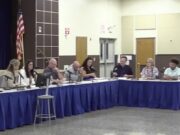





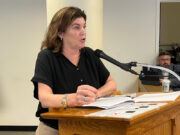


Tough decisions lie ahead in crafting next year’s budget, the school district’s business official told school board members last night, as the Riverhead Central School District approaches a “fiscal cliff” with the loss of nearly $20 million in federal funds.
The school district is in a “perfect storm, where your increased staffing is not going to align with your funding,” Interim Assistant Superintendent for Business Marianne Cartisano said at last night’s school board meeting. The district has been using $19.8 million of federal coronavirus emergency relief funds, which will expire at the end of the year, to supplement its budget over the last three school years.
The school district’s budget, which is roughly $192 million, has been bolstered the last few years by dramatic increases in state funding, as well as the federal relief funds. The boosts have allowed the district to hire more teachers and implement new programs.
But in next year’s budget, the board must focus on stability, said Cartisano, an interim hired after the resignation of both the former superintendent and former business official.
Watch the Cartisano’s presentation below.
“Now, I want to say out loud, you did so because you had the funding from the federal and the state level, you did the right thing,” Cartisano said of the hirings. “But there is no provision to continue to do that.”
The school district has 177 more staff members than it did five years ago, Cartisano said. The district needs “to find a balance between what we can afford and what programs we want,” she said.
Thankfully, most of the money received from the federal government has been spent on non-recurring expenses, Cartisano said. Cartisano said the district has already gone through the current budget line by line to “see what has the least impact on staff and least impact on students” and see what programs could be reduced without being eliminated. There “is not an area that has not been looked at for a reduction,” Cartisano added
But there are still positions that need to be reduced, she said.
It’s not clear right now how many staff may have to be laid off or how many programs need to be cut — Cartisano did not share any projections last night — but documents available on the school district’s website and resolutions passed by the school board provide a glimpse into what programs and positions have been funded by federal dollars.
Funding plans prepared by the district for the grant show a lot of money went toward one-time expenses. That includes purchasing educational technology — including a Chromebook for every secondary student — upgrades to the school security systems, and personal protective and sanitation equipment.
Other federal money was used to fund temporary salaries for school programs. The money was used for stipends for teachers to teach summer school and summer enrichment programs, stipends to tutor and run after-school programs, and pay the salaries of bus drivers and bus monitors for summer schools.
Federal funding was also used to hire Eastern Suffolk BOCES staff members for the alternative high school — now known as the North Star Academy — for the last three school years. The program, which was created with the goal of bringing students falling behind on credits back on track to graduate, is currently at capacity.
A budget prepared for the State Education Department, which administers the grant funding, shows the district funded 28 full-time equivalent professional positions in the 2021-22, 2022-23 and 2023-24 school years with federal funds.
Eighteen of those 28 positions were for all three school years: one social worker; one additional elementary school guidance counselor; three school psychologists; one elementary school teacher specializing in reading; one elementary school teacher specializing in speech; and one teacher specializing in math academic intervention services; and 10 teachers for outreach to English language learners. The other 10 teachers — all for elementary schools — were budgeted just for the 2023-24 school year, the record shows.
The cost of the 28 positions covered by the grant were estimated to be $2.4 million for their salaries and $1.3 million for benefits.
Cartisano said the district will prioritize retaining employees based on seniority, not on whether the district hired that person using federal funding.
“I do want to warn you, this is going to be a new level of March Madness that you probably have not experienced — because it will have nothing to do with basketball,” Cartisano said. “What I would expect is that there are going to be ‘campaigns for causes,’ is what I’m going to phrase it as. Everybody will agree that reductions need to happen, as long as it’s not what they’re interested in, or where their child is interested in.”
“So what I will tell you is every position that you added benefited a child, every program that you brought to Riverhead helped a student,” Cartisano said. “Now we have to back off of that. So what you will hear from parents, from students, and I expect actually from your staff: don’t reduce this, reduce something else.”
She said the administration will present the school board with an “instructional plan” and a “sound financial plan” that must be matched for the budget to be sustainable.
She observed that the culture of the district is “very different.”
“Your culture is ‘wow, wouldn’t it be great if we had this? Let’s add it,’” Cartisano said. “We can’t do that anymore. That’s not fiscally prudent.”
Despite warning the board about the tough decisions it will have to make, Cartisano layered her address with comforting words for board members.
“It’s gonna be OK folks, I promise you. You’re not the first board to go through this. But $19 million is a lot of money to make up — $19 million worth of physical clutter is a pretty big fall,” Cartisano said. “But we’re going to make that as soft a landing as we can, not only for 24-25, but for the four to five years that follow that so that you have a solid financial plan and that it doesn’t look like your EKG going up and down. You have to get off the roller coaster.”
Cartisano did not share any revenue or spending numbers during her presentation. She will continue to speak about the budget proposal in more detail at the next four school board meetings.
She did mention, however, that the school district will finalize its tax cap projection to the state comptroller by the end of the week. She estimates that the cap will be between 3-3.5%. The district will not seek to exceed the tax levy cap imposed by the state, Cartisano said. The state comptroller has set a tax levy increase of 2% on school districts this year, although levying taxes to cover certain expenses do not count towards the 2% cap. A budget that would increase the levy over the state-imposed cap requires the approval of 60% of the district’s voters, rather than a simple majority.
Besides the tax levy, there are factors that could help the district close the funding gap further and soften the blowback from cuts. School district state aid has yet to be finalized, and budget negotiations between legislators and Gov. Kathy Hochul could give Riverhead more than the $80.3 million anticipated in the governor’s proposed budget.
The change to foundation aid formula made in the governor’s proposal would give districts like Riverhead “less than what we should be getting,” Cartisano wrote in a letter with Interim Superintendent Cheryl Pedisich last month. Cartisano said in an interview after the board meeting that reinstating the current aid formulas in the state’s final budget will positively impact Riverhead’s budget further.
The survival of local journalism depends on your support.
We are a small family-owned operation. You rely on us to stay informed, and we depend on you to make our work possible. Just a few dollars can help us continue to bring this important service to our community.
Support RiverheadLOCAL today.
