

























A proposed 15,000-square-foot medical office building on Main Road in Aquebogue drew lots of criticism from local residents during a Town Board special permit hearing Tuesday afternoon at Town Hall.
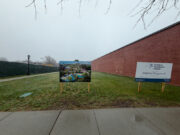
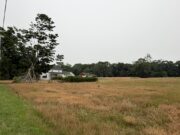
The presently undeveloped 3.5-acre site of the proposed building is located on the northeast corner of Main Road and Union Avenue in the Rural Corridor Zoning District.
Questions about the site plan’s compliance with the restrictions imposed in the Rural Corridor Zoning District, concerns about the potential for increased traffic congestion from the proposed development, and complaints about a proposed traffic signal at the intersection of Main Road and Union Avenue dominated the residents’ comments at the hearing.
The proposed traffic signal was recommended by a traffic impact study prepared for the applicant by its consultant VHB Engineering, which analyzed potential traffic impacts from the proposed development as well as cumulative impacts from a separate development proposal on the northwest corner of the same intersection. The State Department of Transportation OK’d the signalization of the intersection, which will also include the construction of an eastbound left turn lane from Main Road onto Union Avenue.
The proposed development would have ingress and egress only from Union Avenue. There would be no access from Main Road.
Neighboring residents voiced objections to the new signal, complaining that it would exacerbate existing traffic congestion on westbound Main Road due to the traffic signal at Main Road and County Road 105.
“During the fall, when you go to make a right off of 105 onto the Main Road, you cannot move,” Stephanie Visek, a resident of Grant Drive, off of Union Avenue, said. Eastbound traffic on Main Road backs up past Doctors Path to the 7-Eleven at DMV Plaza on Route 58, she said. Adding another traffic light will make traffic back up even more in both directions, Visek said and if the lights aren’t synced, it’s going to “back up to God knows where.”
Other Grant Drive residents who took the podium expressed the same concerns.
VHB engineer Ryan Winter said the applicant’s traffic impact study, which was required as part of the town’s review process, determined that a traffic signal would mitigate both existing and future traffic conditions. He said the developer would request the NYSDOT to sync the new traffic signal with existing signals on Main Road.
The configuration of the proposed site plan and the size of the proposed building was also the source of controversy during the hearing.
Some speakers told the board they oppose all new medical office buildings east of Route 105.
“I see a nightmare happening here,” longtime Riverhead resident Marylin Banks Winter said. “We have enough medical buildings in Riverhead,” she said, pointing to the expansion of Peconic Bay Medical Center and the development of many new medical office buildings in the surrounding area. “I think this whole thing needs to be re-evaluated,” she said.
The Rural Corridor Zoning District regulations allow professional offices, including medical offices, within 1/4 mile of the Hamlet Center or Village Center zoning districts by special permit of the Town Board. Hamlet Center zoning takes in parcels to the west of Edgar Avenue, with the westernmost parcel in that district being less than ¼ mile of the proposed development.
Residents also questioned whether the size of the building meets the requirements of the Rural Corridor district.
“What the zoning calls for is campus-style… buildings not to be more than 5,000 square feet,” Greater Jamesport Civic Association President and former Riverhead Town Supervisor Laura Jens-Smith said. “And what you’re being asked to evaluate is a 15,000-square-foot building,” she said, also arguing that the proposed development exceeds the maximum 25% impervious surface allowed by the zoning.
“I know all of you have spoken quite extensively about preservation and open space and maintaining the character of Riverhead. And I think that this is a unique opportunity for you to actually put your decisions with what you’re professing. Because this is something that is very large, I don’t think there’s any other buildings in the rural corridor that are anywhere near 15,000 square feet,” Jens-Smith said.
The former supervisor challenged Senior Planner Greg Bergman’s comparison of the proposal to existing Main Road office buildings on the west side of Union Avenue. Those buildings were built under prior zoning and should not be used as a guide to appropriate development of the site in question, Jens-Smith said.
The other buildings predating the Rural Corridor Zoning “doesn’t change the fact that they are there,” Bergman responded. “They do contribute to the character in the area. They are office buildings.”
Bergman said the applicant originally presented alternatives for development including a campus-style plan and a two-story building with a smaller building footprint.
“Both the planning board and the town board desired the single-story building, as opposed to the campus-style layout. The thought was to keep the buildings further away from the residential properties located to the north,” Bergman said.
The Rural Corridor Zoning District’s design standards call for a minimum of four buildings, each with a maximum area of 5,000 square feet for development of properties greater than three acres in size. However the standards are part of the supplementary guidelines for that zoning district. The guidelines say the design standards are “intended as a guide” for development and where the standards use the word “shall” it is intended to mean the reviewing board should “obtain compliance” with the standards “to the extent practicable,” to be determined by the board doing the review.
In all, 10 residents spoke in opposition to the proposed plan during the hearing.
Supervisor Tim Hubbard closed the hearing but left the record open for written comment until close of business on July 26.
The survival of local journalism depends on your support.
We are a small family-owned operation. You rely on us to stay informed, and we depend on you to make our work possible. Just a few dollars can help us continue to bring this important service to our community.
Support RiverheadLOCAL today.
