























Typically, the public hearing on Riverhead Town’s proposed preliminary budget for the upcoming fiscal year has drawn little attention and few public comments over the past several years. In fact, the hearing, which is mandated by state law, has often been an open-and-shut matter in recent years. Not this year.
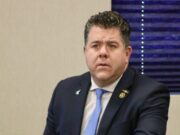
The Town Board hearing on its proposed 2025 operating budget on Thursday afternoon went on for an hour and drew comments, support and criticism from residents — and at one point, even police intervention to remove a resident from the meeting room, at the direction of Supervisor Tim Hubbard.
MORE COVERAGE: Town Board critic ejected from budget hearing under police escort, threatens civil rights lawsuit
Riverhead Financial Administrator Jeanette DiPaola opened the budget hearing by explaining the spending plan’s general terms: a tax levy increase of 7.92% in the town-wide tax levy, requiring the Town Board to adopt a local law authorizing it to pierce the tax cap by 4.14%, to support spending of nearly $74.6 million in the three town-wide funds: the general fund, the street-lighting fund and highway fund.
Total appropriations across all funds next year, is a proposed $117.3 million. The larger total includes spending for special districts such as the residential refuse districts, the ambulance district, and the water, sewer, business improvement and parking districts. Taxes to support that spending are paid by properties located within those districts.
The town-wide tax rate is proposed to increase by 7.55%, from $62.319 per $1,000 of assessed value to $67.025 per $1,000 of assessed value, resulting in an increase of $292 increase in town-wide property taxes in 2025 tax year for the owner of a home assessed at $60,000 — a market value of roughly $620,000. At the proposed tax rate of $67.025 per $1,000 of assessed value, a home with an assessed value of $60,000 would have a tax bill of $4,021.50 for town-wide taxes in 2025, up from $3,739.14 in 2024.
“The general fund is the only fund that we’re proposing to pierce the cap in,” DiPaola said.
The general fund tax levy increase of $4.1 million over 2024 is largely driven by increased salaries and related payroll costs, DiPaola explained, including a $600,000 increase in the N.Y. State Retirement System contribution and a $600,000 increase in health insurance costs, which, she noted, are contractual obligations of the town under its collective bargaining agreements with the unions representing town employees, including police.
“We’re budgeting for a few new vehicles to replace old vehicles that are pretty much end-of-life for police, fire marshal and buildings and grounds,” DiPaola said. “We have an increase of about $400,000 for debt service, which is basically related to a principal payment beginning next year for [debt on the purchase of] the new Town Hall building,” she said. “There is also about a $200,000 increase for the purchase of new radios, due to a new bandwidth set by Suffolk County and about a $100,000 increase for insurance premiums, property insurance, general liability and workers comp,” DiPaola said.
Different opinions, from ‘reckless spending’ to ‘a good budget’
Colleen O’Brien of Aquebogue was first to the podium. She asked for the amount of the town’s current indebtedness and the current balance in the town’s reserve accounts.
“We can get that information for you,” Hubbard told her.
“I think this budget is callous contempt for the taxpayer, young and old,” O’Brien said. “We have a high population of senior citizens. The Social Security increase is 2.5%. A lot of young people are struggling to make a go of it,” she said.
“I think that we’ve had reckless, unsustainable spending in this town. And I think it’s — we’re getting to a point — it’s got to stop,” O’Brien said.
She questioned whether the town will be able to maintain its own police and water districts, given increased costs.
O’Brien called the Town Board budget’s proposed salary increases for themselves “just plain arrogance.”
Jamesport resident Joan Cear thanked the supervisor and council members for reducing the proposed salary increases included in the supervisor’s tentative budget, which she called “a good public relations move.” She offered kudos to council members Ken Rothwell and Joann Waski for stating they would decline any salary increase in 2025, which she said was “a smarter PR move.”
Nevertheless, Cear said, any salary increases for the Town Board in a year when it’s proposing a nearly 8% tax levy increase, is “inappropriate.”
“Half of the Town Board members and the town supervisor have been in their elected positions for less than a year, and they ran for election knowing what the salaries were for their respective positions in a year,” Cear said, pointing out that board members have “repeatedly” said the town lacks revenues to do what it needs to do. “In my opinion, it’s inappropriate for any of you to accept a salary increase,” Cear said.
Cear questioned why some of the appropriations in the tentative budget are higher than the amounts requested by department heads. She provided several examples of what she called “a pattern” where the tentative budget amount exceeds the department’s request, sometimes by a few thousand dollars and sometimes by significant amounts, she said. The Town Board expense request was $287,000 but was increased in the tentative budget to $297,000. The accounting and finance department’s request was $905,000 but the amount allocated in the 2025 budget was $979,000. The expense for benefits were projected at $19,540,000 but the budget allocation is $20,387,000, which is $847,000 over what was requested for that function.
“So can someone please explain to me why the budget allocations in these and several other areas are actually higher than what the respective department or function projects the cost to be,” Cear asked.
“The department request budget is done very early on in the budget process,” DiPaola explained. “Every department is asked to submit their requests by the end of July, and we go through — the supervisor and myself, the budget assistant, the budget officer and the department heads — go through and review everybody’s budget in detail with them,” DiPaola said.
While that is going on, she said, there are still many unknowns, including where the state-mandated retirement contributions will be set and how much health insurance costs will increase.
“So some of these things are moving targets,” she said. Of necessity, those numbers are updated later on in the budget process. The department’s request is “a good start, but it’s not the absolute dead set budget for the department,” DiPaoloa said. “It absolutely changes over time.” Some changes are increases, others are decreases, she said, and the “overall net budget usually goes down from department request to tentative [budget.]”
Cear asked if it would be possible to bring some of the timelines, at least the internal deadlines, could be synced.
Cear also asked about the expense line for the Peconic Hockey rink expenses. “Can someone direct me to where that would be?”
“We have one budget line that the Peconic Hockey utilities [expense] is included in,” DiPaola replied. “It’s actually on page — it’s cost center 1620 — it’s on page 11. So we have a Town Hall utilities-electricity line of $800,000. $162,000 of that is set aside for Peconic Hockey, which was the $150,000 per the contract, plus CPI for 2024, plus CPI for 2025. That’s the only line for Peconic Hockey in our operating budget. It’s the only thing we’re obligated to pay for them for operating expenses,” DiPaola said.
“Do we get any revenue from them?” Cear asked.
“No. We may recoup,” DiPaola said. “So if Peconic Hockey makes a profit, we may recoup the electricity funds that we paid out towards it, based on the profit that they made the year before, once we see the audit and financial statements,” DiPaola said. Those statements are required to be submitted by March 31 of the following year, she said.
“I understand the costs have gone up. I mean, I grocery-shop too. However, I do feel that a 7.92% tax [levy] hike is excessive at this time, and I would encourage all the departments in the town to further sharpen their pencils and further tighten their belts and look for areas to save money, Cear said. “And I encourage the Town Board to investigate alternative sources of revenue.” Cear suggested looking into a possible sales tax on agritourism entertainment or a local “bed tax.”
Hubbard said the town has looked into the “bed tax” question and he believes the town can’t implement such a tax because the county already charges a room tax on accommodations. He assured Cear he would double check that.
Cear was followed to the podium by Ron Hariri of Aquebogue, whose questions and comments drew an unusual response from the supervisor, who asked Hariri to sit down after his comments, the supervisor said, went off-topic. The interchange between Hariri and Hubbard escalated and ended with Hubbard directing Riverhead Police to remove Hariri from the meeting.
“We don’t entertain clowns at the podium,” Hubbard told him.
At that point, the supervisor, without recessing the meeting, ordered the town’s IT staff member who runs the meeting livestream and video recordings, to cut Hariri’s microphone. The audio feed ended, quickly followed by the video screen going black and then being replaced with a blue screen announcing “technical difficulties.”
After Hariri, protesting, was escorted from the meeting by police, Hubbard told the town staff member, “OK can start filming again, please.” The hearing then resumed.
Kathy Berezny of Riverhead said she understands that the budget includes “a lot of large expenses coming in the police department.” She suggested that the town could spread these out, by making a one-year, two-year and three-year plan “so that not all the major expenses are put into one budget.”
Berezny said people are still reeling from the COVID pandemic and the inflation that followed.
Council Member Ken Rothwell said the Town Board worked very hard to have budgets with “a zero increase” for two years in a row during the COVID crisis.
“We made it clear then that we were putting off the inevitable, that vehicles were aging out, they were getting older,” he said. “We did our best to hold back those two years,” he said, because “during COVID was not the time to raise taxes.” However, Rothwell said, “We knew this day would come.”
Berezny offered a comment on behalf of her husband, who could not attend the meeting.
“He feels that the supervisor … is worth your raise, not an 8.7% raise, but a raise, because you are on duty 24/7. Anything happens in this township? You are out of your bed and you are taking care of the residents. And he felt that if anyone was entitled to a raise, it was you,” Berezny said.
Hubbard thanked her and pointed out that the town has been talking with Rep. Nick LaLota about federal funding next year for police vehicles. LaLota indicated that might be possible, Hubbard said.
Mike Foley of Reeves Park said nobody likes to pay tax increases. “But the fact of the matter is that things have gone up markedly in insurance and in salaries, and in spite of the money that we are now providing in raises, and some of them are adjusted raises, the employees of this town, with the exception of the Riverhead Police Department, are underpaid,” Foley said.
“If you look at the comparables in municipal departments in surrounding municipalities. We are not paying comparable salaries,” he said. The end result is that Riverhead Town trains employees who then leave for higher-paying jobs in other municipalities, Foley said.
“How do you keep your people unless you pay them?”
Foley said sometimes the town has to pierce the state property tax levy limit. “It’s easy to kick the can down the road,” he said. “It is irresponsible to do that.”
He pointed to land preservation as something people demand that comes at a price. “So the residents of this town love the open space. There’s a price to pay for open space. When you take open space off the tax rolls, the amount of money that needs to be made up by those residing in the town goes up in ratio,” Foley said. “We have thousands of acres of open space that the people in this room have come to this microphone to do everything we can to preserve open space. So you can’t ask for open space and then complain that we have to pay for it.”
Foley said redevelopment of “EPCAL, done properly, will remove any of the problems that we have as taxpayers.”
Foley also offered support for “reasonable raises” for Town Board members on occasion. To object is “just it’s playing petty politics,” Foley said, “and we’ve had enough of that in this town. We’ve had enough of that in this country. So far as I’m concerned, it’s a good budget. I thank you for your effort. I thank you for the work that you do, and I support this budget.”
Will tax revenues from legal marijuana sales bring a windfall?
Claudette Bianco asked what revenue the town expects to receive from the adult-use marijuana dispensaries when they open.
Two state-licensed retail dispensaries in Riverhead Town are preparing to open: one on Route 58 at the corner of Kroemer Avenue and the other in the shopping plaza in Calverton.
“We get a percentage of the sales tax that the state collects,” Hubbard answered. “We get a percentage of that.” He said he was uncertain about how it’s calculated and when sales tax monies due to the host town are distributed. “It’s a huge source of income,” Hubbard said.
The legislation that legalized recreational marijuana sales in New York, enacted in 2021, provides for a 13% excise tax on retail cannabis sales statewide. The state retains 9% of the excise tax and the state comptroller distributes the remaining 4% to the counties where the tax revenues were generated. The county retains 1% of that revenue and distributes the remaining 3% to host municipalities in proportion to the sales of adult-use marijuana products by retail dispensaries within the municipalities.
The Office of the State Comptroller anticipates distributing tax revenues to the counties in the month following the end of the previous quarter, according to a comptroller’s report released last year. The comptroller’s office said in the report that it expects to distribute most of the revenue associated with the taxes in January, April, July and October after adult-use cannabis retailers have filed their quarterly tax returns and remitted payment of taxes due to the New York State Department of Taxation and Finance. Distributions may be made in other months, depending on when returns are filed, according to the report.
The Town of Babylon, currently where the county’s only state-licensed dispensaries in Suffolk County — outside of Native American reservations — had tax revenues of nearly $1.2 million in the first nine months of 2024 and expected tax revenues on retail marijuana sales to reach $2 million for the year, Newsday reported.
The state legislation does not impose explicit restrictions on how municipalities can use their share of the marijuana excise tax revenues.
The state collects a 9% excise tax on cannabis sales —in addition to the 4% local excise tax. The state’s excise tax revenues are required to be spent on reasonable costs of administration and implementation of the law, then split three ways: 40% to education; 40% to a community grants reinvestment fund; and 20% to drug treatment and public education fund.
Riverhead’s proposed 2025 budget does not contain any revenue projection for cannabis sales tax or indicate how any revenues would be accounted for and expended.
“Sooner than later, the board, we’ll have to set something up at a work session and decide what we want to do with this money that comes in,” Hubbard said.
The budget hearing record remains open for written comments until close of business on Friday, Nov. 15. Email comments to the town clerk.
State law requires the Town Board to adopt a budget on or before Nov. 20. The board is authorized by law to amend the preliminary budget on which the hearing was held Nov. 7.
Before the board can adopt a budget requiring a tax levy increase greater than the cap set by the state, it must first adopt a local law authorizing it to pierce the tax levy cap. That local law was also the subject of the Nov. 7 hearing, held simultaneously with the hearing on the preliminary budget.
Action on the local law and the adoption of a final budget is expected at the Town Board’s Nov. 19 hearing, which is scheduled to begin at 6 p.m. at Riverhead Town Hall, 4 West Second Street, Riverhead.
The survival of local journalism depends on your support.
We are a small family-owned operation. You rely on us to stay informed, and we depend on you to make our work possible. Just a few dollars can help us continue to bring this important service to our community.
Support RiverheadLOCAL today.
