












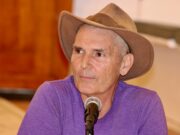


Gary Joyce of Aquebogue couldn’t wait to enlist. He wanted to sign up right out of high school but his parents wouldn’t give their consent and he wasn’t old enough to enlist without it.
As soon as he turned 18, he dropped out of college and joined the Army. It was December 1967.
“I signed up for infantry, paratroopers, special forces,” Joyce said. After five months of training, he was offered training as a medic, which would have meant a year at Fort Sam Houston.
“I said never mind that. I want to get this show on the road,” Joyce recalled.
“And that’s how I ended up going to Vietnam in August of ’68.”
He was a paratrooper with the 4th Infantry Division, Long Range Reconnaissance Patrol. He would spend a year doing over 70 missions in the Central Highlands region of the country.
“We worked it four-man teams. They would drop us off in bad-guy territory. And our job could range from ambush to bomb damage assessments, to kidnaps.”
On Feb. 1, 1969, General William Westmoreland reactivated the 75th Rangers and the Long Range Reconnaissance Patrol, or LRRP, units were assigned to every division.
“And so we were the first of the new — of today’s generation of Rangers,” Joyce said.
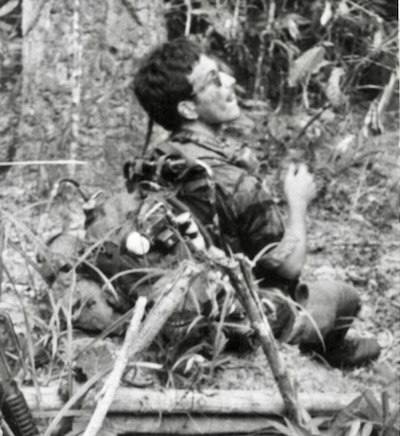
“Our missions were four days long. The longest I was ever in was seven days. That was Thanksgiving, 1968. We got caught in a storm or something. They couldn’t get us out. But generally, we were three nights, four days. They’d pull us out. We’d go back to base camp for 72 hours.” Back at camp they’d unpack all their gear, clean it and repack all their gear, so they’d be ready to go. And that’s pretty much what I did for a year, and then I was teaching it for six months,” Joyce said. He taught what was called “pre-recondo” school. They were up in the mountains in the central highlands. When the six months of teaching into March of 1970.
Wanting to go back into combat, Joyce re-upped for another nine months.
“I figured I could get back to my old unit, or at least get into a combat role,” he explained.
“It turned out I ended up with a security outfit guarding the major communications center in a place called Qui Nhon, which is also on the coast, and that was— it was a non-combat role,” Joyce said. “But they needed somebody with a combat MOS, which is your military occupational specialty, and mine was 11 B, which is infantry. And they needed one to fill out their roster. So they wouldn’t let me go,” he said.
“And after nine months of that, I figured I’d give it one more try to stay over there.But I had a captain, a West Point captain. I wish I remembered his name, but he wouldn’t sign the papers for me to stay,” Joyce said.
“So I offered to re-enlist for six years if I could stay another year in Vietnam.”
So many others couldn’t wait till their tour was up. What was the attraction for him?
“By that point in — where I was, it was like, you’re living on a red line every day,” he said. “Every day you’re out in the woods, you’re living on a red line.”
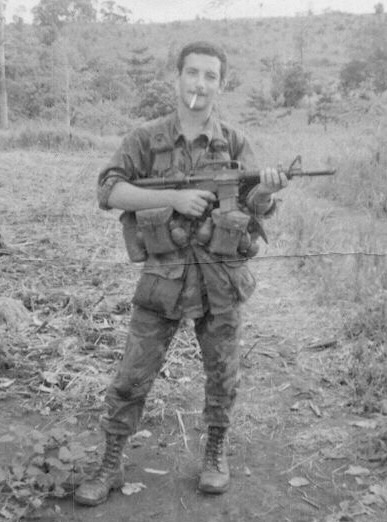
He thrived living “on that edge between life and death,” he said. “It was a total adrenaline rush.”
He spent years after the military chasing that same rush — climbing mountains, diving, surfing, cave diving. “Anything that kept you on that edge between life and death,” Joyce said.
“I had been at it for so long. I mean, for the first 18 months, that’s what I did. The last nine months were just terrible, I mean, because, I mean, you couldn’t find a firefight, if your life depended on it, which it did,” Joyce said, chuckling slightly.
Combat is “just something that, you know, grabs hold of you. Combat’s — I mean, I don’t know what other way to explain it without sounding insane — it’s a rush. It’s just a total rush. That’s all there is to it. And when you’re good at it, you’re good at it. I was good at it…So that’s why I wanted to stay,” he said.
“You get into combat, and you — remember, we’re four people. We fought. I mean, we’ve run into trouble with like 60 guys after us. We’d actually spent days running back and forth, chasing us. We took some of the earliest pictures of the Ho Chi Minh Trail,” he said. The Ho Chi Minh Trail was actually a network of trails that ran through Laos and was a vital supply route that wound through jungle terrain used by North Vietnamese forces.
“We got chased out of there by a company of North Vietnamese regulars,” Joyce said. “We came out on a wire ladder from a helicopter, four of us, and that’s how we got away,” he said.
Joyce said their four-man teams often had a member who was a Montagnard, a person of one of the indigenous tribes of the Central Highlands. “They’re great in the woods. And they were great fighters.
They were great trackers. They knew the jungle.”
“Montagnard” means “mountain dweller” in French. The tribes had a history of tensions with the Vietnamese. When the U.S. withdrew from Vietnam, “we just abandoned them…just like they did in Afghanistan,” he said.
“I would have liked to have stayed in what I was doing, special operations. You’re working with all pros. If they’re not professionals, they’re not lasting, they’re not staying long. Either they’d get killed or they’d get tossed — thrown out of that company. We had that happen. Guys don’t play by what rules there were. And that was it. You know, the team leader just said, you’re done, you’re out of here. And that was it,” he said.
Joyce received a Purple Heart medal for an injury from grenade shrapnel. “From a lieutenant who didn’t know what he was doing,” Joyce said wryly. “I had malaria — untreated. Had a bad landing in parachute school — untreated. Sometimes things happened and you didn’t want to report it. You just wanted to stay with your guys.”
“They give you a bunch of medals, a ribbon, and thank you for coming, all that good crap. That didn’t mean anything really,” he said. “It was just — I wanted to go out [on missions]. Everybody in my outfit was like that. There were very few guys that would turn down a mission. Everybody was into it. They were all volunteers. Most of them were paratroopers.”
Joyce spent 27 months of his 36-month enlistment in Vietnam — 18 of them on combat missions. He came home in January 1971.
“And then, then it was back in the world, which was another big mistake. I should have re-enlisted, but whatever. I can’t do anything about it,” he said.

Coming back to the states meant a big adjustment. For Joyce, that meant “booze and drugs, mostly — in the beginning.” He got married after about two years and the marriage lasted only about eight months. Then eight months later, he married again. He and his wife will celebrate their 50th wedding anniversary on June 1.
He worked for Aer Lingus at Kennedy Airport for 16 or 17 years, he said.
“Then I started writing and that’s where it went from there,” Joyce said.
“I wrote an editorial for Newsday, something about Jane Fonda. You know, Hanoi Jane. Nobody forgets.” After that, his phone was ringing off the hook, he said. His wife was taking most of the calls, as he was working nights at the time. “I don’t remember the tone of it. I’m sure it wasn’t positive, as far as she was concerned.”
He kept writing, his topics being activities he enjoyed, like mountain climbing. “And I kept getting published.”
That led to the publication of a book. “Things just started developing from that.” He wrote about diving and got a call from a diving magazine in Florida. He took a job as its managing editor, traveling back and forth between Florida and New York. He then became the editor of the magazine. The company published several other magazines, and he found himself writing for “almost all of them, either travel stuff or diving stuff or surfing stuff, or boats or whatever. One thing just kept leading to another,” Joyce said.
The publishing company got purchased by a bigger company and he lost his job in the restructuring that followed. He continued writing as a freelancer.
He took a job as the editor of the Traveler-Watchman, a local weekly newspaper in Mattituck. When the Traveler-Watchman was bought by the Independent, Joyce was back to freelancing.
He credits his writing abilities to the nuns who taught him for 13 years, from kindergarten in Brooklyn through high school. His family moved to Hauppauge when he was in eighth grade and he attended Seton Hall High School in Patchogue.
Joyce has been the editor of Fire News for about 10 years, he said.
Despite all the years that have passed since he was in Vietnam, the war “is pretty much the last thing I think of when I go to sleep and the first thing I think of when I wake up in the morning,” he said. “There’s always something that will keep me awake. It could be something simple. There’s sections of road out here that remind me of something, where something happened that I can’t put a finger on,” he said. “There’s a road up in St. James, that’s going down to the beach that just scares the hell out of me the whole time.” But he doesn’t know why.
“I don’t watch war movies, at least not with anybody around. I sometimes —I don’t know when I get it. You know, one of my friends just killed himself not too long ago, a couple months back, one of my team guys and I and it was just because he got injured and he wasn’t healing the way he’d like to, and so he killed himself,” he said. “And he just, you know, you remember things. I mean, I got pictures of me and him, and we’re having a snake barbecue one time. We found a 14-foot, 7-inch pipe, I think it was a Python, and we we had a barbecue, and I got a picture of four of us standing there, holding the dead snake. It’s pretty cool. You know, you remember something like that? It’s fun.”
He remembers listening to the 1969 moon landing on the radio.
“And then there’s times that you definitely want to forget, you know? Too many, too many close calls, too many. Why didn’t — Why didn’t I die there, doing that, at that time? I don’t know. It stays with you. And some things will trigger it. Some things just come. And you go, ‘Oh no, not again.’” Those moments, “flashbacks of a kind,” used to be really bad, Joyce. “They’re flashes of stuff that you just can’t shake. And you just gotta wait it out. Otherwise you just won’t sleep.”
Joyce remembers one time when his daughter was young, about 4 years old. And he woke up to find her standing right next to his bed.
“I know she’s my daughter. I know she’s there, but what I’m seeing is a Vietnamese girl, and I actually tore a hole in a mattress, holding on to the mattress,” he recalled. “That has never come back to me, but I know, obviously I still know it, though, and I remember, and I’ll never forget that,” he said.
In some ways, he said, “I think that actually helped, because you could — you know, maybe it’s telling your brain, ‘Yo, you better f—ing find another way to deal with this shit, you know, but that would make my heart — it’s making my heart beat fast right now. That was a bad one.”
He said he still doesn’t like people coming up behind him, even now in an office setting. Until about 20 years ago, when he heard loud noises, he would duck.
“Everybody’s got their own little triggers.”
Joyce visited Vietnam as a journalist in the 1990s, accompanying six doctors who were bringing out-of-date medicines there. On a beach by himself one night in a region that used to be part of North Vietnam, the water of the lake washed over his feet. “I just started crying. I couldn’t stop crying,” he said. “And I don’t know what the hell caused it to this day. But I don’t dream about it anymore, and I felt a lot better after it happened,” he said.
“So it’s, there’s a lot of, I guess, emotional baggage that goes with it, as well as cerebral,” Joyce said.
He remembers crying when the door of his plane opened after landing in Vietnam in 1968. “I said, man, what the f–k did you do? But then I just fell in love with it. I mean, it was—I don’t want to sound stupid— but it was war, and I enjoyed it,” he said. “Maybe ‘enjoyed’ is not the right word. I got into it. I don’t know why,” he said.
He says he doesn’t really understand why. “I was the most, peace-loving, nonviolent kid,” he said. “I mean, I wasn’t a fighter, but I took to it and I was good at it.”
Joyce had some fights after returning home, too — fights about the war. His experience of the war was so different from what people were seeing on television, he said.
“We didn’t know what you people were seeing back in the States,” he said.
He started watching the Ken Burns documentary about Vietnam, but had to turn it off. “That wasn’t the war I knew,” Joyce said.
“My war was my buddies. We were —and again, I hate saying it over and over—we were pros. I mean, we were professionals. We didn’t have no baby rapers and all that crap. Nobody shot civilians. Nobody used drugs. We didn’t even smoke cigarettes out in the woods, because the smell would give you away. You wouldn’t, you wouldn’t wash, because the smell would give you away. It was just, it was just a totally different war. It was just totally different from what I see on television to this day. I’m like, holy shit. No wonder everybody got pissed off,” he said.
The higher-ups “were totally unprepared for the kind of fight they were gonna have,” Joyce said. Coming off World War II, it was army against army. The guerilla warfare, the hit-and run tactics of the Vietnam War was a whole different story, he said.
His company has reunions from time to time. Their bonds are still strong, even though they may not have seen each other in 40 or 50 years.
“We had a reunion not too long ago, and I heard stories about me that I can’t believe I did, because I don’t remember.” He laughs at himself.
Some of his war buddies have died. “I mean, I’m 76 and most of the guys are about my age, give or take,” Joyce said. “We made it this far. It’s about that time anyway.”
The survival of local journalism depends on your support.
We are a small family-owned operation. You rely on us to stay informed, and we depend on you to make our work possible. Just a few dollars can help us continue to bring this important service to our community.
Support RiverheadLOCAL today.
