

























Efforts to make housing more affordable by cutting regulatory “red tape” are underway in both Albany and Washington.
Gov. Kathy Hochul is pushing to include changes to New York’s environmental review law, known as SEQRA, in the state budget now under negotiation. Her proposed changes are aimed at speeding housing construction in hopes of reducing costs. The proposal remains a point of contention among lawmakers. The Senate included a scaled-back version of Hochul’s “Let Them Build” agenda in its one-house budget bill. The Assembly did not include SEQRA reform in its budget bill.
The governor’s “Let Them Build” agenda would streamline the environmental review process for certain projects and, in some cases, allow housing developments to bypass additional in-depth environmental review.
Outside New York City, the proposal is limited to projects on previously developed sites that are connected to existing public water and sewer systems and fall below a 100-unit threshold. The governor has also proposed deadlines for environmental reviews and broader changes to the state permitting process.
In Riverhead Town, which has municipal water and sewer districts covering a substantial portion of the Riverhead hamlet, those changes could affect development and, potentially, the environment as well.
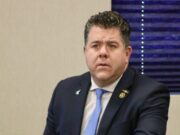
At Palumbo’s Feb. 1 environmental roundtable, the senator did not take a formal position on the proposal, but emphasized the need to account for Long Island’s environmental vulnerabilities when considering changes to state law. He asked the assembled environmental advocates and local officials whether there are ways to expedite reviews of actions involving smaller parcels “and not diminish … the importance” of environmental quality review.
Bob DeLuca, president of Group for the East End, responded that SEQRA’s central value is not just the environmental analysis itself, but the process. The law “guarantees transparency, public participation and a hard look,” he said. “The problem is, when those things don’t happen, you can end up with a project that extends forever and ever, and you don’t get to the core issues.”
“You can get through the process, if you will do it properly,” DeLuca said. “If developers will not withhold information and not finish environmental impact statements and stop crying and carrying on about doing another alternative, things would move more quickly,” he said.
DeLuca also criticized major changes like this being “shoved into a massive budget bill so that nobody knows what it is, and everybody’s focused on the numbers, and it just pops out the other end, leaving us for the next 20 years to figure out what it meant.”
A rulemaking process exists that provides an opportunity for public input, allowing everyone to review the proposal and discuss it, he said.
“We reject the whole premise that SEQRA is the reason we don’t have affordable housing. That is ridiculous,” Adrienne Esposito of Citizens Campaign for the Environment told Palumbo at the roundtable.
“When SEQRA is used properly, it safeguards our environment. That’s the premise and the role of SEQRA, the only law we have that requires a full and thorough environmental review,” she said. “So for us to want to chip away at that now and create a fictitious friction between affordable housing and SEQRA … We reject the premise.”
Kevin McDonald of The Nature Conservancy added that “there’s really no guarantee at all that it actually addresses the so-called affordability issue that is facing so many people on Long Island in terms of entry housing and things like that.”
First District Assembly Member Tommy John Schiavoni later echoed those concerns, telling the room he was “disappointed” the issue was being framed as a fight between environmental and housing interests.
“SEQRA isn’t the issue why you have troubles with housing,” Brookhaven Town Supervisor Dan Panico told Palumbo. “It’s the lack of sewer infrastructure,” he said. “I find that, in general, the state … should worry less about creating new programs and new types of initiatives, and instead try to fund the basics that are the responsibility of government, like the roads, the infrastructure, preservation of open space and developing a regional solid waste plan,” Panico said.
Hochul is working to build support for the changes, which are included in her $263 billion budget proposal. The state faces an April 1 deadline for budget adoption.
On Monday, she convened a roundtable discussion on the proposed reforms. According to City & State, the New York State Association of Counties backs the measures. The association’s executive director, Stephen Acquario, told Hochul and lawmakers that all 57 counties outside New York City support the reform and are eager to see underutilized commercial corridors and former industrial properties converted into homes for working families.
The debate in New York now comes as the Trump administration is advancing a parallel argument at the federal level: that environmental and permitting rules are making housing more expensive.
President Donald Trump has ordered federal agencies to identify and eliminate regulations that delay or increase the cost of housing construction.
“Layers of unnecessary regulatory barriers, slow permitting processes, and onerous mandates at all levels of government have delayed construction, restricted development, and driven up the costs of new housing,” the president said in his March 13 executive order. “These constraints have made housing less affordable for many Americans. It is the policy of my Administration to reduce regulatory barriers to building homes and to steward taxpayer dollars in a manner that promotes housing affordability,” he said.
The executive order sets the stage for sweeping changes. It directs a host of federal agencies to review and potentially revise regulations governing wetlands, stormwater and other environmental protections, as well as energy and building requirements, with the goal of reducing costs and speeding construction. It also calls for incentives to encourage state and local governments to adopt faster permitting processes.
Industry groups have welcomed the move, while environmental advocates have raised concerns about weakening protections for wetlands and flood-prone areas.
The federal action differs from Hochul’s proposal in scope. While the governor’s plan focuses on New York’s own review process and maintains existing environmental permitting requirements, the federal order targets a broader range of regulations, including those tied to water quality and land use.
The survival of local journalism depends on your support.
We are a small family-owned operation. You rely on us to stay informed, and we depend on you to make our work possible. Just a few dollars can help us continue to bring this important service to our community.
Support RiverheadLOCAL today.
