


























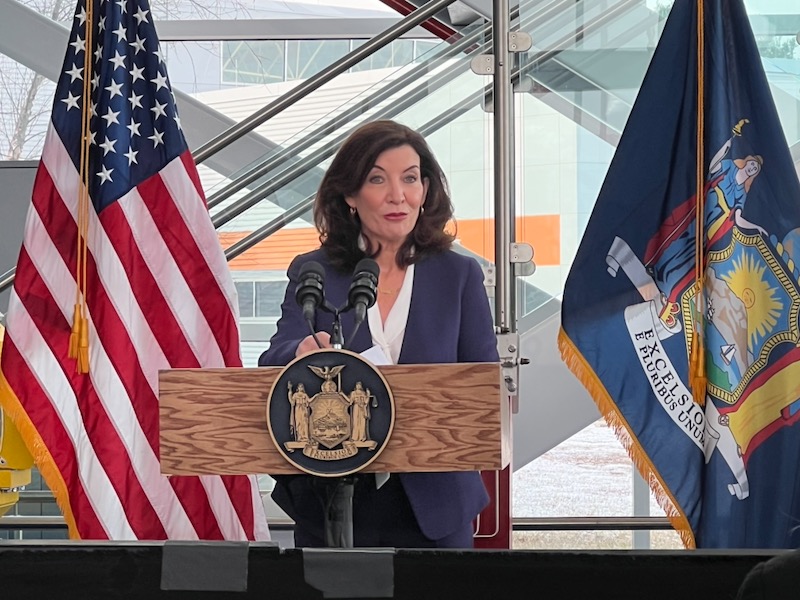
Gov. Kathy Hochul announced Friday that New York will participate in a new federal scholarship tax-credit program that could help families pay for tuition, tutoring and other school expenses, drawing sharp criticism from teachers unions that say the program threatens public education.
The decision opens the door for eligible New York students attending public and private schools to receive scholarships funded by donations that qualify for a federal tax credit. The program begins Jan. 1, 2027.
Hochul said her administration’s review of federal regulations concluded that participation could bring millions of additional dollars to students and families without reducing public-school funding or drawing money from state or local budgets.
“I’m not going to leave money on the table when it could help our kids,” Hochul said in her Oct. 9 statement.
New York State United Teachers, the statewide union with which the Riverhead Central Faculty Association is affiliated, rejected the governor’s rationale.
“We are profoundly disappointed that a governor who has championed public education would opt into President Trump’s private-school voucher scheme,” NYSUT President Melinda Person said in an Oct. 9 statement.
Person said education and civil rights groups had made clear their concerns about the program’s threat to public schools, which she said serve 90% of New York’s children. NYSUT and its allies will continue working to repeal the program at the federal level, she said.
The federal scholarship tax credit was enacted last year as part of the One Big Beautiful Bill Act backed by President Donald Trump. It allows individual taxpayers to receive a dollar-for-dollar federal tax credit of up to $1,700 annually for qualifying cash donations to nonprofit scholarship-granting organizations. Those organizations award scholarships for eligible students’ educational expenses.
The $1,700 limit applies to the donor’s tax credit; it is not a guaranteed payment to parents. Families would receive assistance through scholarships awarded by participating organizations.
Public-school students can benefit, including through assistance with tutoring. Eligible students can come from households earning up to 300% of area median income, with adjustments for household size, according to proposed federal regulations. Scholarship organizations may choose to focus their awards on families with lower incomes.
Hochul said she had conditioned New York’s participation on public-school students being able to benefit. She also said business leaders she had engaged had committed to using the program to support public-school students’ academic needs. Her announcement did not identify those business leaders or specify how much funding they would provide.
NYSUT’s objections extend beyond the governor’s decision to participate. In an Oct. 1 statement responding to temporary and proposed federal regulations, Person argued that New York would assume responsibility for the program while surrendering substantial authority over its operation.
“New York puts its name on the program, but Washington writes the rules,” Person said in the Oct. 1 statement.
She said the regulations would prohibit the state from imposing its own standards on scholarship organizations, deciding which otherwise qualifying organizations could participate, or limiting the schools and expenses supported by the program.
Person also warned that participation could subsidize private schools with admissions policies and practices that would be unacceptable in public schools, while preventing New York from imposing stronger safeguards.
The proposed federal regulations would bar states from adding requirements more stringent than the federal standards as a condition of including an organization on their scholarship list.
The United Federation of Teachers also condemned Hochul’s decision. In an Oct. 9 statement, President Michael Mulgrew argued that participation would surrender local control and said parents, teachers and public-education supporters would continue efforts to reverse the policy.
For Riverhead families, the program offers a potential new source of educational assistance. How much money will become available, which organizations will award scholarships locally and how families will apply remain questions to be answered as New York prepares to participate.
The survival of local journalism depends on your support.
We are a small family-owned operation. You rely on us to stay informed, and we depend on you to make our work possible. Just a few dollars can help us continue to bring this important service to our community.
Support RiverheadLOCAL today.
