























“I cannot believe any board member in good conscience can approve this budget.”
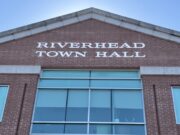
Riverhead Highway Superintendent George Woodson stood at the podium in the Town Hall meeting room this week to upbraid town board members for the transfer of $769,000 from the town highway fund to the general fund in the town’s proposed 2012 operating budget — to pay what Woodson argues are not highway expenses.
Woodson read into the record his Nov. 15 memorandum to the entire Town Board, detailing his objections to the fund transfer.
New York state law dictates how funds raised by the separate highway district tax can be spent, and supplementing the town’s general fund isn’t one of them, Woodson told the board.
He made the same pitch at a work session last month, but if board members were moved by it, they haven’t shown it. No board member has offered a single amendment to the budget first proposed by the supervisor on Sept. 30. In fact, the board has not held a single public discussion of the proposed spending plan, and apparently doesn’t even plan to vote on it. The last regular meeting before the Nov. 20 budget adoption deadline imposed by state law was held Tuesday night, and there was no budget resolution laid on the table.
If the board does nothing, the supervisor’s original budget proposal becomes the 2012 adopted budget on Nov. 21.
It calls for $768,900 to be transferred from the highway fund to the general fund as an “administrative chargeback” — the administrative costs attributable to the operation of the highway department.
The history of chargebacks
The chargebacks to the highway department began in 2008, during the administration of former supervisor Phil Cardinale, after current financial administrator William Rothaar was hired.
Up until 2008, there were no administrative chargebacks to the highway department — though the practice of charging administrative expenses to other special districts, such as the water and sewer districts, had been in place for many years.
But with 2008 and the new financial administrator came a change in practice. That year, for the first time, the chargebacks to all special districts was based on a percentage — then 12% — that was calculated as the “administrative cost center,” according to then-supervisor Cardinale. Up until 2008, the administrative chargebacks to the other special districts was a number that Cardinale said was pulled out of thin air. The new financial administrator, Rothaar, was “aghast” at the town’s past practice, Cardinale said at the Nov. 20, 2007 town board meeting, according to the minutes of that meeting. Riverhead would put into practice a policy Rothaar said was used in every other town, charging back based on a percentage, Cardinale said, and the percentage would be the same for every town department and special district.
Former councilman Ed Densieski opposed the amount of the chargebacks from the various special district funds, including, for the first time, the highway district. Densieski said the way the percentage was calculated was arbitrary and therefore illegal. He abstained from voting on the budget adoption resolution.
The method has been in use ever since, but the chargeback percentage — like the general fund itself — has increased.
The resulting hit taken by the highway fund since then has increased more than 42 percent, from $540,300 in 2008 to nearly $769,000 in 2012.
Woodson: The things I could do with this money
Woodson argues that the justification offered by Rothaar for transferring the funds from the highway fund to the general fund is wrong, because the statute he cited pertains to other special district funds — not the highway fund.
The highway fund can be used only for those expenses listed in section 141 of the highway law, Woodson argues.
“So while the town may choose to charge back to a special district the services of the town attorney [for example] it has no authority to charge against the highway fund,” Woodson wrote in his memo this week. That’s why longtime financial administrator Jack Hansen charged administrative expenses to the other special districts but not the highway district.
“The $768,900 you are attempting to charge back as an administrative fee in my 2012 budget would pay for a new sweeper and new pay-loader and allow me to hire five new full-time employees and still have money left over for paving,” Woodson told the board Tuesday night. “This money should remain art of the highway budget. It is desperately needed and the residents of this town deserve no less.”
“The general fund has huge financial problems and we’ve cut as much as we possibly can,” Supervisor Sean Walter replied. Noting that the practice was begun by his predecessor, he said, “We’re going to wean ourselves off of this.” Walter said he had asked Rothaar and town attorney Robert Kozakiewicz to “reach out to the comptroller’s office” for guidance. Neither Rothaar nor Kozakiewicz was present at Tuesday night’s meeting.
State comptroller’s office weighs in
A spokeswoman for the state comptroller’s office told RiverheadLOCAL said “there is no general authority to transfer moneys from section 141 [highway fund] accounts into any other fund or account” — even where the money being transferred from the highway fund is deemed “surplus.”
However, “there might possibly be ‘chargebacks’ to the highway budget for some kinds of costs that the town incurs for operating the highway department,” said OSC spokeswoman Kate Gurnett. “But we don’t have enough information to say whether Riverhead is doing this the right way or not,” she said.
A chargeback based on a percentage of the general fund is not necessarily improper, she said.
“[T]here are many ways to allocate ‘overhead’ for each department and a wide range of what can be done reasonably,” Gurnett said.
Woodson said he is thinking about asking the comptroller’s office for a formal opinion on Riverhead’s practice.
Riverhead financial reports not yet up to date
The supervisor has said he intends to ask the state comptroller’s office to conduct an audit of the town’s finances. He said the comptroller’s office told him to get the town’s financial reports up to date before seeking an audit.
Riverhead’s financial reports are not up to date yet, though the town is getting closer.
The town’s 2007 audited financial statements weren’t completed until December 2009. The 2008 financials were completed in February 2011. The town is still waiting for its 2009 audited financial statements, which are supposed to be done this month and scheduled to be presented to the town board at its Dec. 1 work session.
It is not clear when the town can expect the 2010 financials, which under state law state law should have been completed no later than June 30. The law requires a municipality to file its audited financial report with the state comptroller within 120 days of the close of its fiscal year; for Riverhead, that means a deadline of April 30. The law entitles a municipality to obtain one 60-day extension, upon request.
Riverhead fell behind in its financial reporting after longtime finance administrator John Hansen left the position due to illness in 2006.
After hiring current financial administrator Willliam Rothaar full-time in 2007, the town also brought in a new auditing firm, Albrecht, Viggiano, Zureck and Co. PC. of Hauppauge. The town had for decades used the Riverhead CPA firm MacAlpert Bank & Co. PC, which merged with two other firms in 1998 to form Markowitz Fenelon & Bank P.C.
Walter said earlier this year the long delays in producing the reports were because Riverhead had for years operated like it was still a small town.
‘Chargeback’ Transfers to General Fund
| Year | Highway | Water | Sewer | Scavenger | Ambulance |
| 2012 | 768,900 | 705,600 | 368,500 | 145,300 | 132,200 |
| 2011 | 738,800 | 652,800 | 353,600 | 124,800 | 110,000 |
| 2010 | 660,200 | 510,100 | 347,900 | 126,400 | 110,000 |
| 2009 | 600,580 | 609,86- | 320,170 | 113,100 | 84,170 |
| 2008 | 540,300 | 604,800 | 284,800 | 118,400 | 74,900 |
| 2007 | -0- | 350,000 | 175,000 | 65,000 | 62,100 |
| 2006 | -0- | 350,000 | 175,000 | 65,000 | 15,000 |
| 2005 | -0- | 250,000 | 175,000 | 65,000 | 5,000 |
| 2004 | -0- | 250,000 | 175,000 | 65,000 | 5,000 |
The survival of local journalism depends on your support.
We are a small family-owned operation. You rely on us to stay informed, and we depend on you to make our work possible. Just a few dollars can help us continue to bring this important service to our community.
Support RiverheadLOCAL today.
