
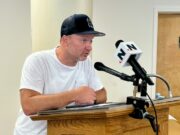

























Calverton resident Greg Fischer is taking on Republican presidential candidate Ted Cruz.
Fischer has filed an action in federal district court seeking a ruling that Ted Cruz is not a “natural born citizen” within the meaning of Article II of the United States Constitution.
The action, filed in Central Islip on Friday, looks to boot Cruz, who was born in Canada, off the ballot in New York. The suit names Cruz and the state board of elections as defendants.
Cruz’s mother was a U.S. citizen when she gave birth to Cruz in a Canadian hospital.
“Ted was her anchor baby,” Fischer said in an interview today, arguing that the candidate’s mother “constructively abandoned” her U.S. citizenship when she started voting in Canada.
“There is only one birthright that natural born citizens have that naturalized citizens don’t,” he said, “and that’s running for president of the United States. I’m the lone defender in all of New York of that right.”
Fischer said there are two types of citizenship, natural born and naturalized. The meaning of “natural born,” he argues, is the same as “native born.”
“Ted Cruz was not born in the United States. He’s entitled to a fast track for naturalization, but he’s not entitled to be considered a natural born citizen.”
Fischer said the only other federal lawsuits now pending on the topic of Cruz’s right to run for president are in federal courts in Alabama and Texas. A suit brought against the New York board of elections in state court in New York City was dismissed because it wasn’t brought in federal court and it didn’t name Cruz as a defendant, Fischer argues.
Cruz, a constitutional lawyer and former solicitor general of Texas, maintains that he is eligible to serve as president because his mother’s citizenship conferred “natural born” citizenship on him even though he was not born in the United States.
On Thursday a Pennsylvania state court judge sided with Cruz, rejecting a challenge to his place on that state’s primary ballot brought by a Pennsylvania resident who alleged Cruz is not a natural born citizen because he was born in Canada.
“The Constitution does not define the term “natural born citizen,” nor was it discussed during the debates at the Constitutional Convention of 1787, and the Supreme Court of the United States has never addressed its meaning Within the specific context of a challenge to the eligibility of a candidate,” wrote Pennsylvania Commonwealth Court Senior Judge Dan Pellegrini.
“From historical material and case law, it appears that the common understanding of the term ‘natural born’ in England and in the American colonies in the 1700s may have included both the strict common law meaning as born in the territory (jus soli), as well as the statutory laws adopted in England since at least 1350, which included children born abroad to British fathers (jus sanguinis, the law of descent).”
Citing, among other sources, a 2016 Congressional Research Service memorandum and a 2015 Harvard Law Review column by two former U.S. solicitors general, the judge wrote:
“The weight of legal and historical authority indicates that the term ‘natural born’ citizen would mean a person who is entitled to U.S. citizenship ‘by birth’ or ‘at birth,’ either by being born ‘in’ the United States and under its jurisdiction, even those born to alien parents; by being born abroad to U.S. citizen-parents; or by being born in other situations meeting legal requirements for U.S. citizenship ‘at birth.”
He ruled against the objector, holding “consistent with the common law precedent and statutory history, that a ‘natural born citizen’ includes any person who is a United States citizen from birth. Accordingly, because he was a citizen of the United States from birth, Ted Cruz is eligible to serve as President of the United States, and the objection … to the nomination petition of Ted Cruz is denied.”
But Fischer, in a memorandum of law supporting his complaint, quotes two U.S. Supreme Court decisions with contrary holdings.
The 1898 case of U.S. v. Wong Kim Ark, the high court said, according to Fischer’s memorandum, “The notion that there is any common-law principle to naturalize the children born in foreign countries, of native-born American father ‘and’ mother, father ‘or’ mother, must be discarded. There is not, and never was, any such common-law principle.”
He also quotes the 1971 U.S. Supreme Court decision in Rogers v. Bellei: “Not until 1934 would that person [a child born to a U.S. citizen outside the United States] have had any conceivable claim to United States citizenship. For more than a century and a half no statute was of assistance. Maternal citizenship afforded no benefit.”
There has not been any U.S. Supreme Court ruling directly on point. So it would be a “case of first impression” if it wends its way to the nation’s highest court.
“This is a huge case,” Fischer said. “This is for real.”
Fischer, a Democrat who has run unsuccessfully for several elective offices over the years — most recently for Riverhead Town assessor and Riverhead school board in 2015 — has announced his candidacy for N.Y. State Senate. He plans to challenge longtime incumbent Republican incumbent Sen. Ken LaValle, he said.
The survival of local journalism depends on your support.
We are a small family-owned operation. You rely on us to stay informed, and we depend on you to make our work possible. Just a few dollars can help us continue to bring this important service to our community.
Support RiverheadLOCAL today.
