






















Sitting at a tiny desk in Room 106, Eder Marquez’s voice grows soft as he speaks about the four years he lived alone in Honduras. From the age of 12, Eder had no choice but to work every single day, living on his own in a country with one of the highest murder rates in the world.
It has been a shock adjusting to life in Riverhead, where he joined his mother a year and a half ago. There are no armed soldiers in the streets, and he has the opportunity to go to college and get a good job after high school – opportunities that were non-existent in the impoverished, violent country where he grew up.
“I like it better here,” he says, slipping between English and Spanish. “Life is better. And I stay with my mother. Ten years of not seeing her… finally being with her is good.”
But life in America also comes with its difficulties. Once they arrive, students like Eder are thrust into a completely different culture surrounded by a language that is totally foreign to them. They are unable to communicate with their teachers and their peers, and many of them come here alone, leaving behind parents, grandparents and siblings to live with distant relatives or family friends.
“Many of them get very depressed,” said Penelope Boerum, a Riverhead High School teacher who is herself an immigrant from Mexico. “A lot of them have traveled alone, and some have spent time in detention centers. Sometimes the parents cross with them and then leave and let them get detained, so they at least have that opportunity to stay here.
“It can be very overwhelming,” she added. “So many of them have no support.”
This spring, Boerum and fellow teacher Claudette Garley set out to change that.
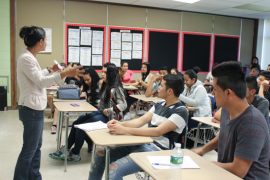
Riverhead’s first meeting of the Hispanic Youth Leadership Club drew an astonishing 78 students in February. There were not enough seats for the number of students who came, crowding the back of the room, sitting on chairs, desks and tables.
“The kids wanted it,” Boerum said. “They kept asking about it. They felt they needed a place to be after school, just to feel like they belong somewhere.”
The club’s Thursday afternoon meetings provide that for them. Students who walk through the door seem to shake off the uncertainty and self-consciousness they carry with them in the hallways. Chattering in both Spanish and English, they laugh loudly and freely. Some are recent immigrants; some have lived in America all their lives. All contribute to the club’s attitude of compassion and acceptance.
“Sometimes if you don’t say a word right, people will make fun of us,” says Mariela Betancourth, a 9th grader who has been in the U.S. for two years. “You feel a lot different from other people. It’s hard making new friends.”
“There is a lot of bullying,” added another student, Dulce Castillo, who is also in 9th grade. “Some English people underestimate what a Spanish person can do. They think we are all stupid, or that we are all into drugs.”
But in Boerum’s classroom on Thursday afternoons, Mariela said, “Everyone you know is here. We can be ourselves,” she said. “We can talk about our culture. We can speak Spanish, and we can speak English, and it is OK if we don’t speak it right, because we understand how it feels, the struggle.”
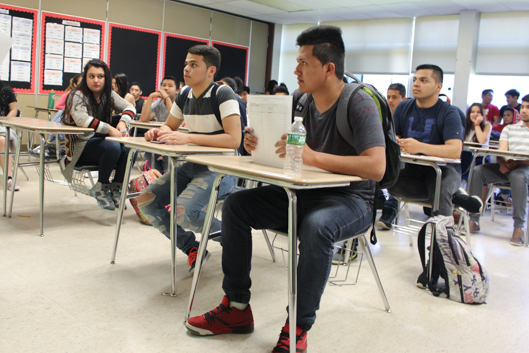
In addition to giving students a safe place to be themselves, the club also gives them an opportunity to help influence the community’s attitude toward Spanish-speaking students. Many kids in the leadership club spoke of a shared desire to change some common misconceptions about Latino and immigrant students.
“Around school, you hear kids say things about Hispanic kids – things that make you feel like you’re less than them,” said Chris Morales, a sophomore who has been in the U.S. for three years. “And sometimes you feel bad about it. So I was really excited when Mrs. Garley told me we’re finally going to have our own club.”
The Hispanic Youth Leadership Club gives students like Chris many opportunities to make a positive difference in the local community. Since the club started at the end of February, the students have done a number of community service projects, including a food and supplies collection for victims of the Ecuador earthquake and a pancake fundraiser at Applebee’s.
A portion of proceeds from the fundraiser – which raised more than $1,400 – will be donated to a local non-profit of the students’ choice. At a recent meeting, the club members voted to pick Maureen’s Haven, a local homeless outreach organization, to receive the funds.
“I want to show the community what we can do for them,” Chris said, his voice filled with emotion. “I want this club to help the community and change the opinions people have about us. Some are so terrible.”
Since he arrived in the country three years ago, Chris has learned how to speak English fluently and is in the process of learning four other languages in addition to Spanish. He is involved in half a dozen clubs at Riverhead High School, he regularly volunteers at food pantries and street clean-ups with his family, and he has ambitions to go to college to become a language teacher.
“In my country, after you graduate from college, there are no jobs there,” Chris said. “Here, you can be someone. I came to this country to help this country, to have a profession and use it to help other people.”
He added that it was “very scary” when he first arrived here. “It’s very hard to be in a class and you’re trying to learn something and be successful and get your goal, but you can’t understand what the teacher is trying to tell you,” he said. “It was hard being in middle school, learning the language, not understanding anything, not having the basic vocabulary to communicate with people.”
Chris lamented some of the hurtful assumptions he has heard in school and on the internet about Hispanic students. “Most of us are fighting for our goals, trying to speak English very hard and trying to do stuff for the community,” he said.
It was a sentiment echoed by other students in the club as well.
“In this country, I have the opportunity maybe to go to college,” says Jose Hernandez, a senior. “In my country, there’s no money, so I don’t have the opportunity for college. But everyone has the same need to succeed.”
If there is one thing Mariela Betancourth wants the wider community to know, it is that. “Everybody’s the same,” she said. “It doesn’t matter where you’re from, what color of skin you are, what language you speak. Everybody’s equal and we want to be treated the same way.”
Boerum and Garley hope the leadership club gives Hispanic students an opportunity to feel that way in a place where it is easy to feel very different. “We hope they feel like they belong somewhere,” Boerum said. “We want them to feel that they can help, that they can do something, that their voice matters, their actions matter.”
To that end, the club has hosted a variety of speakers to inspire and motivate the students – from the Riverhead Police Department’s first Hispanic cop, Byron Perez, to a recent immigrant who went from picking up dirty towels to a management position at the Gurney’s Montauk Resort.
“We want them to feel empowered,” Boerum said. “Many of them feel very hopeless when they first arrive. We want to show them that there are others who have also gone through these hardships, and they have succeeded.”
The survival of local journalism depends on your support.
We are a small family-owned operation. You rely on us to stay informed, and we depend on you to make our work possible. Just a few dollars can help us continue to bring this important service to our community.
Support RiverheadLOCAL today.
