


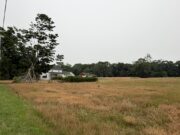

























Local residents upset by excavation work being done by Suffolk County at the North Fork Preserve site in Riverhead are asking the county to stop the project in its tracks.
The county is installing retention ponds and drainage improvements that aim to retain stormwater on the 307-acre site, which was purchased by the county in 2011.
Stormwater currently drains into the Long Island Sound via a system of gulleys and pipes installed on the property decades ago, according to County Legislator Al Krupski.
But environmental advocates don’t agree with that characterization.
“There are four ancient glacial river valleys that drain these wetlands into the Long Island Sound,” botanist Eric Lamont said this morning at the site of Sound Shore Road, where a backhoe was already at work excavating brush and trees.
“For the past several thousand years since Long Island was formed by the glaciers, this water has naturally flowed north,” he said.
“The day has come that we can no longer discharge stormwater directly into our surface waters,” Krupski said this morning.
“This area was heavily manipulated to drain the stormater into Long Island Sound with gulleys and pipes installed in the 1940s,” Krupski said. “They are designed to dump stormwater that contains sediments, nutrients and pathogens direclty into the Sound. Stormwater should be recharged into the aquifer,” he said.
The existing structures are also causing flooding on local roads and private properties in the area, the legislator said.
The State DEC issued a freshwater wetlands permit for the project on Jan. 9.
Lamont and others complain they knew nothing about the project before heavy equipment arrived at the site on Friday, with work to begin today.
Some object to the timing of the work, which they say coincides with “prime nesting and breeding season.”
“All sorts of animals and birds depend on these wetlands and surrounding woodlands for their survival and the survival of their young,” Sean Keenan of Riverhead wrote in a post this weekend to a Facebook group for birders. He and others complained that the work is being done to protect private property owners.
Lamont said some Sound Shore Road residents have complained about flooding. “And that’s basically what prompted this activity we see right here,” he said. “The goal of this project is to retain all the water on this site. Engineers I have spoken to all agree this is impossible.”
Krupski said the project aims to create more wetlands and enhance — not eliminate — existing ones.
The $200,000 project, which is part of the county’s capital budget and is being financed by county bonds, was recommended by the county’s Council on Environmental Quality.
Last summer, the Suffolk County Legislature issued a determination pursuant to the State Environmental Quality Review Act, finding that the proposed work would not have a significant negative impact on the environment.
“Environmental law has just been hijacked,” Lamont said. “There are environmental laws that prohibit this type of activity without public notice. This project was approved without any input from the public and the environmental community,” he said.
“The project is to build three large sumps — they call them retention basins — and 10 impoundments within the wetlands,” Lamont said. “If the environmental community had been notified, this could have been done properly,” he said.
“Pollution conveyed by stormwater degrades the quality of drinking water, damages fisheries and habitat of plants and animals that depend on clean water for survival. Pollutants carried by stormwater can also affect recreational uses of water bodies by making them unsafe for wading, swimming, boating and fishing. According to an inventory conducted by the United States Environmental Protection Agency (EPA), half of the impaired waterways are affected by urban/suburban and construction sources of stormwater runoff,” the DEC said in a statment.
Suffolk County bought the property for $17.3 million in 2011, with the Town of Riverhead contributing $500,000 to the purchase.
The county legislature in 2014 formed an advisory committee comprising local civic, environmental and recreation organization representatives to make recommendations to the county parks department regarding the development and future use of the park.
Plans for the site include passive recreational uses on the 126 northern acres, which contained regulated wetlands, and active recreational uses on the southern 175-acre parcel.
Peter Blasl contributed reporting
The survival of local journalism depends on your support.
We are a small family-owned operation. You rely on us to stay informed, and we depend on you to make our work possible. Just a few dollars can help us continue to bring this important service to our community.
Support RiverheadLOCAL today.
