

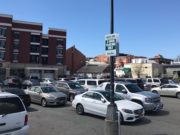






















How will a five-story building with 170 rental apartments on the former Sears site on East Main Street impact downtown Riverhead? That was the subject, in broad brush strokes, of a “scoping” hearing opened yesterday by the Riverhead Town Board.
Formally, the purpose of the hearing is to establish the scope of a draft environmental impact statement for the project, proposed by Metro Group Properties. The developer seeks to build a mixed-use building with 3,442 square feet of ground-floor commercial uses along East Main Street and 170 rental units of varying size on the second through fifth floors. The plan includes 88 parking spaces.
The developer initially submitted a site plan application to the town last year. On April 3, the town board classified the proposal as a type I action under the State Environmental Quality Review Act and requested lead agency status for coordinated review of the application. On May 1, the board issued a positive declaration under SEQRA, meaning that a full environmental impact statement is required.
In the draft scoping statement prepared by the applicant’s planning consultant, Chick Voorhis of Nelson, Pope and Voorhis, the applicant says it will evaluate the potential adverse impacts identified by the town in its declaration of significance in May. These included potential impacts on the school district, on traffic, parking, stormwater, police, fire and emergency services, cultural resources, including visual impacts, and the impacts of construction activities.
Former Riverhead Central School District trustee Ann Cotten-DeGrasse urged the town board to take a hard look at impacts on the district. The development would undoubtedly bring additional students into the district, which she said is already “bursting at the seams.”
Jeanine Zeltmann, a trustee of the United Methodist Church of Riverhead, located on the north side of the street, asked that the environmental review of the project include a thorough assessment of the sound and vibration impacts of construction activities — especially the impacts of the driving of any piles necessary to support the structure, which would be located in a flood-prone area of high water table.
Both Zeltmann and church member Georgette Case, who is also the Riverhead Town historian, spoke of the damage sustained at the historic church which church officials believe was caused by the pile-driving for the construction earlier this year of another five-story apartment building immediately adjacent to the one proposed by Metro Group Properties.

Developer Georgica Green Ventures, which is building Riverview Lofts on the corner of East Main Street and McDermott Avenue, pounded 550 steel posts into the ground with a large pile-driver machine. Church members and trustees said they began noticing cracks in the plaster walls of the church after the pile-driving began in March. The cracks grew in scope and number, affecting not just walls, but ceilings, interior pillars, wainscoting and pews, they said. A portion of the ceiling collapsed in the “bride’s room” — an anteroom just outside the sanctuary in the front of the building. Mortar between the stones of the church’s foundation cascaded out of the joints and onto the cellar floor. The church’s stained glass windows bowed and two of them sprouted cracks in some panes.
Zeltmann said in an interview after the hearing that the church has heard nothing further from anyone about getting the damages repaired.
Georgica Green Ventures did not return a phone call and email seeking comment for this story. At the request of the town, the company had vibration monitors installed inside the church this spring, but the monitors did not record vibrations strong enough to cause structural damage to the building, according to both the developer and town building department officials.

The Riverview Lofts proposal did not undergo the same environmental review being required for the Metro Group project. Georgica Green “pre-filed” a “voluntary” environmental impact statement in June 2017, which was circulated to involved agencies. Based on its review of that document, the town board on Aug. 15, 2017 determined that the project “will result in no significant adverse environmental impacts” and issued a “negative declaration” under SEQRA — allowing the project to move forward without any additional environmental review. On Sept. 6, 2017, the town board approved the final site plan.
The town has since adopted new rules for environmental review that do away with the practice of using so-called “voluntary” environmental impact statements. The “voluntary” EIS can be a tool to take a project that would ordinarily be a type I project with a positive declaration — meaning it would have significant environmental impacts requiring study and mitigation — out of the normal course of review. There is no scoping hearing, no scoping statement — defining what impacts should be studied and mitigated — and a faster pace of review for the EIS submitted by an applicant at the very beginning of a review process. Critics of this tool say it is used to circumvent a full environmental review.
New York State has also amended SEQRA regulations in a similar way. Those new regulations take effect in January 2019.
Metro Group Properties principal Robert Muchnick told the town board the DEIS will examine alternatives to the proposal, including a scaled back version of the building that will include more parking spaces — more than one per unit, he said.
Alternatives to be examined are listed in the draft scoping statement.
The Metro Group scoping hearing will continue at the next town board meeting on Oct. 16, which begins at 6 p.m.
The survival of local journalism depends on your support.
We are a small family-owned operation. You rely on us to stay informed, and we depend on you to make our work possible. Just a few dollars can help us continue to bring this important service to our community.
Support RiverheadLOCAL today.
