

























Riverhead’s proposed water conservation law will be revised after some residents on Tuesday said the law was too strict and did not take into account certain irrigation needs not satisfied by the every-other-day watering schedule mandated by the law.
Aiming to conserve water during times of peak demand, the proposed local law would impose restrictions based on street address numbers, requiring locations with odd-numbered addresses to water lawns, wash cars and fill pools only on odd-numbered days, while locations with even-numbered addresses would be allowed to do so only on even-numbered days. No watering would be allowed at all from 5-9 a.m., when the district’s tanks are at their emptiest.
The law would be in effect from April 15 through Sept. 15 each year. Water district customers in violation of the law would be issued a notice to correct or remove the violation. If the violation is not remedied within a specified time period, the law empowers the water district superintendent to terminate the water service to the building or property and/or recommend fines or penalties.
MORE COVERAGE: Riverhead looks to make odd-even watering restrictions mandatory April to September
The law was drafted by Superintendent Frank Mancini and members of the town’s Environmental Advisory Committee. The Town Board had previously adopted a similar water-use restriction policy in effect for much of the summer, but that policy did not provide enforcement capabilities.
Mancini started the hearing off by saying that he was there to gather feedback, signaling on the outset that the proposal would likely not be adopted by the Town Board as written. Board members echoed that sentiment throughout the hearing, making note of the points raised by residents who said the restrictions were not conducive to effectively maintaining a vegetable garden or growing an infant tree.
The law also allows an individual or entity with an installed water/lawn sprinkler system that cannot be set to accommodate the odd-even schedule to apply for and obtain a waiver that allows them to limit the number of days for watering instead.
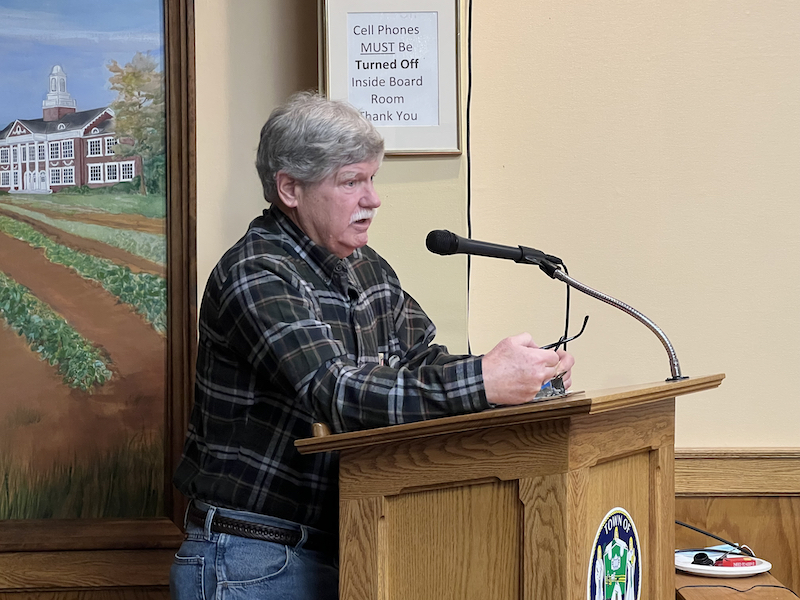
Robert Skinner of Jamesport said he was not clear on how the exemptions work. He said he has an older irrigation system, which would be costly to replace. He raised several questions about the proposed law, including whether he might be penalized for his system violating the law if he is away for a weekend.
“I think that the exemptions part will have to be addressed. I think there are good reasons to be able to use the water daily,” Council Member Frank Beyrodt said. “But I think what we’re trying to mitigate is, like you said, the differentiation between the commercial, that are just blatantly on all the time, even when it’s raining three inches, or irrigating the blacktop. Those are distinctly different than some of the things you brought up.”
Mancini said if a homeowner applies for an exception, someone from the water district will come inspect the irrigation system.
“The intent is that you’re using water efficiently and you’re not just egregiously wasting, like Frank [Beyrodt] brought up. Our biggest offenders are say corporately owned, maybe a mobile home park or box store that has sheared off its sprinkler heads, and the operator of the store desperately wants it fixed, but corporate wouldn’t approve it,” Mancini said. “So this is a mechanism for us to sort of push that pressure. We’re certainly not looking to go home to home to go after normal residents.”
“I think the vegetable garden is a good thing and a new planting is a good thing,” Mancini said. “I don’t think this is going to be as big a deal as people think. We want you to not waste water and to use it efficiently. When I think things like that are going to be easily overcome.”

Keith Lewin of Calverton, who worked previously in environmental science, said the town should be encouraging best practices for water conservation, rather than having code enforcement officers put time into punishing people for “not doing exactly what they should.”
“Saying it has to be an odd or even day doesn’t take into account people’s lives,” Lewin said.
The proposed law would also make people irrigating their landscapes when it is not raining a violation. “How much rainfall?” Lewin asked. “All your automatic shut-offs require a certain amount of wetting before they shut off. I’ve built the equipment that shuts off on the first raindrop. But that’s not how lawn irrigation is done. It’s not how it should be done.”
He also opposed the restrictions for water use for people washing their car. “Does that really affect how much water we’re using and where the water shortages are?,” Lewin said. “ How much water are we talking about to tell someone that when they brought their car in and the geese flew overhead and needs to be washed off, that they can’t do it today because it’s the wrong day?”
“These things just aren’t necessary. And they’re not improving the conservation of water, they’re just putting an onus on the property owner on what they can and can’t do because somebody thought ‘gee, that’d be a good idea,’” Lewin said. “And good ideas aren’t always good for the individual. They may sound great on paper, but we shouldn’t be thinking about the individual and what they have to do in their life. That’s why we want them to be residents of the town.”
Mancini said Lewin, who he said is “more knowledgeable about this than anyone I know,” brought up valid concerns and that he should have been brought in to help draft the law from the beginning. “These are things we’re going to work through. That’s the purpose of this public hearing,” Mancini said.
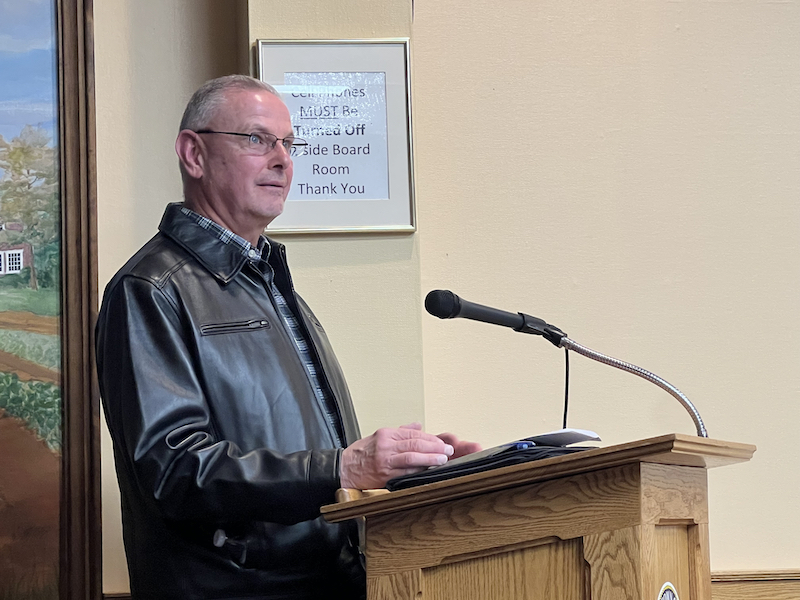
Mark Maieli , president of the Homeowners Association at the Highlands at Aquebogue, said he and the members of the association cannot support the legislation as-is. The restrictions wouldn’t give members in the community enough time to irrigate their lawns, he said. He added that conservation still needs to be discussed and encouraged.
“But I think conservation is everybody’s responsibility,” Maieli said. “The legislation needs to be cognizant of the logistics of everything concerned, and especially that of the users unsuitable. And suitable and affordable alternatives are needed before penalties and fines are implemented.”
Other prohibited acts in the proposed law include using public water in a way that causes runoff; using a hose that dispenses public water that is not fitted with a shut-off nozzle or other device that prevents the hose from dispensing water when not in use; using public water on driveways and sidewalks; and using public water for a fountain or other decorative water feature without the use of a recirculation system.
Some residents who spoke at the hearing also drew a correlation between the law’s timing and recent and proposed residential and commercial development within the town, stating that the town approving such developments was to blame for the increased demand of the water district.
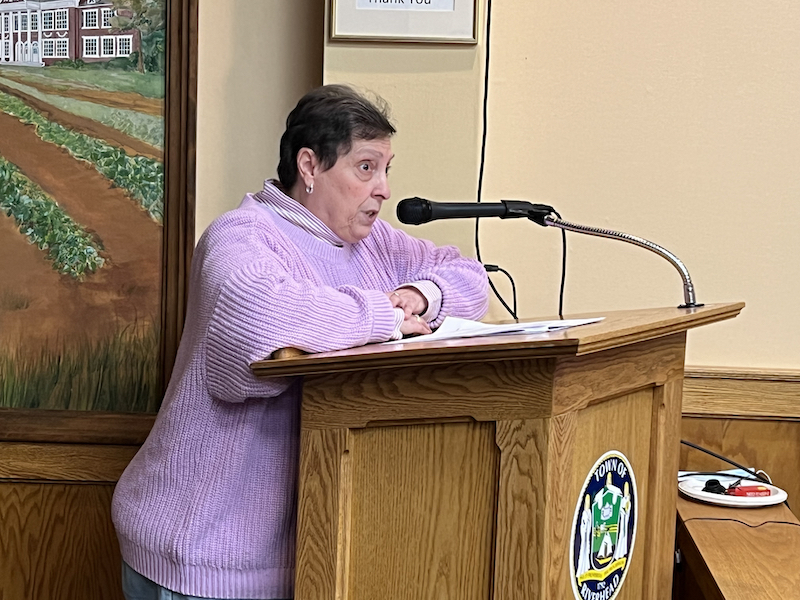
“I’d like this board to explain to me the rationale for instituting water restrictions on your residence using odd-even house numbers, as well as a price increase if I use more than 90,000 gallons, while at the same time not only allowing but advocating for millions of square feet of new warehouses that distribution centers and other industrial building being planned for Calverton,” Claudette Bianco of Baiting Hollow said. “Some of these locations will have thousands of employees and transient truck drivers around the clock as they go about their business. Do you think some of them might flush a toilet or use some water? How many thousands of gallons will be used daily?”
“While your concern for water conservation is laudable, it would seem your goals are incompatible. Your continued approach of haphazardly addressing issues in isolation, as if one wasn’t related to another, doesn’t seem to be working,” Bianco continued. “Once again, utilizing an updated comprehensive plan to stitch together many of your objectives could help without creating other complications. When things are in sync, they work well together. As far as I’ve seen, that’s not been the case.”
Developments contribute money to expand the water district to their projects, Mancini said, in addition to paying fees that contribute to storage tank projects. He said that the water district does not decide what projects get approvals to be built.
“I think what undermines that argument is that the town is committed to building a large two-and-a-half million gallon storage tank in Wading River,” Mancini said.” The water district is using fees already collected to help fund that project.
“We are working tightly with the USGS [U.S. Geological Survey] to develop the water resources in town,” Mancini said. It’s a slow process because it involves federal and state agencies and and quite a bit of science and engineering, he said. “But they are in progress.”
The proposed law would also give the town supervisor the authority to declare a water emergency in any area of the town served by the water district upon the recommendation of the water district superintendent. The emergency allows the implementation of restrictions on water consumption for 24-hour periods until the emergency declaration is rescinded.
The survival of local journalism depends on your support.
We are a small family-owned operation. You rely on us to stay informed, and we depend on you to make our work possible. Just a few dollars can help us continue to bring this important service to our community.
Support RiverheadLOCAL today.
