


























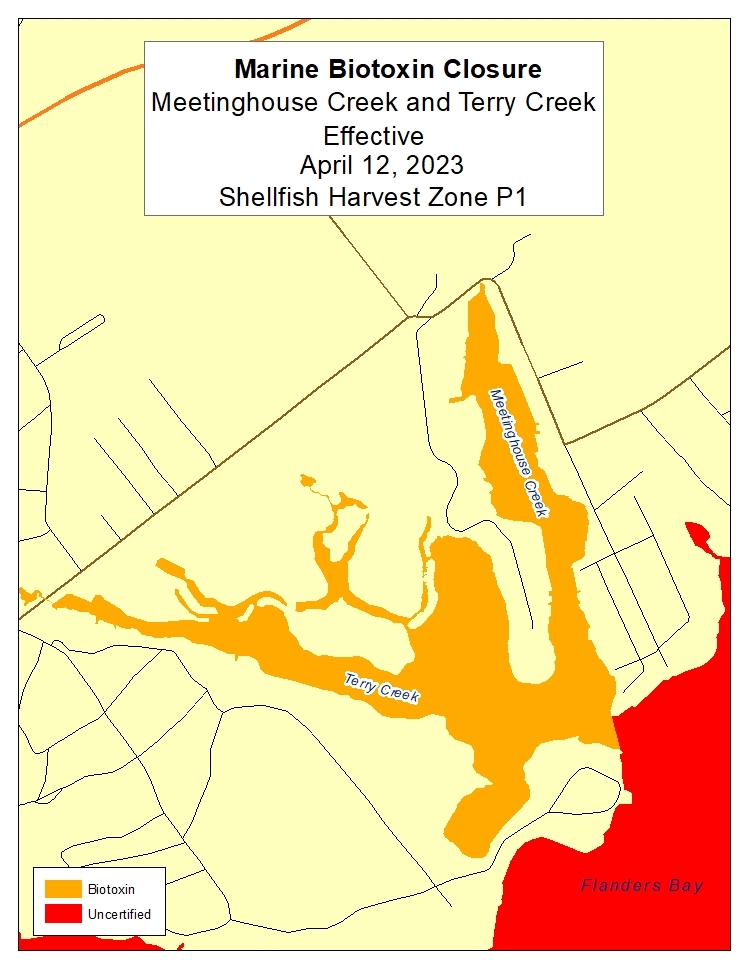
Terry Creek, Meetinghouse Creek and western Shinnecock Bay have been temporarily closed to shellfishing by the State Department of Environmental Conservation, effective immediately.
The ban is in response to the presence of saxitoxin, a marine biotoxin that accumulates in shellfish and can sicken people who eat shellfish affected by the toxin. The closure is needed to protect public health, the State DEC said in a press release.
The agency found the presence of saxitoxin in mussels harvested from monitoring sites in Meetinghouse Creek and Shinnecock Bay.
Filter-feeding shellfish — clams, oysters, mussels, and scallops — can accumulate marine biotoxins, which can cause illness in shellfish consumers. Carnivorous gastropods — whelks, conchs, moon snails — feed on shellfish and can accumulate biotoxins at levels that are hazardous to human health.
Both Terry Creek and Meetinghouse Creek are already uncertified year-round for the harvest of shellfish.
Approximately 102 acres in Flanders Bay and 1,429 acres in Shinnecock Bay in the following areas are affected:
Town of Riverhead: Meetinghouse and Terry creeks, both tributaries of Flanders Bay, in their entirety are temporarily closed to the harvest of shellfish and carnivorous gastropods.
Town of Southampton: The portion of Shinnecock Bay lying east of the Post Lane Bridge (Quogue) and lying west of a line extending southerly from the southernmost point of land at Pine Neck Point (East Quogue) to the northern terminus of Triton Lane, located on the barrier beach south of Pine Neck Point, is temporarily closed to the harvest of shellfish and carnivorous gastropods.
Saxitoxin has been detected in the same bodies of water several times over the past decade, prompting previous bans on harvesting shellfish and gastropods. Saxitoxin was suspected as a cause of the die-off of diamondback terrapin turtles that began washing ashore on the beaches of Flanders Bay in late April of 2015.
MORE COVERAGE:
Cornell’s Wildlife Health Program and Dr. Chris Gobler’s lab at Stony Brook University later confirmed that saxitoxin was present in the turtles’ tissues, as well as the corresponding local mussel species in the turtles’ stomach contents. See: Conservation CSI: Cornell researchers solve mystery of mass turtle die-off
DEC said it will continue to monitor for the presence of biotoxins in shellfish at several monitoring locations around Long Island and implement closures as necessary.
DEC will re-open areas as soon as possible based on the results of laboratory analyses that will be conducted over the next few weeks. A recorded message advising harvesters of the status of temporarily closed shellfishing areas may be heard by calling (631) 444-0480. The message will be updated during the course of the temporary closures. Maps of the affected areas and information about these temporary closures are available on DEC’s website. Information about marine biotoxins and paralytic shellfish poisoning is also available on DEC website.
The survival of local journalism depends on your support.
We are a small family-owned operation. You rely on us to stay informed, and we depend on you to make our work possible. Just a few dollars can help us continue to bring this important service to our community.
Support RiverheadLOCAL today.
