













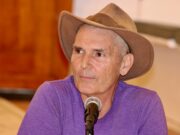


Rene Suprina is one of two Democratic candidates for Riverhead Town council. The verbatim transcript below, made from an audio recording of the Oct. 9 interview, has been lightly edited for clarity (deleting repeated words etc.)
Please note that this conversation preceded this week’s Town Board’s vote to cancel the town’s contract with Calverton Aviation & Technology (CAT) to sell its industrially zoned land at the Calverton Enterprise Park.
Alek Lewis: You said the town should cancel the deal with CAT, for EPCAL. If the deal was canceled, what’s your plan for the site?
Rene Suprina: So my plan? Well, we have to generate revenue. I also want to balance that with the environmental impacts. And I really think that it’s something that we should hold public forums for, and people should come in. And we should get ideas of what people would like.
I think we should have studies done out there of what really is feasible. I mean, to talk in general, all of this. I mean, honestly, you know, I’m a musician, I would love to see an amphitheater there. But there’s a group of folks here that love the drag strip idea, you know, so I think that there’s a lot of possibilities. And I just want to see something that the whole community can benefit from.
And I just have always believed that we haven’t had enough community input as to what to do with that. I know it’s been sitting for a long time. But I just don’t think rushing into this whole EPCAL deal is the right thing to do.
Alek Lewis: The zoning at the site is planned development zoning, plus all uses that promote economic development with a few exceptions, which are allowed by town board special permit. That means, basically, the purchaser of EPCAL could build practically anything they want, like high cube warehouses, logistics and distribution centers, all sorts of things.
So if the deal falls through, would you support revising the zoning on the property?
Rene Suprina: I would, I just have to say, honestly, I’m a teacher. So the details of those kinds of things — I would have to rely on experts to just give me a little deeper dive to explain those types of things.
I’m in favor of doing anything that benefits all in the community. That’s, that’s pretty much how I operate. So, I know that there’s businesses over there that are successful. You know, I’m a little discouraged by that hockey rink, we’re big hockey fans in my family, we have season tickets and stuff. So I don’t know what the answer is. I could just be speculating, but I would need more information and better understanding about the zoning, specifically over there.
My take right now is that I don’t want the airports, I don’t want the runways to be sold, I don’t want the increase in the traffic, walking around the neighborhoods over there. Those poor folks, I don’t want them being pounded by this decision. So like I said, I would be willing to take a look at the whole project. Of course, it also depends upon who is actually sitting on the board and who has the majority would probably also probably have something to do with how much would be done.
Denise Civiletti: There is a process that was followed that’s not unlike the master plan process for the whole town right now, that was followed for EPCAL, in the early 2010s to like 2016. Then they adopted this revised reuse plan. And I should say that what’s happening there now kind of dumped that, or at least the upshot of that, they did that whole process with public input. But, unfortunately, you’ll see that and find that often, maybe that’s changed now, but you try to get public input and people don’t participate. But they went through that process. They came up with a plan, they came up with zoning, they came up with a subdivision plan, and the town, in its wisdom, then decided to toss it out and do this deal. So how do you prevent that from happening?
Rene Suprina: No, because I think again, it just all comes back to transparency. I also think that it comes back to, we’ve been a one party town for a very long time. I don’t think It’s good to have one group of people in charge, and I think that they become complacent, I’m gonna be positive, I’m gonna think that they’ve become complacent. You know, ‘we’ve just been in charge, we just kind of get to do what we want to do.’ Therefore, that kind of takes off the onus of ‘well, we don’t have to worry about what the public says, because they’re always voting us in,’, I don’t know, I’m speculating.
So I guess, for me, this would all go back to the transparency, trying to create an open environment where people feel safe to come in and share their views, which I can say myself as a resident, I don’t necessarily feel that, it concerns me. You learn a lot when you go through this process of running for town board, or whatever the position is. I didn’t understand or know about the water that’s contaminated up there. I mean, to me, it’s just like, holy moly, isn’t that the most basic thing that we should be fixing right now? So I just think there’s a lot of layers to it. It’s just overwhelming; it’s just crazy.
Denise Civiletti: Do you think that these large warehouses, distribution centers are appropriate for any location in the town? Everybody’s said they’re against these mega warehouses. Inside of EPCAL, outside of EPCAL; do you think they should be allowed anyplace?
Rene Suprina: I don’t think so. I mean, I grew up here, I grew up in Southold. You look at the landscape, I remember when the LIE came out, you know, past, [Exit] 62, and that was a big thing when it came down to Riverhead. And we’ve kind of settled into that, but I just don’t see any benefit. I understand that, again, we have to have revenue, but I don’t think that just the strip of land that we live on can accommodate all of this. I don’t want our landscape to be blemished by these buildings. So I am opposed to them. 100%.
Alek Lewis: What about inside the EPCAL property?
Rene Suprina: Maybe very limited — low buildings, attractive buildings, but nothing that’s going to bring, I know that people feel this, I don’t want Amazon flying in and out of here. When I go over to Westhampton, I do go to the beach over there and stuff, and I look at that industrial park where they’ve got the brewery there and stuff like that.
I just, personally, I guess I’m old school. I don’t like that modern look over there. I don’t like to see the big Amazon warehouse signs. That’s just me. I’m old school. I want to see beautiful farms, I want to see — I’d rather have every weekend sitting in traffic for pumpkin picking than because I have these warehouses of trucks.
Denise Civiletti: But recognizing then that the only way to accomplish that as a town and as a local official, if you’re elected, is through land use controls, regulations, laws. That sets the parameters of what people could do with land that they believe they own. I say that because this is indigenous people’s land. That’s a problem we should have understood. So like. So what do those land use rules and regulations look like if Rene Suprina is writing them? To effectuate what your objectives are?
Rene Suprina: I guess for me, I’m looking at the things that are going to happen. First of all, I feel like things are just approved, and there’s no thought afterwards. Yes, let’s go put on —what is it 412,000 square feet of warehouses up on [Route] 25? Does anybody think that, okay, so now you have all of these buildings, all these shops on [Route] 58. Then, in-between, you’ve got the Calverton post office, you’ve got a school there, an elementary school. Now you’re going to have that bad intersection at Edwards [Avenue], whether or not they fix it, and then you’ve got warehouses. I mean, to me, that’s just a disaster.
I think about big trucks coming back and forth. I just feel like– and I know that one of my opponents did say that if people own their property, they should be allowed to do with it what they want. I suppose, what the law allows, I could just say that from my own family and Southold, you know, I grew up on five, six acres of property. And my dad for many decades tried to get it subdivided so my brother and I could build a house there and the town of Southold said no, the town of Southold has come down real hard on that kind of stuff. I don’t think we need to be that extreme, but I just think there has to be a balance as to how is this going to impact the area around. I don’t see why we have to build sky high things that are going to be impacting the landscape of our community.
You know, even downtown, I would love to see the buildings just on the river side of Main Street, if they could just stay maybe two floors high, and then if somebody wants to put a third floor on, we can investigate that. But don’t block our river view. I’m probably thinking more of the aesthetic side, I’m an arts person, that’s my job.
Denise Civiletti: Would you say there’s too much industrial zoning?
Rene Suprina: Personally, probably, I would say that. Yeah. I’m gonna say that.
Denise Civiletti: What would you put in the place of it?
Rene Suprina: I would like to do more specialty shops, and more of an arts vibe. Again, looking at Patchogue and Greenport — I feel like that we should be the cutting edge town. We’re in between those two communities, and they’ve had great success. I would just like to — what are we going to do to revitalize downtown? What are we going to do to draw people here? I go to Tanger, even Tanger isn’t jam packed as much anymore. I don’t know if we spread ourselves too thin.
Denise Civiletti: I was asking about industrial zones. There’s no industrial zone [downtown]. I wasn’t talking about downtown. Industrial zoning, what you’re complaining about in Calverton, the warehouses: what’s your goal there, if it’s not industrial?
Rene Suprina: I don’t know. I always pictured this — I don’t know. I can’t answer that. I don’t know. I guess maybe I misunderstood your question. The industrial zoning, you know, you have to have jobs and stuff, I would have to see that people are really going to be able to make a living out of this, you know, bringing in more $15-an-hour positions, isn’t allowing anybody to be able to live here, whether you’re renting — forget about buying a house or a condo or anything at $15-an-hour.
Alek Lewis: Your opinion on the current IDA is pretty clear — you want to abolish it.
Rene Suprina: There’s no gray area with that.
Alek Lewis: How do you go about doing that?
Rene Suprina: Well, if I’m in a minority, it’s probably not going to happen. I don’t know why people are so opposed to the Suffolk County IDA. Just the little bit that I know, you just go on, I’m looking at their website, and they’re larger, and they have more resources. And we go to our IDA and it’s not properly funded. I guess I would just keep beating the drum that we need to have an IDA that could really support all of us and stop making their whatever they do behind closed doors. I don’t I don’t know what the process is to dissolve the IDA.
Alek Lewis: Say your whole ticket gets elected, successfully lobbies the state government to eliminate the Riverhead IDA. Are you worried about the removal of local control?
Rene Suprina: No, no, not at all. I taught in Easthampton in Springs School for half my career, any of these East End towns? I know there’s something that’s going on right now, I think in Mattituck, or something that caused a little uproar. You know, so I haven’t really been paying too much attention over there. But I haven’t seen anything.
Denise Civiletti: Is that Strong’s Marine?
Rene Suprina: It’s not Strong’s Marine, there’s another big building that they just got two-and-a-half million dollars of a tax abatement for something. I just saw it about 10 days ago.
Alek Lewis: But what you’re saying about the Hamptons, Southold — they don’t have the industrial land that we have here.
Rene Suprina: Right, they have beaches, waterfronts.
Alek Lewis: Going back to zoning and the industrial land, there’s a lot of developable industrial land in Calverton, the development pressures are bigger in Riverhead than other East End towns.
Rene Suprina: No, I understand that. But, like everything else, you have to have some sort of a balance. I feel like what we’ve been doing — and maybe it comes back to the master plan, and we don’t have a master plan in place, a comprehensive plan. I just feel like things just are going— this is just my perception. If it wasn’t for you guys — every time I open up RiverheadLOCAL, oh my god, geez, how can that happen? It just seems like everything — it’s like fast and furious. So the perception, maybe, that it’s just coming fast and furious at us. I would like to see a pause on everything. If our ticket got elected, I would just want to pause and just kind of see where we are. Sometimes I feel like things are just snowballing so fast and you just have to take a timeout, a timeout.
Denise Civiletti: So you’re saying a more moratorium while we finish the planning process?
Rene Suprina: I think so. I feel like sometimes in this town, we’re like a runaway train that’s come off the tracks, and I would just like to get it back on the tracks and be thoughtful about how we go.
Alek Lewis: What type of a moratorium would you want to see, on what? Just a town-wide moratorium?
Rene Suprina: Yeah. And maybe that [moratorium] would motivate us to get the [comprehensive plan] done in a more timely fashion. I know they say sometimes they take 10 years to complete, but I feel like, and again, I’m looking at the town square. I feel like we need to just take a brief timeout.
Alek Lewis: So, kind of piggybacking off of that, current Town Board members have supported exempting certain developments that have already filed applications with the town for building from new requirements in the town code. So, given that the Comprehensive Plan is going to come in and perhaps shake things up and impact projects — possibly currently in the pipeline — would you support exempting any projects from new code provisions of the comprehensive plan? And where do you draw that line?
Rene Suprina: So I’m a rule follower, and I believe that everybody should follow the same rules. I think that probably if there are projects that are already in the pipeline, you would have to look at them on a case by case basis. I don’t know that it would be fair to just go across the board. But I really feel strongly about everybody has to follow the same laws, the same zoning. Because we like you better, you can’t get your approvals after you’ve already done things that weren’t quite correct. I feel strongly about — everybody has to follow the same rules. But I would be willing to look at on a case-by-case and give people the benefit of the doubt. But knowing me, I would probably go back to saying, ‘Well, this is what the rules are now and this is what we have to follow.’
Denise Civiletti: Are you in favor of preserving the town’s remaining approximately 7000 acres of farmland from development? And what do you think is the best way to do that? Now, bear in mind that farmland is zoned for agriculture, people could build houses, subdivisions. There’s other uses that they could put now, most recently, in some places, battery energy storage facilities. Are you in favor of preserving that farmland? And how do you do it? What’s the best way?
Rene Suprina: That’s a good question. Yeah, of course, I’m always in favor of preserving land. But the people that own the land also have to be able to make a living and support their families and stuff.
Denise Civiletti: You come from a farming family.
Rene Suprina: I do.
Denise Civiletti: What’s your family name?
Rene Suprina: DeLong. is my maiden name. So my dad actually was a car salesman, and my mom was a tour secretary, but my two grandfathers, we had a lot of properties. So we farmed. One grandfather was a bayman. We grew up poor. So we, you know, we always had food, thankfully, because of my grandfathers. So I grew up with a horse in the garage, and all sorts of stuff. So I really would like to see types of farming — you’d have to sit and talk to the farmers and stuff — but I would like to see farming that definitely could generate income for them. I know the battery storage thing, that just scares me on so many accounts, just because of when they have the fires of the cars over at EPCAL, and every time you open up the Daily News you see more things that are catching fire in the city and stuff. So, I’m not ready to accept that technology.
Denise Civiletti: Do you think farmland preservation can be done in a way that allows farmers to reap the benefits of land ownership and investment?
Rene Suprina: Yeah, they’re doing this agritourism, so I am a supporter of that, in spite of all the traffic and stuff. Maybe they can lease out their land and people want to come in and do wineries or I wouldn’t be opposed to them, if their families want to come in and construct homes and things like that. I don’t know that it’s really realistic to preserve all 7,000 acres. I mean, I can’t picture how much that would be. But again, everything is a balance. That’s everything that I come back to in all of these different topics, and how do you balance that out? Because we want people to be able to stay in the community and to make a living for their families. You know, maybe solar farms? I don’t know. I don’t know enough about the technology. New types of irrigation.
Denise Civiletti: Let me ask you this. What motivated you to run for Town Board? Why do you want to be on the Town Board?
Rene Suprina: What motivated me initially [was] where I live. In my neighborhood I’ve had a lot of negative impacts from the [Timothy Hill] Children’s Ranch behind me. And I grew up in Southold, taking the blue nus to Riverhead when we were in high school, and that was a great day — you come downtown, and you spend the day. And so for me initially, it was because of safety and because I wanted to do downtown revitalization, and then this EPCAL thing just just blew up. But those were the two things that really motivated me. I just think that we have so much potential.
Alek Lewis: So what’s your opinion on the current downtown revitalization? If downtown revitalization was something that inspired you.
Rene Suprina: Well, yesterday at the county fair, I’m thinking, first of all, it’s so great to see so many people there. I thought for the first time, I felt like everything was alive down there. I didn’t go to any of the Alive on 25s this summer, but I felt like why can’t we do more of this? Like in the summertime, why can’t we? I don’t know what they charge for vendors, but it seems like — I had friends that used to be vendors at Alive on 25 and then they got priced out of renting their space. Can we maybe lower it and make it more affordable to attract people to come and fill up that back parking lot? And maybe at the end of Alive on 25, just have one big band so people can just come. So, the apartment buildings — one of the debates when it was said that there was an apartment building going in the old Rimland [building] —
Denise Civiletti: Hotel, he said.
Rene Suprina: Yeah, I was like, holy moly. I had no idea that that was even — because there’s so much stuff going on.
Denise Civiletti: Nobody has heard anything about that until that moment.
Rene Suprina: I was like, oh my God.
Denise Civiletti: What does that say to you?
Rene Suprina: What it says to me that this stuff is going on behind closed doors that nobody knows what’s going on. And, you know, once things get changed down there, you’re not going to bring that back. And I think that you do, I mean, again, going back to like homelessness, all this stuff, you can create hubs in downtown that architecturally fit in with the flavor of downtown. I don’t even know about all these parking garages and stuff, I guess I had envisioned, maybe naively in the beginning, when I said I would do this, what about trolley cars? What about something very unique. And you go down to Tanger, and you go shopping, grab a trolley cart and come down and try to bring people down here. When you see the little bicycles from the brewery, you know, I don’t know if they’re still doing that or not, going around Second Street and stuff.
I go down. I don’t feel safe. I mean, I’ve said that before, publicly, and I’ll say it again. If it’s after dark, and we have a choice to go — if you walk out the Suffolk Theater, and you want to go across the street to Craft’d which we like that place. I don’t feel safe, I don’t feel safe.
Alek Lewis: What will you do to improve that, though?
Rene Suprina: What I’ve talked about is that we need to have more visible cameras, we need to have better lighting, the night that we played at the Town Square, the lights went down, and the lights of the light bulbs that are installed there are not bright enough. We have a lot of young women in the band and we are now loading equipment into that back parking lot. Even the back parking lot yesterday — and this struck me, when they did that Penny Lane band for one of the Thursday night concerts. And so I loved the EPCAL thing, I thought ‘I’d like to go over there and just see what they sound like’ because we were up on the grass. I saw that they were on the showmobile. I’m standing there and just at the edge, it’s all the bricks, everything is broken and the water from the irrigation system is pooling and it’s just, again — I think somebody said Town Square: ‘Oh, so now it’s a rectangle that slopes. There’s no electricity there. You have to be down at the bottom in the parking lot.’ So my thought is: Why do you even have a town square then, if you got to put everything in the parking lot?
Those dark alleyways — you should have cameras there. I’ve always said some sort of a [police] substation. And somebody had commented– and even if you just have a van, something that has some sort of police presence in that overnight hour, so that if you’re a woman and you’re walking down the street and you feel somebody walking behind you, you have a place that you can go. The back parking lots that are, you know, they’re lit, but the Ring technology that we all have on our houses — why can’t you have something [like] that installed [so] that somebody’s coming and you’re trying to go to your car? And you can go and say, ‘hello.’
My hair girl, she’s young, she’s in her early 30s, she just opened up her hair salon a little bit down from Digger’s. And, you know, I drive by, because I’m like her mother, and I’ll drive by on a Thursday night, you know, it’s like 7:30 at night, and she’s got the windows open, and they’re dancing. And I’ve said to her stop, you’ve got to pull down your shades, you got to make sure your doors are locked, anybody can walk in. And she did admit to me last week, she said: ‘Yes, somebody did try to come in that was definitely strung out on something.’ And so those young girls should not feel unsafe in their place of business downtown, you know, after dark or in the evening hours.
Until you can have people feel like, oh, I can get out of my car, I can go into wherever I’m gonna go, Jerry and the Mermaid or whatever, and then get back to my car safely. Maybe I’ll go down and go [to] the other end of town and go have some desert someplace. But I know that for myself, personally, I don’t feel safe. And just I know that I have a lot of friends that share that as well. More presence of —I know that the police are staffed with their walking guys during the day. I’ve been told that after 11 o’clock, they reduced the numbers, which to me seems a little silly, like that would be when you’d want to have people and maybe some canines walking around or something.
Denise Civiletti: Let’s change the topic a little and talk about affordable housing. Do you think Riverhead has an affordable housing crisis? And what should the town’s role be to make living affordable here, for particularly the next generation?
Rene Suprina: Well, I feel like we should have hubs, where you can be close to services and shopping and things like that. The affordable housing, I don’t think that there’s any place that’s really affordable. I’m going to talk on the East End. I know that over the years, again, when I worked in Springs and I lived in Riverhead, it seemed that Springs and Riverhead were the two places that people — particularly the restaurant workers — would migrate to, because that was more of the affordable housing. I think that we have some, but my idea, but when I think of what my mortgage payment is versus what it would be to rent something affordable — I don’t know that I could afford to do that, as a retired teacher.
I know they have those apartments, you know, the Peconic Landing, above the brewery there. I have a friend of mine, whose son is living there. And he’s making it go, but it’s tight. It’s not something that he can — he’s not gonna have lots of leftover money to try to save and buy a house. I think honestly, the whole housing market, just across the country, is just completely out of control. And I don’t know how to bring that back.
Alek Lewis: Is there something that the Riverhead Town Board can do to help the housing crisis, to mitigate that for potential residents, current residents?
Rene Suprina: I don’t know about this stuff. But I would think that, yeah. Is there a way that you can put a cap on what the rent is? What you can charge people? Identify particular places? But I suppose that also has to be balanced with who owns the apartments and they have to be able to pay their bills.
But I think that there probably has to be a conversation. I feel like no conversations go on. And this could just be my misinterpretation of what actually goes on, but I just feel like, you know, when you talk about safety, put up some cameras, when you’re talking about these kinds of things — do people sit in the same room and actually talk to each other? You know, bring in all the stakeholders, the potential landlords, property owners that are building these things, and are we really looking to make affordable housing?
Alek Lewis: One conversation that was happening this past year was something that was passed on the state level — is the Community Housing Fund. That was the referendum where all five East End towns could opt in — and the voters can choose to do it — for a half percent real estate transfer tax, to generate revenue for affordable housing. So would you, if you were on the Town Board, support putting that on the ballot?
Rene Suprina: Yes. Stuff like that is, to me, a no brainer. I did read that. I was like: ‘Why does that kind of stuff happen?’ What’s the motivation for us not to participate?
Alek Lewis: So the town would be able to control that revenue, what comes out of that. If that is passed, what would you like to see that money go to, as far as supporting more affordable housing?
Rene Suprina: Well, again, I think about affordable housing and thinking, about people that that would benefit from that, or that would be in need of affordable housing, it’s probably hard for them to maintain housing, apartments, small cottages, whatever it is, and having a car and car insurance and stuff.
These types of things — I would want to create, maybe like a little community. We don’t have any services — say you want to do it downtown, where that seems to be where we’re putting the affordable things. Well, are there little markets there that people can go and do some food shopping? Are there places that you know, I know that we have a lot of hospital services and stuff in the town, but maybe an urgent care down there and just try to support, use some of those monies to just help try to create a community within that affordable housing so that people, they don’t have to go, ‘how are we going to Uber up to Peconic Bay Medical Center if we don’t have to,’ or CityMD, if we could have more services at our fingertips here?
Alek Lewis: Let’s say you’re the only person on your ticket elected to the Town Board —
Rene Suprina: I think about this every day.
Alek Lewis: Or if you’re a part of a minority. How do you deal with that situation? How do you govern?
Rene Suprina: I do pride myself on being able to work with almost anybody. I’m gonna just say almost anybody, I do have to say, one of my opponents, I said to her we probably do agree more than we disagree. I’ve done a lot of leadership roles with different organizations and stuff. I believe that you can’t come in, even if you’re on the majority, you can’t come in with a hammer and you’re going to change everything today. So I always feel that if you can nudge people in the right direction, a little bit at a time, that usually works. So I think that probably for me, I would try to nudge if I was in the minority, or if I was the only one there. But the bigger thing would be: I would want to hold people accountable. Bad behavior. disrespectful behavior. I think that if I realized that I couldn’t really nudge anything, I would probably want to be more of the keeper of good behavior.
Denise Civiletti: Do you feel like you would be able to speak out and say, publicly, ‘you can’t do this?’
Rene Suprina: Yes. Absolutely. And that’s probably the role that I would take on. I go back to — we expect this behavior from our children. Why are the grown ups allowed to get away with inappropriate — and this board is atrocious, their behavior is absolutely atrocious. So yeah, I would have no problem. Because what else could I do? If you’re in a minority and you’re by yourself, and part of what I’m saying is we have to improve our behavior, we have to make sure that people feel welcome to come in. And if you sit there —-
Denise Civiletti: What about beyond that? What about beyond, stop being rude guys, like that. But what about like, you’re aware of behind the scenes meddling and things like that?
Rene Suprina: If it wasn’t related to a personal issue, because I understand that from being a school administrator, I would call them out on it publicly, every single time. I would probably have a lifeline right to the newspapers or whatever forum I could use, and I would have absolutely no problem calling them out on everything.
Denise Civiletti: How do you feel you’d be able to work with the Republican majority? The flip side of that question is you have to work with the Republican majority if you are elected.
Rene Suprina: One of the weird things about me is that most of my friends are conservative Republicans. Andy [Leven] and I are a great example. I adore him. I know he adores me. We do have some things that are fundamentally different and that’s okay. I’ve always said that sometimes even if you are on the other side of the line from me, you might say something that I will go, you know, that’s not such a bad idea. Now if we took that it can be now twisted a little bit like this and it starts the conversation.
Denise Civiletti: Are you a registered Democrat?
Rene Suprina: Yes, I am a registered Democrat.
I think that when you have opposing views, sometimes it may be a little messy and stuff. But if the other person has good intentions, I think that you can sometimes come away — I know that I’ve changed my position slightly on things, going ‘oh, they do have a point.’ So I think that I could as long as nobody’s mean, just don’t be mean. But I know that’s an elementary school thing.
The survival of local journalism depends on your support.
We are a small family-owned operation. You rely on us to stay informed, and we depend on you to make our work possible. Just a few dollars can help us continue to bring this important service to our community.
Support RiverheadLOCAL today.
