














The wars in Iraq and Afghanistan were raging, but what stayed with Janet Godfrey was how rarely she heard anyone talk about the men and women serving overseas. To Godfrey, the silence was deafening.
News reports came and went. Daily life rolled along. The Wading River mother of seven sat at her sewing machine and kept thinking there had to be some small, concrete way to say, “We see you. We’re grateful.”
“I thought, if I could make people think about the troops for one day, that would be something,” she recalled in an interview this week.
She put a notice in her parish bulletin and stationed her kids at the doors after mass, handing out fliers and inviting anyone who sewed – or wanted to help in any way – to come back the next Saturday.
It was supposed to be a one-day sewing bee.
As they were finishing up that Saturday, “One of the women said, ‘You know what we should do next week…’ and I don’t even know what the rest of her sentence was. But I thought, ‘Oh! You want to do this again? We’ll do it again!”
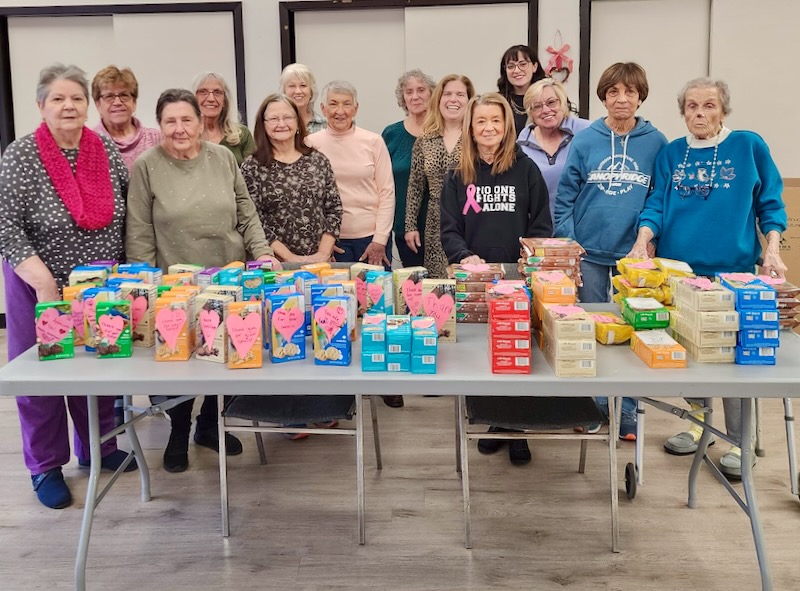
Twenty years later, that “one day” has become Operation Veronica, an all-volunteer, homegrown nonprofit that has quietly sent more than 400,000 handmade comfort items, along with thousands of boxes of snacks, toiletries and supplies, to American service members deployed around the world.
Every Friday morning, at a local community center, the work continues.
“We really thought we were going to do it once, and we never stopped,” Godfrey said. “We’d love to be put out of business, but as long as they’re out there, we want them to know they’re not forgotten.”
A small room, a big mission
The first gathering took over a couple of classrooms at St. Anthony’s of Padua in Rocky Point. Godfrey brought sewing machines and fabric, and set up stations so volunteers could make “neck coolers” to help keep troops from overheating in brutal desert heat.
She gave the children their own room, stocked with crayons, markers and paper, so they could draw pictures and write letters to tuck into the boxes.
“There’s something beautiful about a kid’s drawing and a note that just says, ‘Thank you for keeping us safe,’” she said. “It means a lot when you’re far from home.”
As the number of volunteers grew, the project moved from the parish to the Shoreham community center on Defense Hill Road. The town gave the group closets for storage. The Friday morning meetups became a habit.
Today, a core group of 12 to 24 “girls,” as Godfrey affectionately calls them, meet on Fridays from 10 a.m. to noon. Some are machine sewers, some hand-stitch, some specialize in tying survival bracelets, some sort and pack.
“I am very proud to say that we have zero overhead. The ladies buy their own thread for heaven’s sakes. I don’t even buy that, but every single penny anyone donates to us goes either in the box as product or on the box as postage,” Godfrey said.
From neck coolers to survival bracelets and more

What goes into the boxes depends on where the troops are and what they ask for.
In hot climates, the volunteers sew neck coolers that soldiers can soak in water and wear in the field. In cold-weather deployments, they switch to polar fleece neck gaiters that fit under helmets and help keep out biting wind and snow.
Year-round, they make survival bracelets out of 550 paracord. Each bracelet carries about 10 feet of cord that can be unwound and used to tie down gear, replace a broken bootlace or improvise in the field.
“They look like a bracelet, but the guys know it’s useful,” Godfrey said. “We’ve gotten notes back about how they used them for all kinds of things.”
The boxes also hold what she calls “pocket food” – snacks that can be grabbed and eaten on the run: granola bars, protein bars, tuna pouches with plastic forks, small bags of nuts. When the weather is cold enough that it will not melt into a solid lump, they send chocolate.
Toiletries are always in demand, especially in remote locations. And every shipment is padded with letters, cards and drawings, many of them made by local schoolchildren. Godfrey will often visit classrooms to talk about the troops and, at the same time, give teachers a ready-made letter-writing lesson.
She never sends a box that serves just one person, because she knows for each recipient there are a bunch of other troops with the same needs. Each shipment is packed with enough items for sharing.
Some who first heard from Operation Veronica as young enlisted soldiers reach out years later from a new assignment.
“We had one sergeant write back eight years after he’d been deployed,” Godfrey said. “He said we had sent enough for him to share with his buddies. He ended by saying something like, ‘Every time I think about that neck warmer you sent me, I am warmed all over again.’”
She paused, remembering.
“We all cried when we read that,” she said. “It reminds us what this is really about.”
“We’re not just sending stuff,” she said. “We’re sending a message: you are remembered, you are loved, you are valued, you are not forgotten. We pray for you every day.”
Helping troops help others
Over the years, Operation Veronica has shipped to troops in Afghanistan and Iraq and at bases in Syria, Kuwait, the United Arab Emirates, Israel, Germany and Romania, and even to troops stationed on ships.
The group gets requests. Sometimes the requests are straightforward: a chaplain or commander writes to say a unit is deploying to a remote base or overcrowded barracks and sends a wish list. Other times, the troops ask for help so they can help the civilians around them.
One of the most emotional projects Godfrey recalls began with an email from a unit at Torkham Gate, at the Afghanistan–Pakistan border, where winter temperatures are brutal and nearby villages had high child mortality.
“They said, ‘We’re watching these babies die because they don’t have warm clothes, and we can’t stand it. Is there anything you can do?’” Godfrey recalled.
Operation Veronica put out a call. The response was overwhelming. Blankets, snowsuits, tiny hats and mittens and baby clothes flooded in. Volunteers sorted, packed and shipped box after box.
“We lost count,” Godfrey said. “We were just trying to get it out the door as fast as it came in.”

In another case, a chaplain the group had supported on several deployments wrote from a base that was about to receive 1,500 troops into a facility built for 500. He sent a list of basic needs. Operation Veronica went shopping and partnered with the Rocky Point VFW to ship everything.
Godfrey reached out to Joe Cognitore, commander of the Rocky Point VFW Post 6249 VFW to say Operation Veronica didn’t have enough money to ship the items. He replied: “No problem.” The VFW post picked up the $1,500 postage tab.
“We’re so blessed,” Godfrey said.
For girls in Afghanistan who were finally being allowed to learn to read and write, the group gathered notebooks, paper, pens and pencils. The girls reacted to receiving those notebooks the way an American child would react to receiving a Game Boy, she said. That’s how excited they got.
Godfrey bristles when she hears people say Americans “didn’t make a difference” there.
“There are girls who would have never been educated, who would never have learned to read and write had it not been for the American soldiers there,” she said..
A name with a purpose
Though the project began in a Catholic parish and Godfrey herself is Catholic Operation Veronica is not formally a religious ministry. Volunteers and donors come from many backgrounds.
The name, however, comes straight from Catholic tradition.
Saint Veronica, the story goes, couldn’t stop Jesus’ suffering on the road to Calvary. All she could do was step out of the crowd, wipe the sweat and blood from his face with her veil and let him know he was not alone.
“That’s all we can do,” Godfrey said.
On a wing and a prayer
Operation Veronica is a registered 501(c)(3), but it looks nothing like a large, professional charity. There is no office, no paid staff, no fundraising consultants. Volunteers buy their own materials. They work out of rent-free space.
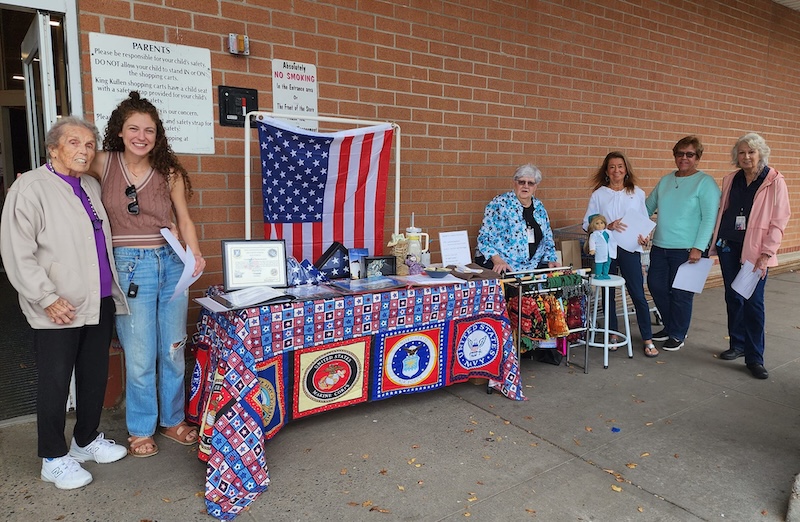
There is no steady funding stream. When donations are low, Godfrey’s husband jokes that his credit card is the “unofficial funding arm” of the organization. Much of the support comes from what she calls her “traveling road show” of talks at churches, civic groups and clubs. They sometimes set up a table outside the King Kullen in Wading River and ask shoppers to pick up an extra item or two for the troops.
This holiday season, the group is trying something new: a “Sponsor a Box” campaign, using the online fundraising platform GoFundMe for the first time.
“The idea is, if you’re looking for a gift for someone who has everything, you can sponsor a box in their honor,” Godfrey said.
For about $25, donors can help fill and ship a box to a deployed unit. They can dedicate it to a veteran or loved one, send a note and photo to Godfrey, and she will print them and tuck them inside.
“It becomes a gift twice,” she said. “It blesses the person whose name is on the box, and it blesses the person who opens it on the other end.”
A 20th holiday season of gratitude
As Operation Veronica heads into its 20th holiday season, the sewing machines still hum on Friday mornings. The paracord still gets braided into bracelets, the pocket food still gets sorted into boxes, the cards and letters are still tucked on top.
Godfrey would be happy to see the project end someday because every American service member is safely home. Until then, she and her volunteers plan to keep showing up.
As long as there’s one soldier, one sailor, one airman, one Marine who feels a little less alone because of what we send, it’s worth it, Godfrey said.
HOW YOU CAN HELP
Operation Veronica is an all-volunteer, nonprofit organization based in the Shoreham–Wading River area. Here are some ways local residents can get involved:
• Sponsor a box: Make a donation to help fill and ship a care package to deployed U.S. troops. Boxes can be dedicated in honor of a veteran, friend or loved one. The donation can be made on Operation Veronica’s GoFundMe page.
• Donate items: Shelf-stable snacks (granola and protein bars, tuna pouches, nuts), toiletries and other approved items can be dropped off during work sessions at the Shoreham community center on Defense Hill Road, across from Shoreham-Wading River High School, on Fridays between 10 a.m. and noon. (Please call ahead 631-880-8750 to let Godfrey know you’re planning a drop-off.) No alcohol or tobacco products can be included in shipments. Chocolate is welcome in cold weather, but not in summer months.
• Volunteer: Sew, hand-stitch, help assemble survival bracelets, fold pocket flags or pack boxes during the Friday morning sessions. New volunteers are welcome; beginners can be paired with experienced sewers. The group generally meets every Friday, except around major holidays, including Christmas and New Year’s.
• Share a name: If you have a loved one serving in uniform outside the continental United States, you can ask that they be added to the shipment list. Reach out by email to OpVeronica2005@gmail.com, or text/call 631-880-8750. Your soldier’s privacy will be protected. Godfrey does not share names and addresses with anyone.
For more information, visit the Operation Veronica’s website.
The survival of local journalism depends on your support.
We are a small family-owned operation. You rely on us to stay informed, and we depend on you to make our work possible. Just a few dollars can help us continue to bring this important service to our community.
Support RiverheadLOCAL today.
