
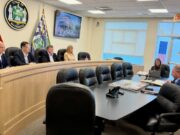













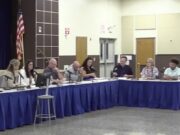







A Zoning Board hearing on two routine variance requests last night turned into a marathon scrutiny of every aspect of a proposed cannabis cultivation operation on Calverton farmland.
Residents opposed to the plan packed the Town Hall meeting room to press officials and the applicant’s attorney on everything from odor control and traffic to how the project should be classified under the Riverhead Town Code. The hearing went on for more than two hours before the board closed it and reserved its decision to its next meeting on Jan 8.
The application before the ZBA seeks relief for two elements of the site plan: impervious surface coverage of 24.04% where 15% is permitted in the Agricultural Protection (APZ) district, and an eight-foot woven wire deer fence where six feet is the maximum height permitted by the code.
Deputy Town Attorney Annmarie Prudenti, counsel to the ZBA, opened the public hearing by emphasizing that, regardless of how wide-ranging the public comments might be, the board’s decision is limited to those two variance requests.
But as residents filled the room and lined up to speak, the discussion repeatedly shifted to questions that typically arise during Planning Board site plan review — and to a threshold question raised by residents about whether the proposal should even be treated as a “greenhouse” use in the APZ district.
The “Brother Bear Canna” proposal is under review by the Planning Board because site plan approval is required for permanent greenhouses in the Agricultural Protection Zone (APZ) district. Planning Department staff have described the site as a residential parcel improved with a two-story single-family residence and barn structures, in a surrounding area that includes single-family homes and two large 55-and-over communities, Windcrest East and Foxwood Village, as well as a 41-acre town-owned open space parcel.
In the staff report prepared for the Planning Board, Senior Planner Greg Bergman cited state law treating cannabis as an agricultural crop when cultivated in accordance with the cannabis law, and noted that agricultural production is permitted in the APZ district and greenhouses are permitted on parcels of five acres or more.
The staff report also outlines what the proposed facility would contain: in addition to cultivation areas, it would include rooms for fertigation, trimming, drying, curing and packaging, along with employee facilities and mechanical equipment space.
ZBA members had many questions about the proposed operation. Member John Porchia, in particular, peppered the applicant’s representative, Tony Kieffer of Arch Solar, its engineer Jerry D’Amaro and its attorney John Anzalone with questions about the need for an eight-foot deer fence and potential odors associated with the cultivation process.
Packed hearing, broad concerns

Residents opposed to the proposal described it as industrial in nature and urged the board to deny variances without more detailed information about environmental impacts and operations.
Windcrest East resident Diane Gaudiosi told the board the proposal is “an industrial-scale cannabis facility” seeking variances that would “alter drainage” and “alter wildlife movement,” and argued the town lacked “environmental studies” and “operational clarity” needed to evaluate the application.
George Pammer, also of Windcrest East, urged the town to treat the proposal as “an industrial cannabis factory dressed up in agriculture language,” saying “factories need scrutiny” and should not receive variances “without proving they won’t harm the land around them.”
Janice Scherer of Calverton, a professional town planner who works for the Town of Southampton, said the variances sought “would create an unwelcome change in the neighborhood character, and it would harm nearby properties.”
“This is a lovely rural parcel with a historic home that I drive by 50 times a day,” Scherer said. “It just doesn’t fit the character of the area. And I think in that way, it would negatively affect the physical and environmental conditions, the traffic, the drainage, our view shed, all the things that we identify with in this location, and this is definitely a self-created hardship. They are trying to profit off of something, buy something that is not for this purpose, and receive variances and different things for something that does not belong here,” she said.
Nicole Miller of Golden Spruce Drive questioned the size and of trucks that would be going in and out of the facility and how often truck trips would occur. The applicant stated that they would be box trucks, she noted, but those come in many sizes, with the larger ones being only slightly smaller than tractor-trailers, she said.
“Are we talking just one or two trucks twice a week, or several trucks twice a week, and if it’s at the size of 24-to 26-foot trucks,” she asked.
Residents also raised questions about the applicant and associated entities.
One speaker, Kerry McKillop of North Woods Road in Calverton, said it was unclear “who the applicant for this project is,” referencing the different names appearing in the materials and describing the cultivation license as being held by Grasse River Hemp LLC.
The Planning Department staff report states that the project is being developed by the partnership of Brother Bear Canna and Grasse River Hemp LLC, and lists three New York State Office of Cannabis Management licenses — cultivation, processing and distribution — associated with Grasse River Hemp LLC. The property is owned by another company, 1458 Middle Road LLC.
Kieffer said he would submit a written statement to the planning department clarifying ownership and licensing questions.
Greenhouse or vertical farming?
A major thread of the hearing centered on whether the proposal should be treated as a greenhouse — a permitted use in the APZ district — or as vertical farming, which is not a permitted use in the district.
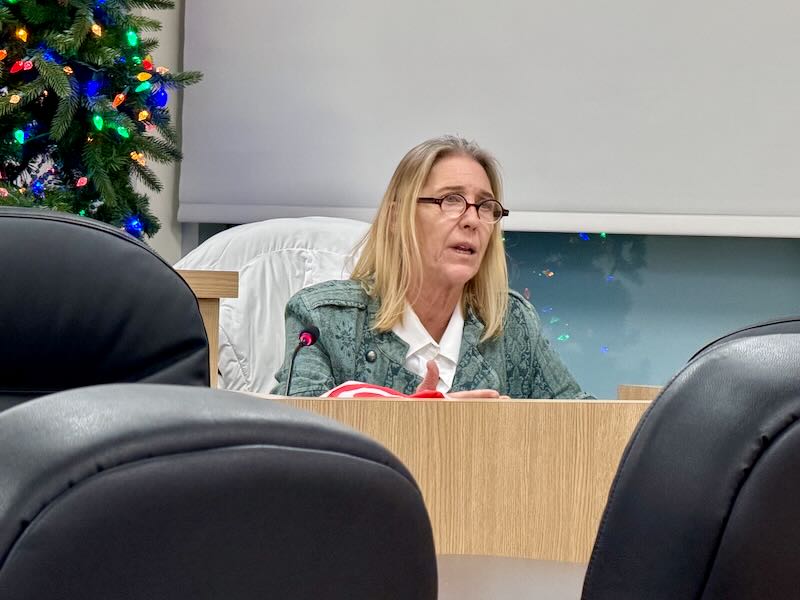
In pursuit of that examination, Prudenti pressed the applicant on its growing methods.
“I believe you’ve described it before the Planning Board as a greenhouse operation, but the more information that I’m receiving, the more I’m questioning, is this a greenhouse operation?” Prudenti said.
Greater Calverton Civic Association President Toqui Terchun told the board the detailed questioning during the hearing was “refreshing.” Terchun read into the record a letter asking the ZBA to issue a use interpretation before taking up the two variances.
The letter framed the “threshold question” as whether the facility is “a traditional agricultural greenhouse” or more accurately classified as “vertical farming, manufacturing or industrial processing,” which the letter asserted are not permitted uses in the APZ district.
“If the proposed use is not permitted in the AP zone, the variances are moot,” Terchun said. This is not a traditional greenhouse, she said. “The application describes a 34,000-square-foot, 24-foot-high industrial building supported by 24/7 multiple shift operations with 30 employees… artificial LED lighting and full industrial HVAC systems on site, drying, curing, trimming and packaging and possibly extraction, secure eight-foot fencing, atypical for residential uses, a retail-ready or wholesale-ready, finished product, rather than raw material agricultural commodities,” Terchun said.
“These characteristics match vertical farming/ industrial processing, not greenhouse agriculture, regulatory indicators of an industrial use,” she said. The operation requires approvals typically associated with manufacturing and processing facilities, not agricultural buildings,” she said.
“This is a precedent-setting project, and we appreciate the scrutiny to which you’re putting it,” Terchun said. “This board has previously issued use interpretations based on regulatory requirements, such as the EPCAL anaerobic digester case where DEC permitting placed the facility in a use category not allowed. The same logic applies here. Regulatory classification determines zoning classification. We respectfully request that the board issue a use interpretation determining whether the facility is a permitted agricultural greenhouse or unpermitted industrial vertical farming use,” Terchun said. If it’s industrial, it is not permitted in the APZ district, she said. “We urge the board to make this determination and protect the intent of the agricultural protection district.”
Later, board members pressed the applicant’s representatives about cultivation methods, including hydroponics, and questioned whether what was being described aligned more closely with “vertical farming” than a greenhouse.
In response, the applicant’s attorney argued the project meets the greenhouse concept because the cultivation structures would have light-transmitting roofs, describing “a polycarbonate light transmitting roof” designed to achieve the greenhouse effect. Board members also asked about the adjacent “head house” building, which the attorney described as housing shipping/receiving, employee areas, and the drying, curing and trimming rooms, along with water treatment and fertigation equipment.
During the exchange, the applicant’s attorney also raised state-law limitations on local regulation of cannabis cultivation, asserting that towns are prohibited from regulating where cannabis is grown.
Odor control, air handling, and other operational details
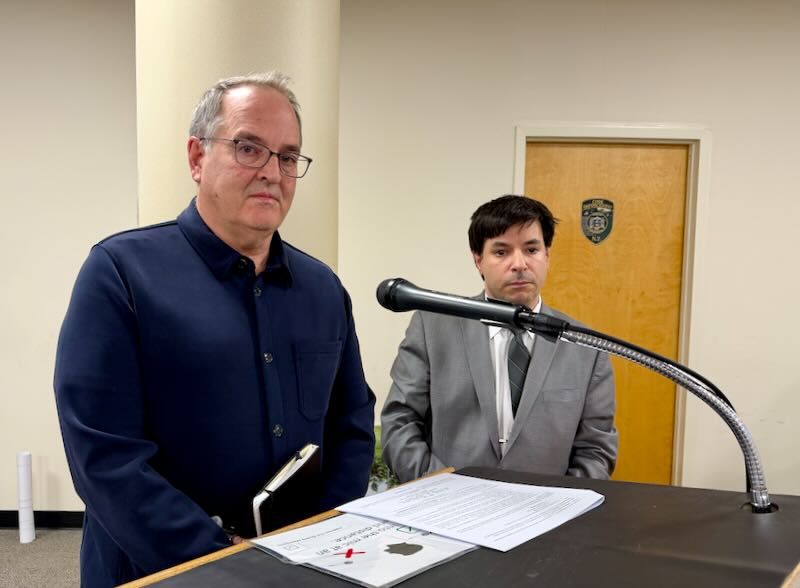
Odor and emissions were among the most frequently raised concerns from residents, and board members questioned the applicant’s representatives about ventilation and filtration.
The applicant’s representative described a sealed HVAC system intended to keep pathogens out and odors in, saying air circulates through activated carbon systems designed to scrub volatile organic compounds and address concerns about terpenes.
The Planning Department staff report similarly states that the application proposes a fully enclosed structure with sealed, climate-controlled HVAC “to minimize or eliminate odors,” and says the town requested specifications and maintenance details for the odor-control equipment.
Residents also spoke about drainage, wells and water quality. Frank Cavallaro of Purple Beech Street in Windcrest East told the board his community had been denied irrigation wells in the past due to groundwater contaminants and said he contacted the DEC regarding the project site and was told the agency had “no knowledge” of an application for wells at 1458 Middle Road.
Kieffer said the wells proposed at the site do not require DEC permits because they are designed to pump less than 45-gallons-per-minute, the threshold for DEC permit.
Deer fence variance draws wildlife concerns
While much of the hearing focused on the broader operation, some speakers addressed the deer fence variance directly.
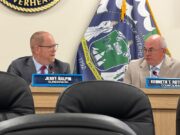
Supervisor-elect Jerry Halpin, identifying himself as chairman of a wildlife management committee, told the board six-foot fences can be easier for deer to clear and that eight-foot fences can “at times, cause more harm to our wildlife,” urging the town to require the lower height.
Next steps
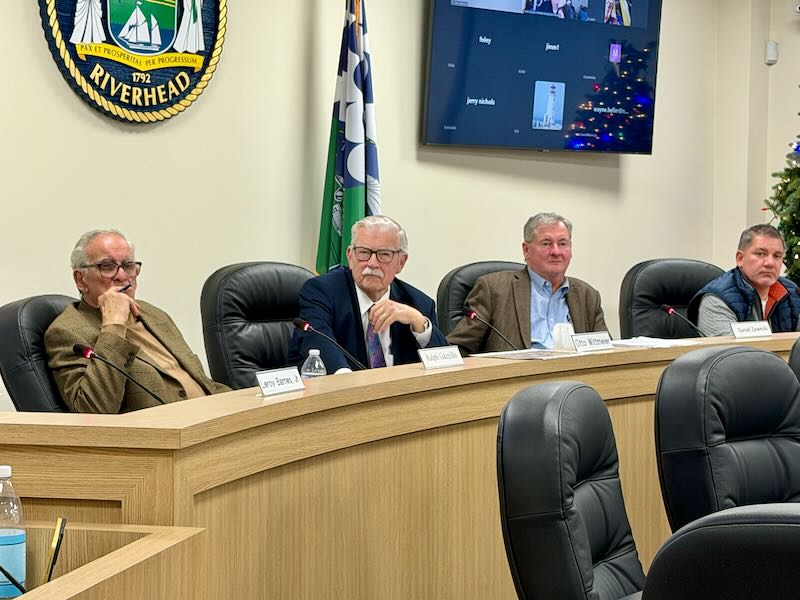
After extended testimony and board questioning, the ZBA voted to close the hearing and reserved its decision to its next meeting, which is scheduled for Jan. 8.
The Planning Board’s review of the site plan is ongoing, and town staff have noted other approvals will be required, including from the Suffolk County Department of Health Services Office of Wastewater Management and several town departments.
The survival of local journalism depends on your support.
We are a small family-owned operation. You rely on us to stay informed, and we depend on you to make our work possible. Just a few dollars can help us continue to bring this important service to our community.
Support RiverheadLOCAL today.
