























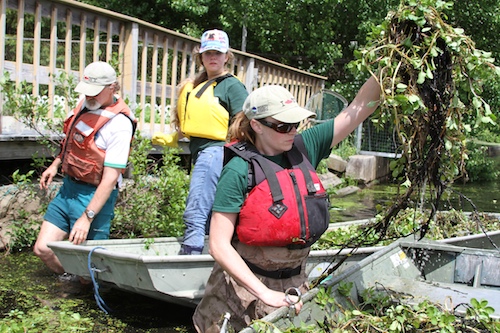
Volunteers went on their first Peconic River excursion of the season Saturday in an ongoing attempt at clearing out the invasive Ludwigia plant.
Ludwigia, or water primrose, is a non-native and invasive aquatic plant that has been posing a threat to native species of plants and animals in the Peconic River since it was first discovered to be growing out of control there in 2003.
The Peconic Lake Estates Civic Organization (PLECO) has been working with the Peconic Estuary Program for the last seven years to recruit volunteers to go out onto the Peconic River to gather and dispose of the rapidly spreading Ludwigia.
If the Ludwigia is left to grow out of control, it will choke out the lake, said PLECO president Ernie Fugina. Julie Nace, a member of the Peconic Estuary Program, added that the plant grows in thick mats above the water so it blocks sunlight, depletes oxygen in the water, hurts native species and recreational boaters can’t paddle through it.
The approximately 25 volunteers who went wading in the Peconic River Saturday filled the backs of two pickup trucks with the plants. This is a slow-growing year compared to some in the past, Fugina said. The first time volunteers went out to gather Ludwigia seven years ago, they filled two Dumpsters with it — a total of 60 cubic yards.
The weather plays a role in how fast the plant grows and spreads, Fugina added, pointing out that this spring has been unseasonably cool.
“I wouldn’t want to do this if it was a real warm spring and it was the first week of July,” Fugina said, “because this stuff just explodes.”
Removing the plant by hand is the only way to go about handling the Ludwigia invasion, since herbicide will kill more than just the Ludwigia and machines will take everything in their path, not to mention break the Ludwigia into tiny pieces that will float away and begin to grow again, he said.
“This is something we’re always going to have to do,” Fugina said. “We’re never going to eradicate it.”
“I think that, with any invasive plant, there is rarely a good solution unfortunately, said Nace. “So if [volunteers] can maintain it at a level that’s acceptable, the volunteers will continue doing it.”
Nace and Fugina said that it is unclear where the Ludwigia came from in the first place.
There will likely be another day planned to gather more Ludwigia sometime this July, Nace said. We’ll schedule one for August and September, too, if it’s necessary.
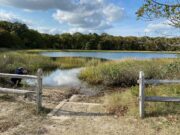
Below: Map of Ludwigia gathering locations on Saturday June 8

RiverheadLOCAL photos by Emil Breitenbach Jr.
Click thumbnails to enlarge images
{gallery}2013/slideshows/2013_0608_ludwigia{/gallery}
The survival of local journalism depends on your support.
We are a small family-owned operation. You rely on us to stay informed, and we depend on you to make our work possible. Just a few dollars can help us continue to bring this important service to our community.
Support RiverheadLOCAL today.
