


















Some people are like those blow-up punching-bag clowns filled with sand. They can be knocked over again and again and again and yet they float back to the upright position with a carnival smile still on their faces.
As my husband and I look into finding the right school for our daughter, the answers always come back to her. We agree that we want her to be able to enter situations with confidence, not necessarily knowing how to navigate tricky situations, but with the skills to be able to figure it out; to know who and when to ask for help, and definitely to know right from wrong. We know that the world can be a seriously difficulty place and the other kids can be mean. We kept her home this year so she would have more time to develop confidence and security.
I remember as a child not having any idea how to respond to some of the things other kids would say to me. And I don’t think that being thrust into difficult situations with no prior experience is the way to learn how to navigate the world. That would be like bringing a child to the ocean, throwing them in the water once and expecting them to figure out how to swim. Children learn tasks by doing and practicing. They learn behaviors by observing others and being redirected, shown the correct way.
Fortunately, my life had been mostly sorrow-free until about six years ago when my mother was diagnosed with cancer. My resilience had never really been tested prior to the age of 27. I mean, I consider myself a strong person for having dedicated myself to my career goals at an early age, and for having the physical and mental willpower to succeed in medical school and residency. I never really doubted my ability to do those things. But many times over the last six years, I seriously doubted whether or not I would be mentally and physically strong enough to deal with cancer in my family. Nothing was near as challenging or devastating as seeing the woman I love and admire and respect most in the world worry and suffer, in and out of chemo and labs and tests and surgeries.
From her diagnosis to her death I aged from 27-32. My daughter, on the other hand, never knew life without Suah’s cancer. As my mother’s cancer developed and aged, so too did Isabella, from six months gestation to five years young. During my pregnancy, she surely felt my adrenaline and my worry coursing through our shared circulation. We shielded her as much as we could, but when she became old enough to ask questions, around age three, we had no choice to explain it. Why doesn’t Suah have hair? Why is Suah in the hospital again? What’s the bandage for? Why is Suah always sick? Why can’t she come to the library?
My mother put up the bravest front for my daughter. And she included her illness in the most positive way – assigning Isabella with the desirable and noble duties of refilling her ice cup to quench her insatiable thirst. Izzy felt so useful, so helpful, like she had a role, a responsibility in making Suah happy as Suah had done for her so many times. She observed the empathy and compassion that was shown to Suah, by friends, doctors and family. She began to imitate those behaviors which have become the core of who she is and who she will be as an adult.
Isabella became old enough to inquire about the science of cancer. Why did she get cancer? Will I get cancer? Will I have to get needles? Will you get cancer? She was also very interested in the process – the bandages, the medicines, the buttons on the hospital bed. As Suah became sicker, Isabella took on an even more important role. She became the creator of distractions – forcing Suah to play beauty salon and keep her mind off of her painful neuropathy, her constant nausea or the fact that she couldn’t eat solid foods for six months. My mother meditated on her Isabella, the little girl she watched and helped us raise through chemo and post-op times six. She focused on the fact that Isabella needed her and that kept her going for so long. Her resilience was like that of the blowup clown. If she heard me compare her to a clown punching bag, she’d laugh, roll her eyes jokingly and say, “Yeah, that’s me all right!”
I didn’t really have to learn resilience until my moral character was well developed. Isabella was confronted with it from the gate. And asking a five-year old who has witnessed cancer and its devastating toll to bounce back like the laughing carnival clown is like asking her to move a mountain. (Suah loved similes and literary devices.) This fall, we will be sending her to school after having given her the extra time she needed to overcome the loss of her primary teacher in life.
I am hoping that resilience is genetic, that somewhere deep inside, as Isabella grows and matures and observes, her own inner punching bag will develop and she’ll always land on her feet smiling — just as Suah was until her very last day and just as I am right now.

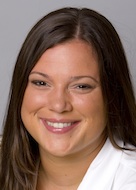
Alexis Hugelmeyer, D.O. is the wife of Michael, mother of Isabella, 5, and Lance, 3, and a family physician whose passion is hands-on manipulation for treatment and healing of any and every type of medical problem. She is the director of community outreach education at Peconic Bay Medical Center and also a private practitioner in Riverhead, where she has founded The Suah Center for Natural Healthcare. A graduate of Villanova University and New York College of Osteopathic Medicine, she lives in Baiting Hollow.
Look for Dr. Mom every Saturday on Riverheadlocal.com
The survival of local journalism depends on your support.
We are a small family-owned operation. You rely on us to stay informed, and we depend on you to make our work possible. Just a few dollars can help us continue to bring this important service to our community.
Support RiverheadLOCAL today.
