



























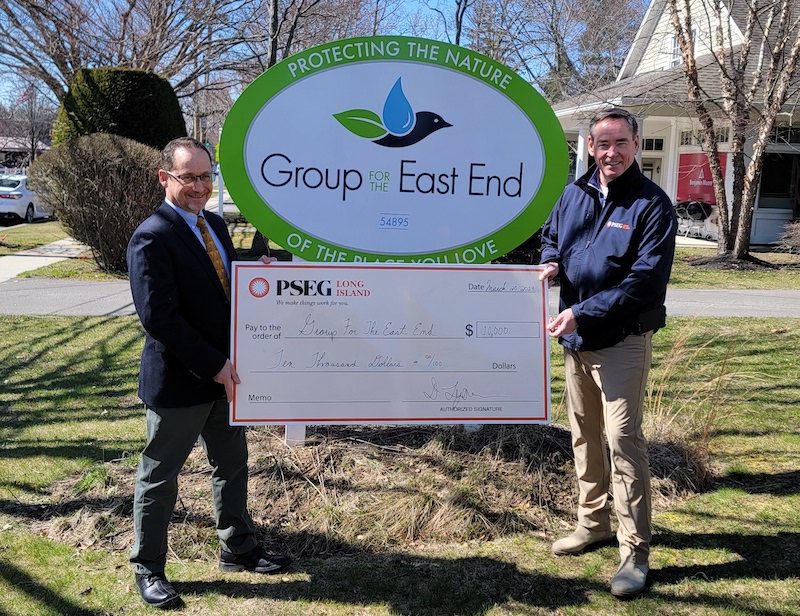
The Group for the East End has received $10,000 from PSEG Long Island to support its conservation efforts for the local osprey population.
The magnificent raptors nest and breed in North America in the spring and summer, and journey to Central and South America for the fall and winter. The return of the ospreys is a harbinger of spring on Long Island, where osprey pairs make their seasonal homes on treetops and manmade structures.
The Group for the East End, an environmental advocacy and conservation nonprofit, has been monitoring ospreys in the region for more than 30 years in a quest that has successfully helped to restore the endangered population. The group estimates roughly 550 nests on the East End, group president Bob DeLuca said.
PSEG-Long Island’s donation will help the Group for the East End do more outreach events and update its website to educate people on ospreys for recreational purposes and to facilitate the safe nesting of the birds, DeLuca said. He said the money will also help the group maintain its osprey site map — which was last updated in 2019.
“We think we have a fairly solid management strategy for the bird going forward. And it’s nice to see the utility obviously being part of that,” DeLuca said in a phone interview this week.
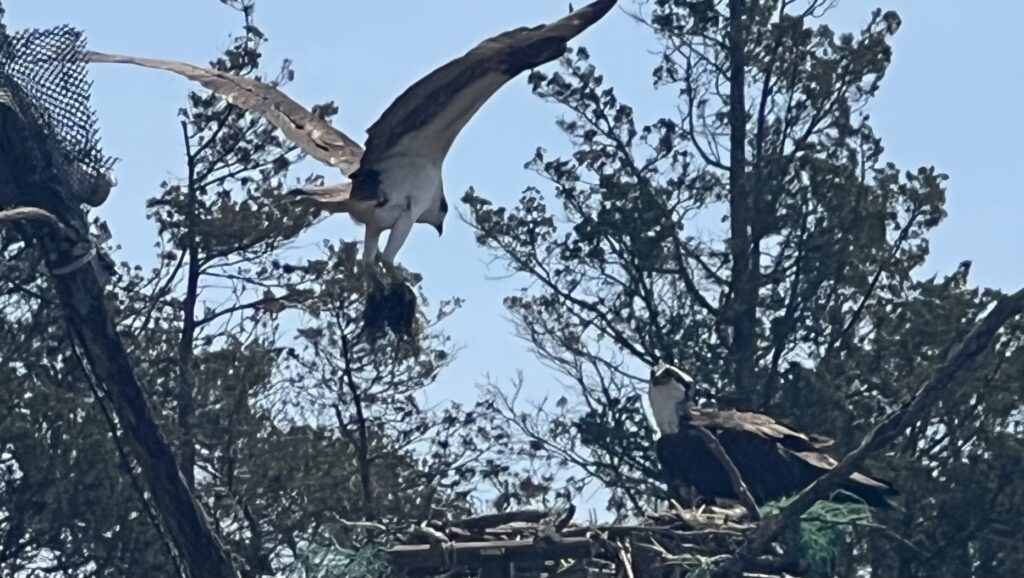
The growing osprey population on Long Island is of concern for the utility company, since the large fish-eating raptors have often made their nests on the top of utility poles, causing dangerous conditions for both the birds and the infrastructure.
DeLuca said the group, in partnership with PSEG Long Island for the last four years, has been sweeping the East End and documenting osprey nests on utility poles that have “the greatest chance of harming the birds.” Ospreys often return to the same location to nest every year, and the group’s information allows PSEG Long Island to install deterrents that make it harder for the birds to perch new nests.
“They’ve got, I think, 100 or more of these deterrents now installed, so that we don’t have to have any worries of these unfortunate incidents where the birds are blowing up or getting electrocuted,” he said.
In some cases, the utility company has made platforms on utility poles to specifically accommodate nests; one such pole sits at the intersection of Doctors Path and Northville Turnpike, according to an interactive map maintained by PSEG Long Island.
“PSEG Long Island is proud to partner with Group for the East End in protecting the osprey, because good environmental stewardship is part of being strongly involved in the community, and also because protecting these birds from high-voltage equipment improves reliability for our customers,” Dave Lyons, PSEG Long Island’s interim president and chief operating officer, said in a press release. “We are excited to see what we will do together in the future.”
The utility company maintains 24-hour live “Osprey Cam” web cams at two of its nest locations, in Patchogue and Oyster Bay.
Ospreys were once an endangered population in the northeastern United States. Population decline of the species was caused by the effects of the agricultural insecticide DDT, which thinned the birds’ eggshells, according to the Department of Environmental Conservation. Since the insecticide was banned nationally in 1972, the population has had a resurgence. Long Island, due to its abundance of both coastline and the bird’s meal-of-choice: bunker fish.
DeLuca sees the resurgence of the ospreys on the East End as a success story for environmental conservation efforts, and one that can give hope to the next generation that they can make a difference, even when environmental issues appear impossible to solve.
“Often the story is that humans touch something and they screw it up, right? And the Osprey recovery is a good example where lots of people over a long period of time invested time, money and sweat,” DeLuca said. “And the birds have thrived; so we can get it right.”
The survival of local journalism depends on your support.
We are a small family-owned operation. You rely on us to stay informed, and we depend on you to make our work possible. Just a few dollars can help us continue to bring this important service to our community.
Support RiverheadLOCAL today.
