




















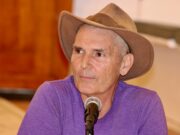



Andrew Leven is one of two Democratic candidates for Riverhead Town council. The verbatim transcript below, made from an audio recording of the Oct. 9 interview, has been lightly edited for clarity (deleting repeated words etc.)
Please note that this conversation preceded this week’s Town Board’s vote to cancel the town’s contract with Calverton Aviation & Technology (CAT) to sell its industrially zoned land at the Calverton Enterprise Park.
Denise Civiletti: Steven Losquadro, legal counsel to the Republican Committee — I think both the county and Riverhead — provided us with your voter registration documents that he obtained from the Somerset County Board of Elections and the Suffolk County Board of Elections through a FOIL request. And the Suffolk records show that you registered to vote in Suffolk County on March 3, two days before the Democratic Party leader announced this year’s slate. The Somerset records show your voter registration was deleted. I can show you this document.
Andrew Leven: I’m not even sure what you’re describing.
Denise Civiletti: That’s why I made a copy.
Andrew Leven: Deleted? From where?
Denise Civiletti: From their voter rolls, and it gives a date, April 14. I know that one of your opponents has made an issue of your residency. This is what Mr. Losquadro sent me from Somerset County, and this is [from] the Suffolk County Board of Elections.
Andrew Leven: I didn’t even know — I don’t know how this even works. I have no idea.
Denise Civiletti: I’m looking for your comments on that. Mr. Losquadro was saying that it shows you were enrolled in two places from March 3 to April 14. So, as to your knowledge, is that accurate? He also says that you were registered in two places while you were gathering signatures on your designated petitions for Riverhead Town Board. What’s your response to that?
Andrew Leven: Let me take them one at a time. I don’t really know anything about how this works. I was given a pathway to follow, and I followed it, by a person who I believed knew how this worked. I have no interest in violating local, state or federal law — I never have, and there’s a good reason for it: I never wanted to give other people control over my life.
We all have the illusion of control, I understand that, but there are a few things that we can do, and we do them. I always adhere to the law, as I understand it, to the point of declaring kielbasa at the border when I flew in from Poland with my wife, which she still teases me about.
I don’t know what happened with Somerset County. I have no idea if I was supposed to advise them of my change in status or not. I did not [advise them]. I see that I’m deleted, I don’t know how they got that information. I am registered to vote here. I was told that I needed to register by a date certain, I was invited to join this ticket and that was right around the time when I was invited. Why would I switch registration unless I was running here?
Denise Civiletti: I felt it was important to address this.
Andrew Leven: Sure, I’m glad you did. This is news to me.
Denise Civiletti: You didn’t contact Somerset County and say ‘I registered, I moved?’
Andrew Leven: I have no idea how a person would even delete this. I don’t know what the import of it is. I feel like, if I register to vote in Suffolk County and I only vote in Suffolk County, then I have met my legal obligation. If I vote in two places, I will have violated the law. I have no intention of doing that. Why would I? To be on the Riverhead Town Board? I don’t think so.
Denise Civiletti: I don’t want to beat a dead horse here, but Mr. Losquadro was not alleging that you violated the law. I asked him that question.
Andrew Leven: Just to editorialize a little bit, I find it actually a little bit reassuring that the only things that they really have to criticize me about are things like this, which I have no control over — at least not a conscious control over.
Wasn’t there a second part of the question which I missed?
Denise Civiletti: He [Losquadro] says that you were registered in two places while you were gathering signatures.
Andrew Leven: I wasn’t gathering signatures. I was told by people, who I assumed know, that were gathering them on my behalf. There was some technical thing where I was not allowed to personally seek signatures, under the election law.
Denise Civiletti: Maybe because you’re a registered Republican. OK. Next question.
You said something at Calverton-Wading River Civic Forum for candidates that surprised me. You said that there are no damages if the town cancels the contract with CAT. You’re obviously a lawyer, you hold a JD from Syracuse College of Law. You said you graduated valedictorian of your class. You’re obviously a smart guy, well-versed in the law.
Andrew Leven: You’ve talked to me, so you know that.
Denise Civiletti: I think then, you got to understand that what you said was not exactly accurate. So, why did you say that? Could you defend that? I feel that it created a false impression for the public, who don’t necessarily understand this.
Andrew Leven: So, what I was trying to communicate, and as you understand, the debate format is not ideal for, let’s call it, ‘granular analysis of issues.’ It really doesn’t lend itself to that. You have a very limited period of time.
What I meant to communicate is, as a matter of basic contract law, if you don’t have damages —- there’s been a violation of your contractual rights — but you don’t have damages, then you don’t have a loss. That was what I was trying to convey. I don’t really understand, except to know that it looks like our town started with a very poor legal foundation, got themselves immediately or soon into trouble, and instead of ever trying to be accountable for where they are, and in a straightforward way try to fix it, they keep on bolting another piece of tin onto this rickety chassis.
So, it’s very difficult to tell even what this deal looks like. The last time I was at the IDA, there was a total confusion about a two-phased process versus a one-phase process. The Town Supervisor came in and interrupted and made demands, and it was kind of chaotic. So, on a legal side, I would have to really sit down with somebody who understands this part of the world, because it would be malpractice not to, before I could render a legal opinion.
But in general, it seems to me that before the IDA approves this project, what CAT has is a hope of approval, and that hope, it seems to me conceptually, there is a question in my mind whether that would constitute cognizable damages in a lawsuit. Because, hoping that a governmental body will give you an approval that they don’t give you — I don’t know, seems kind of speculative to me. Again, I wouldn’t file a lawsuit with that level of analysis, I would have to research it and figure it out, but that concept was what I was trying to communicate.
And I’ll go one further: once the IDA passes this thing, I think then CAT has some very clear vested legal rights and real damages that would not be speculative and would put the township in a much worse legal posture and posture in every way.
Denise Civiletti: And until the March 22 agreement that the Town Board passed, nothing about this contract was contingent on IDA benefits. Anyway, thank you for clarifying that.
Andrew Leven: If I could just go a little bit further, because, again, not my area, but when you’re talking about a contingency being a governmental approval of another agency, that strikes me as it’s at least [worth] taking a serious look at — whether an IDA disapproval would constitute cognizable legal damages in the court of law.
Denise Civiletti: You just mentioned the IDA process and this two-step thing, etc. Because of that, it’s hard to even phrase the question about it, but: if the IDA rejects the CAT application, and whatever they believe they’re passing judgment on at this point, and the town then exercises its right to cancel the contract, which it has under that March 2022 letter agreement, and they do it, they cancel it, and you’re elected — if that happens before, what do you see as the right plan for that site?
Andrew Leven: Let me just say, initially, that I think it’s almost certain that if the IDA disapproves this, that CAT will sue the township, because that’s how they do business. You know, being a lawyer, both of us, I assume you have come across a situation, I certainly have, where people use lawsuits not to validate a legal right or a contractual right, but as a tactic to accomplish something they want to accomplish. As far as I can tell, that is CAT’s M.O.. They have a lot of money, they have very good law firms, they’re very well resourced, and they are going to use our legal system as a tactic — I assume.
As far as what I would do for the site? I can tell you what I wouldn’t do. This situation, obviously, has been around for decades and I’m not going to presume that I can walk in here and, like President Trump, say ‘I’m gonna end the Ukrainian war in an afternoon,’ right? I would have to really understand what the possibilities are. What I wouldn’t do is I wouldn’t pick the four or five neighborhoods that right now are right on the bubble for really getting asphyxiated by this. I wouldn’t pick out specific neighborhoods for asphyxiation. Whatever is put there, it has to follow a basic principle, and the principle is — I have developed this principle through being, among other things, on the planning board in Bridgewater for six years way back: if a community is going to benefit from economic development, and I want Riverhead to benefit from economic development, the burden should not be borne by discrete pockets of residents, the burden should be distributed as evenly as possible. That would be my guiding principle.
What that actually means, you know, [is] to be determined. It would be a little irresponsible of me to say we’re going to do ‘this,’ when I don’t know that ‘this’ is yet.
Denise Civiletti: And that’s a good segue into the next question.
Alek Lewis: The planned development zoning district, which governs the EPCAL site, allows all uses that promote economic development as of right, and then some allowed by special permit. I know you’ve criticized this before.
Andrew Leven: It seems a little broad to me.
Alek Lewis: The purchaser could build practically anything they want, including warehouses, logistics and distribution centers. If the EPCAL deal falls through, would you support revising the zoning on the property?
Andrew Leven: Yes. I would support revising the zoning on the property to make sure that the goal — it has to be consistent with the goal that I’ve just articulated. It has to be consistent with not vesting legal rights in people who either buy or lease that land, that could have such a catastrophic impact on the surrounding neighborhoods.
Alek Lewis: What does that mean to you, though? What would you like to see at EPCAL in terms of economic development?
Andrew Leven: In general, what you’re really looking for is uses that are of moderate or low intensity, but are commercial, right?
So for example: if you had a facility that an internet servicing company used to store their data, which can be large, but virtually nobody’s there, right? There are other possibilities. I know we have a moratorium on solar panels. It’s ironic to me that we can have a moratorium on solar panels, which could actually help certain farmers continue farming, because it’s been explained to me by the farm bureau that you can make more money per acre solar farming than you can farming a lot of the crops that are being farmed.
Everybody says they want to preserve farmland, so we have that moratorium, and yet we can’t gin up the resolve and the foresight to have a moratorium on warehouses, when our comprehensive plan is so unclear as to what a warehouse even is is obviously out of hand. And I say, obviously, not as a matter of opinion, but just as a matter of observation, when you have the possibility of 20 million square feet of warehousing being put into the town of Riverhead, that is a situation that is out of control.
Alek Lewis: Riverhead Town is currently in the process of updating its comp plan, and industrial zoning is going to be something that the town says it wants to change. Although what that looks like isn’t 100% decided yet. Everybody on the ticket has said they’re opposed to these ‘mega warehouses.’ Do you think they’re appropriate in the Enterprise Park? And are they appropriate anywhere? Outside of the Enterprise Park, in industrial-zoned land?
Andrew Leven: I have to come back, because I think it’s the way to the goal, right? You have to start with a goal, and then you figure out the best way to try to meet that goal, maybe not 100% but at least partially. The goal has to guide the means. It’s hard for me to imagine mega-warehouses, with a lot of truck and other traffic on that site, not asphyxiating some of those neighborhoods– it’s hard to imagine. Maybe there is a way to do it, and if there is I certainly would be open to it.
Alek Lewis: Let me just say: if the goal is economic development, we have all these market studies saying that logistic centers, warehouses, they’re a really hot market, they’re in demand. So how do you reconcile those two positions?
Andrew Leven: I reconcile it with a degree of healthy cynicism. Others may call it a different type of cynicism. It comes from having lived a life in court, and on the side of the table where I lived it, having been on the planning board, having hired consultants in private practice and hired experts.
I know that there are a lot of consulting studies out there that say what the developers who hire the consultants want the studies to say, I understand that. I really don’t give them a lot of weight. I know that logistics centers and warehouses are the flavor of this part of the decade, there have been other flavors.
The planned urban development flavor, where everybody was trying to build residential housing, and retail and commercial all in one area — and shopping. The idea was, and there were a lot of consultants who were talking about it, you can work where you live, and it’ll cut down on traffic and everything else. It absolutely didn’t work, for the simple fact that most people are not so passionate about their jobs that they want to live across the street from where they work and next to all the people that they work with. It just doesn’t work.
I know the studies are there. I would be interested in getting some other points of view in the mix, the point of view of traffic people who are not hired by developers, points of view of environmentalists who are not hired by developers. I am skeptical. I know that, for example, there hasn’t been a major mall built in this country in decades. And yet, there was a time when everybody was building malls, because that was the flavor of the decade. And now, what do we have? We have hundreds — I don’t know how many malls are around the country, but they’re dinosaurs. They can’t get people, they’re turning them into amusement parks, like in New Jersey.
Alek Lewis: If you’re on the Town Board, you’re gonna be the one that’s gonna be making the local laws in regards to zoning. You still really haven’t said what you would prohibit, what do you think should go in industrial zoning, and also: do you think there is too much industrial zoning in Calverton?
Andrew Leven: I’m gonna say something that, I’m not sure how you’ll receive it, but I’m only saying what I believe to be true. I think it’s a little unrealistic, of the press in general, to expect the opposition, who has virtually no access to this information, is cut out as much or more than the public, to act like we have a sort of shadow cabinet, like we’re in the United Kingdom. We’re not invited in to these conversations. For me to come up with specific details, I think, is unrealistic.
Denise Civiletti: Let me maybe rephrase the question. It dovetails off what you said before; essentially, what I’m hearing is that you don’t believe what’s there, with the zoning that exists, serves the town.
Andrew Leven: I don’t think it serves the town, no.
Denise Civiletti: It needs to be reworked.
Andrew Leven: Yes.
Denise Civiletti: You also said that you’d like to see studies that were done by someone other than consultants paid for by developers.
Andrew Leven: Yes.
Denise Civiletti: So, theoretically, at least, that’s what was done with the reuse plan, the revised reuse plan, the urban renewal plan in-between, and that all, to some degree or another, depending on who you’re talking to, led to the zoning that exists today. Are you essentially then advocating — and I’m not criticizing this, that should be looked at over again? Like, we got it wrong, or it doesn’t apply today because it’s out of date?
Andrew Leven: What I’m saying is: here’s the way I’ve lived my life and here’s who I am. As a voter, you can choose to go that way or choose not to go that way. The way I’ve lived my life is I need to know the facts first. I need to actually know the facts. I’m not confident that those facts, that the full body of factual information that would be relevant here, has been exposed, has been considered, has been revealed. That’s one thing.
The other thing is: do we start from scratch? Maybe. But I’ll say this: in terms of the process that has gotten us here, I’ve only been here, as you know — as Mr. Losquadro knows — for a relatively brief period of time. I come here without some history that I have to defend, without preconceived views, without having grown up with people who I don’t want to get mad at me. I come here with a fresh set of eyes. I have never seen a town in this level of disarray in my life. I find it absolutely breathtaking. When I showed up, when I started reading, I asked my realtor: ‘what are those runways over there?’ And I was told that it was a park. That’s what I was told. Then I came here and I started reading your publication, and it became clear to me– look, I’m not a land use lawyer, I’m not an election law lawyer, but I do have a trained mind. I do have a way of approaching issues.
I looked at the stories, I said: ‘holy baloney, this thing is two minutes from midnight and nobody’s even talking about it.’
Denise Civiletti: This is as muddy as it gets, the whole thing. But your realtor misrepresented the situation?
Andrew Leven: Yes. I like her, and I think it was completely innocent. But I will also try to answer your questions a little bit more directly.
Given what I’ve seen, and I’m much more focused on what actually has occurred and actions than I am on promises, which are often empty– given what I’ve seen, I would not feel comfortable relying on the history and the process that got us here. I think that the people involved did a dreadful job– dreadful. I would not rest on that foundation and try to make decisions on how to move forward.
Denise Civiletti: Can you speak to this practice that has been embraced for adopting legislation that exempts all these different pending applications? What’s your position on that?
Andrew Leven: Can you tell me a little bit more about the legislation?
Denise Civiletti: Every time they discuss a moratorium, for example, they exempt things that are in the pipeline. They’re extremely vague, and that seems to change from one moment to the next, what that means.
I’m not sure that anybody has a clear understanding of what a vested legal right is, as far as the law of the state of New York is concerned. Clearly, I think, they don’t. But in a sense of fairness, etc. they should be exempted because they’ve spent all this money, they’ve done an EIS, etc., and so they exempt things.
We are asking if particularly you would support exempting things that are of that nature in the pipeline, whatever that may be, from new land use rules that are adopted pursuant to the comp plan, because one thing we foresee is: the comp plan is adopted, the town board adopts legislation, but then says that ‘this will not apply,’ that these new rules don’t apply to projects that are at some certain phase, which can essentially, you know, negate the code.
Andrew Leven: Yes. I would flip that coin and look at the other side. I would say: what does the town need? What is fair to the town? What I would support is moratoriums on anything that is commercial.
Denise Civiletti: Beyond moratoriums, just the new legislation talking about new codes that are adopted, pursuant to the comp plan. Once they’re adopted, would you support exempting projects from that, even if they don’t have the legally vested rights?
Andrew Leven: Well, that does take me back to one of your first questions, as you heard me in saying that there would be no damages in breaking the contract with CAT. There’s no point in taking away a right that a person is probably going to be able to validate in court, after costing the township a lot of money to get literally nowhere.
For those projects where it really is arguable whether there is such a right, that is actually an opportunity to sit down with that particular property owner and see if some middle ground that better serves a wider array of interests could be reached. And oftentimes, it can be, because everybody has to deal with reality. That includes developers and property owners.
In general, I am not for thoughtlessly taking away the rights of property owners that they have relied upon in good faith over the course of time. There are consequences, I think, to having not been well-governed for years. Some of those consequences are: you have perhaps set expectations among certain people that you should not take away, that it would be unfair to take away. It would have to be project by project.
Denise Civiletti: Do you support the county’s present initiative, which has stalled in the legislature, to implement the 1/8% sales tax increase to fund the installation of advanced septic systems for residences?
Andrew Leven: I think in general, things like public health are a very high priority. I think that there’s some reason to believe that they have been ignored in various iterations in Riverhead. I’m thinking of the water situation now in Manorville, for example. Public health isn’t cheap– it costs money, but it seems like a very good use. I’m talking about concepts now. I haven’t seen the numbers, I haven’t seen what it actually looks like. But in general, if you’re going to spend money as a governmental body, public health should be one of the main priorities. So yes, in general, as a concept, I would support that.
Alek Lewis: Are you in favor of preserving the remaining 7,000 acres of farmland from development within the town? And if so: what’s the best way to do that?
Andrew Leven: My predisposition would be yes, but 7,000 acres is a lot of acreage. Again, you know, you have individual property owners, you have different neighborhoods. I certainly would want to give the people who are going to be impacted most directly a voice and hear what they have to say, rather than just show up and tell them: ‘we’re preserving this whether you want us to or not.’
I suspect, and what I’ve come to understand from being in this town and talking to people, is that the general predisposition is yes, we would like to preserve it. That is certainly consistent with my predisposition. But predisposition has to give way to actual fact, if the actual fact requires that that happens. In terms of doing it: again, pretty complicated idea. The more we can rely on a phrase that perhaps is one of the most misused phrases in the English language: public-private partnership– the more we can rely on that, the better.
An easy thing to look at, but maybe not an easy pathway to walk, would be to try to revamp our TDRs in such a way that it was made more effective as a way of preserving farmland. I’m told by [Long Island Farm Bureau Executive Director] Rob Carpenter that there’s been only a matter of several hundred acres that have been able to take advantage of that program in something like 20 years, or 10 years.
Denise Civiletti: Your running mates [Angela DeVito and Rene Suprina] support abolishing the Riverhead IDA. Your position on that isn’t exactly clear to us. Can you explain what it is?
Andrew Leven: If you want one guiding principle, my North Star: I want to understand the facts before I make a decision. What I’ve seen of the IDA has really been limited to EPCAL at this point, and I think they’re absolutely the wrong place to be doing this. Since they’re volunteers, they should simply refuse as volunteers to participate in this absurd misuse of them as a body. But they won’t.
Alek Lewis: Outside of the EPCAL thing, can you elaborate on your position on the IDA?
Andrew Leven: I am not going to throw the baby out with bathwater. I would really want to really understand that. Mr. Hubbard keeps talking about these 19 projects– it shouldn’t really take that long to look into each of them enough to understand: what was the concept that was sold? What was the relief that was given? What was the expectation, and was it met? If I’m seeing that 18 of those 19 projects are dogs that won’t hunt, and it was a poor outcome for the township, then I would probably say: ‘let’s go with the Suffolk County IDA and get rid of this body; it’s not working for the township.’
But, if it were a more nuanced outcome, I’d have to think about it, right? They are volunteers, and if they’ve done a reasonably good job, and it doesn’t appear to me that they have, but I would really want to know before I dropped that pile of dirt on them.
Alek Lewis: You’ve made it clear that you’re a proud Republican running on the Democratic ticket —
Andrew Leven: I don’t think I’ve ever said ‘I’m a proud Republican.’ I’m actually not proud of being a Republican. I think that my party has left me, I don’t think I have a party anymore. I’m not proud of it.
Alek Lewis: One of your ticket’s things is that they’re not just members of the Democratic party. So, I want to ask: did you screen with the Republicans?
Andrew Leven: No, absolutely not. Listen, I came out here to mind my own business. I came out here to enjoy a really beautiful home in a really beautiful neighborhood. I’ve been fighting with people as my job for my entire adult life. I know how to do it, but I don’t look forward to it, and I wasn’t looking forward to it here. I spoke out about EPCAL because I read your articles. You’re the reason.
Denise Civiletti: It’s my fault.
Andrew Leven: It’s your fault. I spoke at a few things, a few public events, and the next thing I know the Democratic Party Chair [Laura Jens-Smith] calls me up, says can she come over and talks to me about it, and says ‘would you be willing to run as a Democrat?’ I said ‘look, there’s a problem with that.’ First of all, I’ve never run for any office. That idea that I’m a carpetbagger, that I would purposely fill my carpet bag and rush over here so that I could grab power on the Riverhead Town Board is absolutely absurd, and shows you how empty the other side is, in terms of what they’ve come up with against me.
I said to Laura, ‘look, I’m a Republican,’ she said ‘that’s okay.’ I am disturbed. If anything, our society is functioning less than it was even in 2020. The threats to what I want my children and my grandchildren to have are so acute and so concerning that it’s on my mind most of the time. I don’t have an answer. But, it occurred to me that a small part of the answer might be this.
Alek Lewis: What local policies, beyond the EPCAL sale, do you agree on with your running mates?
Andrew Leven: I agree with them that we need to work closely with our police force to see what low-hanging fruit, if any, can be gathered in terms of a more effective law enforcement. What I mean by that is: not coming in and criticizing but coming in and saying ‘look, you guys and women are on the front line. What have you seen? Are there some simple things that could be done better that we could support you in doing now? And are there medium-term things that you feel we should assess and evaluate that we might be able to support you going forward.
I agree with the need to prioritize the comprehensive plan, and get that thing done, and get it done in a way that we can then execute on it. I believe in public safety prioritization, in places like Manorville. I believe, as I’ve explained, I think that one of the biggest impacts that local government has on people day-to-day is land use, and as you know I’m very focused on that, because you make a decision today, and the town has to live with it for 40 years.
Alek Lewis: The new comp plan is being written by consultants chosen by the current government, your opponents and the town’s politically like-minded administrators. Knowing what’s come out of the discussion so far about the new comp plan, would you adopt the comprehensive plan as it’s being proposed if you’re elected to office?
Andrew Leven: It’d be nice to see it first, before I made a decision. I will tell you that the meeting that I attended where I, again, spoke out, I wasn’t impressed. I’ve been involved in what’s called a ‘master plan’ in New Jersey, when I was on the planning board. You know, EPCAL was basically not in it. It was sort of to the side, and it was unclear whether it was even going to be included in the comprehensive plan. So that tells me that focusing on actions but also always wanting to see something before I opine on it, I’m not getting a good feeling that what we will have in place is going to be something that I would feel comfortable [with].
Alek Lewis: What happens if these recommendations come out and you don’t agree with them? Then you enter office, and your board would be the one that adopts the comp plan, where do you take it from there?
Andrew Leven: We get the plumbing right, because without the plumbing, you can’t live in the house. If that means having to redo some parts or all of it, the consultant piece, that’s what we do.
Denise Civiletti: If you’re the only person elected from the Democratic ticket, or you otherwise find yourself in a minority, how do you work with the Republican majority?
Andrew Leven: It may not be easy. I suspect it won’t be that easy. But I would do exactly what I think you would expect me to do: I would go and meet with the people on the other side who are elected, and I would say ‘where can we collaborate? What do we agree on? What can we work together on?’ And identify those things. I’m sure there are some.
And on the things we cannot identify, that we cannot agree upon, I would do what I could, which would be limited, because of the way this is set up. But I would do what I could to make sure that at least you don’t have to keep on making all these FOIL requests, and that at least the public was generally aware of what was going on. I would also write to the DEC and make a formal request as an elected Town Board official for them to advise us on how the SEQRA law could be better addressed and adhered to, because my understanding is that it is being ignored right now. I think that this is something that, frankly, Tim Hubbard should have done six months ago or longer, and I think you can do that. I don’t know how amenable the DEC is to giving advisory opinions, but I think they’re more likely to work with an elected official than to work with members of the public who don’t hold office.
The survival of local journalism depends on your support.
We are a small family-owned operation. You rely on us to stay informed, and we depend on you to make our work possible. Just a few dollars can help us continue to bring this important service to our community.
Support RiverheadLOCAL today.
