













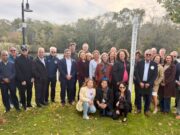





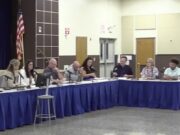






The Riverhead Charter School’s plan to build a high school on Sound Avenue came under scrutiny at a meeting of the Greater Jamesport Civic Association Saturday morning at which Raymond Ankrum, superintendent of the charter school, was a guest speaker.
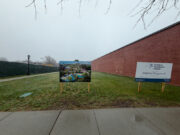
Ankrum discussed the school’s plans for a nearly 72-acre site on the south side of Sound Avenue, adjacent to the existing charter high school which opened in September 2022. During the meeting, held via Zoom, Ankrum fielded questions from civic group members and neighboring residents about the need for the high school and the specific location.
The plan will require a special permit from the Riverhead Town Board as well as site plan approval by the Riverhead Planning Board. Formal applications were not yet filed as of the end of last month, according to the town’s response to a Freedom of Information Law request.
The proposed new construction will also require the approval of the State Education Department.
Area residents have nevertheless already begun to organize in opposition to the plan, citing impacts to the Sound Avenue, including potential increased traffic congestion on the two-lane road, a state-designated scenic and historic corridor.
MORE COVERAGE: Residents organize against Riverhead Charter School plan for new high school on Sound Avenue
The charter school is in contract to purchase the land, which is presently undeveloped. The charter school’s board on Nov. 30 authorized the purchase for roughly $4.5 million using reserve funds, Ankrum told RiverheadLOCAL in December. The new facility would accommodate more than 400 high school students — an increase over the existing high school’s current capacity of 130 students, he said.
The Riverhead Charter School’s most recent charter renewal from the New York State Board of Regents, granted for five years in 2022, authorizes total K-12 enrollment of 1,244 students.
About 50% of the charter school’s students come from the Riverhead Central School District, Ankrum said. The other 50% come from 18 different school districts across Suffolk County, he said.
As the school has expanded grade levels — its first high school class will graduate in June — and enrollment, it has outgrown its current facilities, Ankrum said. Students “just aren’t having the high school experience” the school wants to offer them, he said.
The property in question, comprising four separate lots totaling 71.8 acres, is located within Riverhead Town’s Agricultural Protection Zone (APZ), a zoning use district that limits non-agricultural development. Private educational institutions are allowed in the APZ by Town Board special permit.
In addition, most of the land under contract by the charter school — the southernmost 59.5 acres — cannot be developed or used for non-agricultural purposes at all. The development rights on that lot, which has road frontage only on Church Lane, were sold to the County of Suffolk in 1978, county land title records show.
The northern 12.3 acres, with frontage on Sound Avenue, has its development rights intact, with development subject to the requirements and restrictions of the APZ district.
Ankrum on Saturday told the approximately 40 people on the Zoom conference that the school is fully aware that only the 12.3 acres of the site is developable.
Responding to what he called “untruths” circulating in the community, Ankrum said the only thing the charter school is thinking about for the southern 59.5 acres of preserved farmland, currently a sod farm, is pursuing farming on the site in a way “to benefit the community.”
“And that’s the only thing that we’re thinking about with regards to that land — not building a school on that land, not eventually trying to get a permit to build on that land. We know that that’s an impossible feat. Something that will not happen in our lifetime. So it’s not a thing that we’re trying to do,” he said. “We do not have any plans to try to touch those 59 acres.”
The preserved acreage cannot be used for ballfields, Ankrum said, in response to a question from civic President Laura Jens-Smith.
“Nothing can be built there. Zero. Zilch,” he said.
He said the school was thinking of renting that land for farming to provide a farm-to-table experience for “Riverhead residents, underserved residents, historically marginalized residents, would have a fresh food option.” If the community is opposed to that, the school is “willing to let that go,” though Ankrum said he could not understand why there would be opposition to the idea.
Joseph Fortunato of Aquebogue told Ankrum that while he “appreciate[s] the sentiment of wanting to help the community with a food market or whatever… that’s not the business you’re in. You’re in the business of educating children. I think you should make it very clear that you’re not buying that piece.” Fortunato said a lot of people think that “once you get your foot in the door,” other things can happen in the future.
Ankrum said he would take that feedback to the board and in the next couple of weeks they would make a decision about buying that 59.5-acre parcel.
On the developable 12.3 acres, Ankrum said, the charter school plans to build a high school building of between 50,000 and 80,000 square feet. A second phase would be a middle school building of about 30,000 square feet, he said.
Residents asked Ankrum if the school had considered other locations, such as the EPCAL site, the former state armory on Route 58 and the former McGann-Mercy High School. Ankrum said it had, over a period of years, and discussed the barriers the charter school encountered at those alternatives.
“We’ve exhausted all of our options,” he said.
In response to questions about the proposed site design and how close to the road the buildings would be, Ankrum said the school hasn’t prepared “final renderings of what the property is going to look like.” He said the architects would take visual impacts into account. “We will definitely put a lot of thinking into hiding the view from the road,” he said.
Richard Wines of Jamesport said the developable portion of the property is only 500 feet deep. The Riverhead Planning Board has been working to preserve Sound Avenue as a scenic and historic corridor by keeping all significant development 500 feet back from the road, Wines said.
“I’m hoping you’ve been talking to the planning department about how you can manage to keep 100,000 square feet of development 500 feet back from Sound Avenue when the property that’s developable is only 500 feet deep,” Wines said.
“Our engineers are definitely in constant communication with the town planning board, and I’m sure they’ll be able to come up with a way” to build on the site what the school wants to build in keeping with the town’s requirements, Ankrum replied.
Ankrum responded to concerns expressed about traffic impacts by saying that the school would do a traffic study and do whatever it can to mitigate traffic impacts from the school. He also said the school’s hours of operation don’t coincide with peak traffic times on Sound Avenue.
Residents at the meeting also asked questions about the charter’s school impacts on the Riverhead Central School District’s finances.
Each public school district that has residents who attend a charter school must pay per-pupil tuition to the charter school. The greater the number of residents attending a charter school, the greater the tuition payment from the district to the charter school.
The tuition payment to the charter school from the Riverhead Central School District to the Riverhead Charter School has increased over the past five years from $7.1 million for 463 students in 2019-2020 to nearly $11.7 million for 580 students in 2023-2024, according to the school district. Over that period the cost per student has risen from about $18,000 to about $20,000.
“The parents that choose to send their kids to the Riverhead Charter School, their tax money follows that child, and that’s how it should be,” Ankrum said Saturday, when a resident questioned the cost to the school district. “Your money follows your child,” he said.
“I’m OK with you guys disagreeing. But I’m only providing you with a context of how funding works, right? Because this argument may not be with me, this argument may be with the state in terms of rewriting formulas or whatever,” Ankrum said. He said the state funding formula allows the “sending” district to retain 20% of the cost per pupil for “administrative costs.”
The outflow of funding has been a great concern for the district, which opposed the establishment of the charter school in 2001 — even filing a lawsuit in an attempt to stop it — and has had a contentious relationship with the charter school ever since.
In a joint statement from the district’s school board president and the interim superintendent, emailed after the meeting by the district’s public relations firm, the officials said:
“It is a fact that since the 2017-2018 school year, the Riverhead Central School District has paid over $57,236,138 to the Riverhead Charter School. This is taxpayer money that is siphoned away from the public school district. And while all this money is shifted to the charter school, public school district costs do not go down. Transportation costs continue to rise. Health insurance costs continue to rise. Student support services, such as emotional and mental health services, have increased over this same time period. Money is diverted from the public school district, money that could be supporting the services offered [to] students in the Riverhead School District. Rather, this diversion of millions of dollars results in services being curtailed or even eliminated.”
Palmer was on the Zoom conference but did not speak during the meeting.
Ankrum pushes back against the district’s argument by saying that the state endorsed school choice when it allowed for the establishment of charter schools and he believes parents deserve choice when it comes to their children’s education.
Ankrum also argued on Saturday that the Riverhead Charter School, though it gets less money per pupil — after the 20% reduction in per-pupil tuition — achieves better results for its students than the school district. He encouraged residents to go to the State Education Department’s website, where test scores are reported, to see for themselves.
“If you go on that website, and you look at the past 10 years, and you compare our academic gains to Riverhead Central’s academic gains, it’s really no comparison,” Ankrum said. “So imagine us blowing them out of the water in terms of what we do academically for our kids, with them receiving more money per pupil.”
In response to questions posed by former Council Member Catherine Kent, a retired teacher who spent her career in the Riverhead school district, Ankrum said that 70 to 75% of the charter school’s student population is Latino and roughly 50% of the student body is classified as ENL (English as a new language.) He said only 6% of the ENL students opted out of state tests.
School district officials, in the emailed joint statement, took issue with Ankrum’s remarks. The statement said Ankrum “attempted to denigrate the Riverhead School District and the test scores of Riverhead School District students in an effort to attract more students to his charter school.”
The officials said in the statement that a public school district is “mandated by law to accept and provide educational and support services to all children who live in the district’s catchment area.” Accordingly, the officials said, there is “no basis for comparing charter school test scores to public school test scores.” The officials noted that special needs students comprise 17% of the district’s total enrollment while the charter school’s special needs student enrollment is 5%.
Residents who have organized an opposition group called “No Charter on Sound” are planning to attend this evening’s Town Board meeting to voice their concerns about the proposal to the Town Board, according to its Facebook group and recent digital and print advertising.
The survival of local journalism depends on your support.
We are a small family-owned operation. You rely on us to stay informed, and we depend on you to make our work possible. Just a few dollars can help us continue to bring this important service to our community.
Support RiverheadLOCAL today.
