























Riverhead got the former Grumman site from the federal government for a buck. But it was no bargain. Pollution there threatens private wells and may threaten public water supply too. And the Navy, though legally responsible for cleanup, just keeps dragging its feet.
We applaud Riverhead Town’s decision to collaborate with the Suffolk County health department to independently test the groundwater inside the Calverton Enterprise Park for PFAS.
To date, the only groundwater (and soil) investigation at the site has been undertaken by the U.S. Navy, which owned the property until 1998, when it was transferred to the town by an act of Congress. Grumman Aerospace Corp. — later Northrop Grumman — operated a manufacturing and testing facility there under contract with the Navy. Grumman moved out in 1996, leaving behind a host of environmental problems resulting from its operation at the site, requiring extensive cleanup and remediation by the Navy. The Navy is still working on the remediation.
As time went on, we learned of new types of pollutants affecting soil and groundwater at the site — “emerging contaminants” that pose significant and potentially dangerous health hazards for multiple animal species, including humans. Many of these are persistent in the environment — they don’t eventually “go away” — so persistent, in fact, that they are dubbed “forever chemicals.”
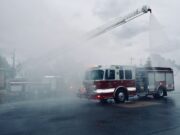
Among these are the class of chemicals known as PFAS (shorthand for per- and polyfluoroalkyl substances), synthetic chemicals used for a variety of purposes in many different industrial processes and consumer products. They are also found in firefighting foam used to extinguish certain types of fires, including those involving fuels.
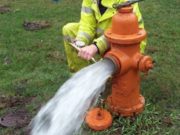
The danger is real. In 2020, New York State adopted a maximum contaminant level for PFAS in drinking water of 10 parts per trillion. But Navy representatives told community members the Navy is not bound by state standards. They said the Navy would only abide by the federal Environmental Protection Agency’s regulations and the EPA had not yet established no maximum contaminant level for PFAS in drinking water. After a year-long process, the EPA in April announced adoption of a maximum contaminant level for PFAS in drinking water of 4 parts per trillion, which is as low as can be detected with current technology.
The Calverton Restoration Advisory Board members —a group appointed by the Navy to act as a liaison to the community — were anxious to hear what the Navy representatives would say at the upcoming RAB meeting about how PFAS contamination at the EPCAL site will be addressed, now that the EPA has a drinking water standard for the chemicals.
Turns out, the Navy has nothing to say about it yet. You’d think the EPA’s action took them by surprise. It shouldn’t have. It’s been a long time in the making. Yet, the Navy told the Calverton RAB that discussion of PFAS is off the table until the Department of Defense issues policy about what to do. It seems a federal drinking water standard doesn’t isn’t enough for the Navy.
Anyone who’s been watching the Navy’s cleanup over the last three decades —proceeding, as it does, at a glacial pace — knows the Navy’s plan of action for cleaning up PFAS at the site, won’t be ready for prime time too quickly. In fact, if we had to hazard a guess, we’d say it will likely take years before it even decides what needs to be done and how to do it. If you doubt this, you haven’t attended one of their mind-numbing presentations at a RAB meeting.
Meanwhile, plumes of contaminated groundwater flow underground in directions determined by geological formations. Depending on the location of the contamination, the flow will be to the southeast or to the northeast. Eventually, it will migrate off-site. And that will suit the Navy just fine, because the Navy has also maintained that it is not responsible for off-site groundwater pollution emanating from the former Navy Weapons Industrial Reserve Plant.
One area of identified PFAS contamination, labeled “Area of Concern 6” is located at the northern end of the 10,000-foot runway had PFAS in groundwater measured by Navy contractors at nearly 1,200 parts per trillion. Remember, the EPA’s new limit is 4 parts per trillion.
And that’s just one area of known contamination. Honestly, who really knows what else has yet to be discovered at the Calverton site? Witness the recent discovery of 18 55-gallon drums buried at a Bethpage park that was once part of the former Navy/Grumman site in Bethpage. The drums contained waste petroleum and chemical solvents, including at least one known carcinogen. Why would behavior in Calverton have been any different? If anything, the Calverton site’s remote location and the sparsely populated areas surrounding it would have made it an ideal dumping ground.
Based on the Navy’s past performance, it’s obvious the community can’t rely on the Navy to protect the health and safety of local residents — even though the Navy, however much it dodges and weaves, is responsible for the mess. As one official put it, prosecutors don’t rely on the defendant to collect the evidence. Riverhead cannot rely on the Navy to assess and correct a mess of its own making. Yet that’s the kind of passivity that the town has displayed — until now.
Riverhead is partnering with the county to collect and analyze its own water samples, by drilling test wells in a way that will help determine whether the groundwater pollution from the former Grumman site will threaten the Riverhead Water District’s public water supply wells in the vicinity.
County Executive Ed Romaine is committed to making sure there’s a complete and effective cleanup — and that the Navy bears the full cost.
With the county’s cooperation and assistance, Riverhead Town can make sure its public water supply is protected.
The survival of local journalism depends on your support.
We are a small family-owned operation. You rely on us to stay informed, and we depend on you to make our work possible. Just a few dollars can help us continue to bring this important service to our community.
Support RiverheadLOCAL today.
