





















A group of civic-minded residents will join Riverhead Town officials on a new committee that aims to guide the development of town-owned land at the Calverton Enterprise Park going forward.
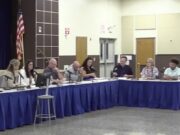
Riverhead Town officials last week introduced the Citizen’s Cooperative Development Team, a new committee that will be chaired by Supervisor Tim Hubbard with the goal of bringing together town officials’ and residents’ ideas for the future of the former Northrop-Grumman manufacturing plant, also known as EPCAL.
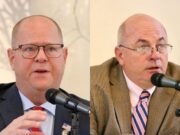
Riverhead resident Mike Foley, Greater Calverton Civic Association President Toqui Terchun, former Riverhead Town Council Member Barbara Blass and North Fork Environmental Council President Mark Haubner will lead the community side of the committee. Hubbard said he started working with the volunteer group, which he called the “shakers and doers” of the town, shortly after he entered office at the start of the year.
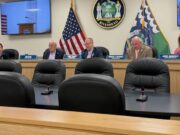
“I’m very happy with the direction it’s going in and how it’s going, and how it formed and how it kind of has now taken on a little bit of a life of its own,” Hubbard said at last Thursday’s work session. “And I think it’s going to be so helpful for us down the road with the sale or development of the EPCAL property.”
The group’s responsibilities will be to vet and offer input on development projects proposed for the site and communicate with the public and local civic groups about EPCAL. The residents have started an email account, revisionepcal@gmail.com, to answer questions and to take comments, criticism and suggestions.
The Town of Riverhead Community Development Agency owns roughly 2,100 acres of land at EPCAL, a parcel which includes the town’s Veterans Memorial Park. The town was selling 1,644 acres of that parcel — including the site’s two runways — in a $40 million deal with Calverton Aviation & Technology (CAT), an affiliate of the Canadian development conglomerate Triple Five. Roughly 1,000 acres of the land sold to CAT would have been preserved and maintained as a habitat for wildlife.
But the town canceled its contract with CAT last October, after the Riverhead Industrial Development Agency refused to grant financial assistance to its development project. CAT has sued to try to force the sale of the land, leaving its future development uncertain. Riverhead Town has asked the court to throw out the lawsuit, but it could be years before the town’s legal issues are resolved.
“Rather than sitting on our laurels and waiting for the litigation to finalize, we wanted to hit the ground running,” Foley said. “The best way we felt we could do that was number one, establish a civic group — a small civic group — that could handle process, communications, environment and coordination.”
Foley said Haubner has experience in environmental issues, Blass knows about zoning and planning, and Terchun is a civic leader who can handle getting information out to the public. The group created a vision statement for EPCAL’s development with the help of town officials.
“We’re looking primarily for revenue. We want it to be a model for dozens of creative initiatives,” Foley said. “We want EPCAL to provide a safe and healthy and comfortable place benefiting the entire community. And we want it to become an educational, recreational destination experience for visitors.”
“The mission to preserve habitat and the outcomes will emanate from the vision, which is [that] we want the best technology, we want the best innovation and we want to be able to provide that in a coordinated way, so that all the parts of this eventually fit together,” Foley said.
Foley said the committee will have subcommittees that will tackle topics like emerging technology, energy and marketing. The subcommittees will be composed of residents who volunteer their subject matter expertise, Foley said.
CAT’s development plans for EPCAL — which were presented to the Riverhead IDA an air cargo logistics hub for eastern Long Island — brought hundreds of people out to public meetings over the last two years to oppose the land deal.
“I think it’s going to be such a better way to try to develop that property — is have the community involved with it right from the beginning,” Hubbard said. “Because as we know with the last time, it kind of came in and then this thing was on everybody’s face. And there really wasn’t a lot of talk about what the community wanted or what they felt should be there.”
“I think we all pretty much have a great idea: that we want it to be prosperous. We want our young people to be able to get jobs — tech jobs that are maybe salaried [and] paying where they can afford to live here,” Hubbard added. “We want to be kind to the environment, because we know how sensitive that environment is up there in particular. And it was just a matter of getting it back on the tax rolls and helping the town out financially…”
Most of the undeveloped town-owned land at EPCAL is within the Planned Development zoning district, a special zone created for the property in 2016 to spur its redevelopment. The zoning allowed “all uses that promote economic development,” as well as supportive housing and other supportive uses like retail. The Town Board passed an amendment to the zoning district at the start of the year to restrict aviation uses at the site.
Foley said that when the Citizen’s Cooperative Development Team formed at the beginning of the year, it was criticized by other civic leaders who tried to make the issues surrounding EPCAL political.
“Some of the issues we got hit with in January was the negative impact of an all-Republican Town Board. Some of the Democrats instantly turned [negative], thinking political — and we stopped them,” he said. ”We said, we’re not going to do this, you’re not going to question the supervisor’s resolve on Triple Five. You’re not going to question the supervisor and the Town Board’s resolve for opening up government. You have to watch what they do.”
“You got a criticism? Fine. Go to the microphone,” Foley said. “But don’t assume that they’re going to be screwing the pump by what they’re doing. Clearly, your actions have spoken as loud as our words, and that’s what makes our job a whole lot easier to defend it when it happens.”
Town council members voiced support for the new committee.
“I think it’s great because you’re going to provide knowledge to the community and ward off negative perceptions when people don’t know what’s going on,” Council Member Denise Merrifield said.
Foley gave credit to Hubbard during the discussion for encouraging communication between the town and civic groups.
“The fact that he’s opened things up the way he has; the fact that he was open to communicating with the community for years but was stifled by the organization structure,” he said. “With him sitting in the supervisor’s chair, we’re not really inhibited anymore — and he’s really pushed that hard.”
The survival of local journalism depends on your support.
We are a small family-owned operation. You rely on us to stay informed, and we depend on you to make our work possible. Just a few dollars can help us continue to bring this important service to our community.
Support RiverheadLOCAL today.
