





















Town officials are gearing up to implement a paid parking system in downtown Riverhead as they start the next phase of development for the town square — set to include an amphitheater, boutique hotel and more — and a multi-story parking garage in the First Street parking lot.
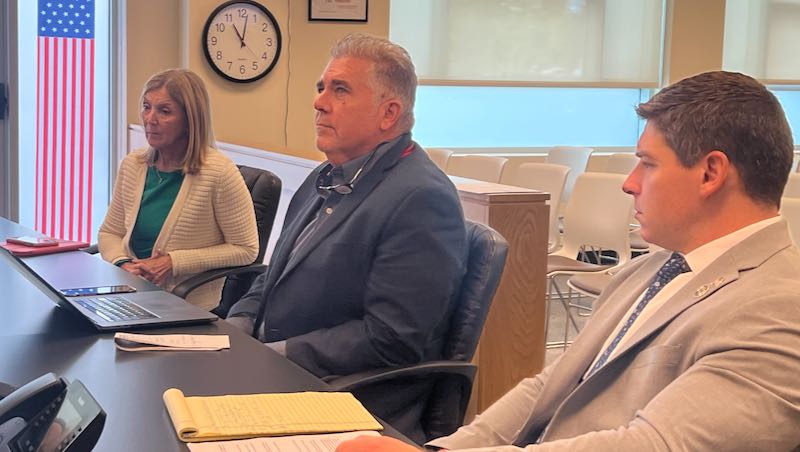
“The garage will have operations and maintenance costs that will need to be covered. The taxpayers are not going to be the ones that are going to pay for that, that will be paid for by the people that use the facility. And this is all part of making that happen,” Dawn Thomas, Riverhead’s planning, economic development and community development director told the Town Board during last week’s work session. “We want people to park once in the garage or in a neighboring lot and walk throughout downtown. We want that pedestrian activity. This is a part of how we get that to happen.”
The plan is to create a system that allows the town to manage where people park downtown for both short-term and long-term stays, using a pay system, said Kevin Wood of Parking and Mobility Consultants. The town hired Wood in April to develop a comprehensive downtown parking plan.
To inform Wood’s plan, the town will conduct a 30-day trial for paid parking in the town parking lot between Roanoke and Griffing avenues starting later this month to collect data on the use of the lot by businesses and visitors. It will also conduct “written and detailed” surveys of people using the lot and people on Main Street. The results of the survey and other elements of the trial will be in a “comprehensive report” delivered to the town, Wood said.
The date for the start of the 30-day trial will be determined this week and will be discussed at this week’s work session, Wood said in a phone interview yesterday.
At last week’s work session, Wood and Thomas proposed conducting a one-day trial on Oct. 13, the day of the Country Fair. Board members agreed with the proposal. But after the meeting, the trial period was extended from one day to 30 days, in order to allow Wood to collect more data over a longer period of time, he said Monday.
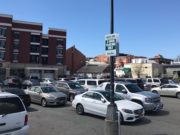
The parking lot between Roanoke and Griffing was selected because it’s “very manageable” to study and collect data on, Wood told the board last week. It is a “shopper’s dream lot” due to its proximity to restaurants and other businesses, Wood said. The town should be encouraging parking turnover in that lot, which has 127 spaces, he said. People who work downtown — who will be parking all day or longer — will be encouraged by the system to park further away, he said.
The town will use a digital parking management system for payment and enforcement called HONK, which is used in other business districts like the Village of Port Jefferson, officials said. Prices during the trial will be $1 per hour and $5 for one day, with a 35 cent “convenience to parker fee,” according to Wood. (An agreement with HONK for the trial period is being negotiated by the town attorney’s office, he said.)
Payment will be accessed through a scannable QR code posted on signs at the lot; the driver enters their license plate number, how long they intend to be parked and their payment; they receive a digital receipt with a reminder when the time is up, Wood said. The payment can also be made by text message, he said.
“We’ve been exploring a lot of different things to consider, working with the stakeholders — the [Business Improvement District], the [Chamber of Commerce], downtown businesses — Kevin’s been doing all that outreach,” Thomas said. “The parking district committee has met with Kevin multiple times. He’s brought a few guests in to speak to the committee about what’s happening in other places and how we can use those things here. And so… it’s time to test how this will work.”
Town officials said last week that enforcement would be waived for the trial; handicap parking would remain free. When fully implemented, the town will be able to control the parking system, Woods said; that includes making parking free some days, changing rates or implementing promotions.
“So we think everyone should pay, with the exception of — and this is open for discussion — the employees or the store owners directly in the back or in front of this parking lot,” Wood said. “And we would give a special code to anyone that we didn’t think should pay on that particular pilot date.”
Wood said the town could also consider a parking validation system that allows a restaurant, at its option, to credit customers for parking.
While there is no long-term plan for paid parking downtown, Town Board members acknowledged that paid parking is necessary for downtown’s future.
“I always feel the concern from the business owners [is]: ‘you’re chasing my customers away because I have to pay to park. Where don’t you pay to park?” Supervisor Tim Hubbard said. “I mean, are they chasing customers away in Patchogue or Farmingdale or Port Jeff? Those places are packed. Those parking lots, you’ve got to ride around to find a spot — and it’s all paid parking. So the fear that people aren’t going to come to your business because I got to pay now to go in, it’s just not realistic,” Hubbard said.
Currently, the upkeep of downtown Riverhead’s public parking lots is funded by a tax on businesses in the Riverhead Parking District. The tax is expected to generate roughly $201,600 next year, and the Town Board is expected to allocate an additional $77,000 to parking upkeep from the general fund, according to the supervisor’s 2025 budget proposal.
New development in the parking district is not required to provide off-street parking, which has increased demand for parking downtown as new commercial spaces and apartments were built over the last decade. Town officials considered implementing laws over the years to either require off-street parking or make developers pay a one-time “payment in lieu of parking” fee to fund parking district improvement projects; those proposals died after objections from developers and the town’s Parking District Advisory Committee, which is made up of downtown landowners and business people.
More development is planned in the downtown area, including hundreds more apartments — some of which are planned on sites that are currently public parking lots. Town officials see a multi-story 500-space parking garage on the First Street parking lot as the solution to the incoming increase in parking demand. The town has secured a combined $16.6 million in federal and county grants for the garage and is hoping to make up the rest of the cost in land transfers needed for downtown projects. Town officials said the boutique hotel and condominium building planned for the town square is also expected to purchase spaces in the parking garage for use.
Sean Kenna, president of downtown Riverhead’s Business Improvement District Management Association, said that he understands the need to generate revenue for the parking district. “I don’t think it’s a bad idea, just because of the parking issue that’s already happening,” he said.
Kenna, whose Italian restaurant and pizzeria Cucina 25 on West Main Street is adjacent to the Griffing-Roanoke parking lot, said paid parking “might deter people coming downtown,” because “the downtown area is not ready for it,” he said.
“Imagine someone coming to get a slice of pizza and that they have to pay for parking for an hour, but they’re just getting a slice and leaving; or picking up their order that they already ordered,” he said. The town should section off both long-term and short-term parking spots in the Griffing-Roanoke parking lot, Kenna said.
Connie Lassandro, president of the Riverhead Chamber of Commerce and a member of the Parking District Advisory Committee, said paid parking is “inevitable” and hasn’t negatively impacted other areas on Long Island. With careful planning and a phased plan that exempts local employees and residents, it has the opportunity to benefit the downtown area, she said.
Both Lassandro and Kenna said the downtown isn’t at a point where it needs paid parking, But, they said, it is on its way to becoming the vibrant downtown town officials envision — akin to areas like Patchogue and Port Jefferson, where paid parking is the norm.
“I think we will get there. Overnight? No. But I think we eventually will get there,” Lassandro said. “And we’ve certainly gotten an influx of dollars into Riverhead, which is really astronomical, what we’ve gotten in. And I think that’s going to be the deciding factor on how fast we can go and what we can do.”
The survival of local journalism depends on your support.
We are a small family-owned operation. You rely on us to stay informed, and we depend on you to make our work possible. Just a few dollars can help us continue to bring this important service to our community.
Support RiverheadLOCAL today.
