
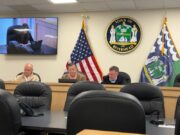


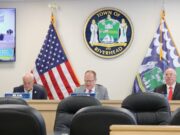






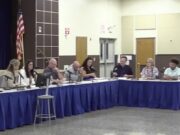


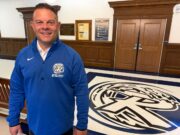

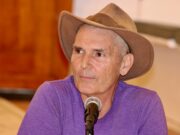
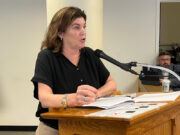


Riverhead Town Board candidates Jerry Halpin, Mark Woolley and Kevin Shea answered questions for about an hour Saturday morning during a candidates forum hosted by the Heart of Riverhead Civic Association.
The event was the second civic association candidates forum so far this election cycle. Like the previous forum hosted by the Greater Jamesport Civic Association on Sept. 30, the incumbent Town Board members, who are all seeking re-election, chose not to attend the event. The incumbents, all Republicans, said the forums hosted by the two civic groups in question would be biased against them because their leaders are members of the town Democratic committee and actively engaged in local political activities. MORE COVERAGE.
Topics included: town finances, overcrowded housing, the future of EPCAL, handicap parking downtown, security of riverfront for boaters, protection of open space, the Riverhead IDA and workforce development.
Questions were submitted to the civic association by its members and other residents and selected for the program by the forum’s moderator, retired Family Court Judge Greg Blass of Jamesport. The forum took place at Riverhead Free Library, beginning at 10:30 a.m.
Below is an audio recording of the hourlong question and answer session, followed by a transcript of the questions and answers given by each candidate. The transcript was made by an AI app. The answers have been edited to remove duplication of spoken words and filler words.
Question: There is an ever growing concern that Riverhead town is outspending its income as a member of the town board, what is your excuse me, approach to this concern?
Jerry Halpin:
That’s a really good question, and I believe that the budget just came out, and so with a 7.74 tax piercing again, we definitely have to figure out a way to not only slow that, but to reverse that, and to go in the opposite direction for our residents. The first thing that everyone says is we have to have new streams of revenue. For me, that means that we need to, we need to not miss an EPCAL once we get out of that lawsuit. The next thing that we do, and we propose an EPCAL has to be, has to be a home run. We need to work with our county, state and federal officials to bring something there that actually brings real paying jobs, that’s sustainable. We also must continually cut waste. The way that government works is taxation, fees and fines and new streams of revenue, and so one of the things that we’re going to have to do is continue to figure out ways to cut waste. That will mean that we’re going to have to make some hard decisions as a community. The government elected officials need to look and to listen, but we need to make those decisions of what we can actually live without. Every one of us does it in our own home. We’ve all done it since 2020, and we must continue. We also have to continue to pursue grants. Obviously, our town is really good at getting grants, and we need to do that, but work on them to develop and to sustain the development that we already have. There are so many things. And then we also need to do the big one, and that is we need to review the IDA process, which is hurting our individual taxpayers in the long run, the continual revitalization of that will be inevitably positive to all of us more
Mark Woolley:
First of all, good morning and once again, glad to be here talking to everybody. Thank you for coming out. The important thing is the budget, and we see what’s happened again. They promise to, because they will, pierce the cap for what will be the fourth year. And to me, it just shows just a total lack of knowledge. As far as budgeting. It’s, you know, the blame game with them. The current town board is, you know, it’s policing and it’s retirement and it’s health care and it’s the state and, you know, and then I look just down the road and I see that Brookhaven is able to manage it and so Southold. In other towns they go ahead and not pierce the cap. So, county budgeting, and also the school district. So to me, this is just a blame game. There’s also this. See, this is their idea of what they call forward thinking. This is how they bring the talent into the future by just continuing to tax us and increase the fees and increase the salaries and the like. I don’t trust their budgeting at all. I want a forensic audit of the budget before I even lay a hand on it. I don’t want my fingerprints on this budget at all. I want a full accounting, and I want with every single resolution, I want fiscal impact statement. Jerry’s correct about EPCAL. We need to end that lawsuit. We need to figure it out. Nobody’s going to be happy. Both sides won’t be happy, but we need to do what we’re supposed to do with that. It was meant to be the generator, the economic engine for us. And we need to conclude that [inaudible] issue,
Kevin Shea:
Hi, I’m Kevin. In answering to the question about the budget, the first thing I would want to do is similar to what Mark is, we need to decode it. When you see the the budget up on the internet, you will see it, but it apparently there’s a lot of things missing from it’s rather opaque. It’s very difficult to understand what direction the town is going in. So they have formulas where you allow you to decode it, to see what direction we’re going. Are we going towards some peak where a development, where it going to go up, or going down. We need to examine that. Second thing I would want to do is try to separate what we want and what we may need. There are a lot of essential services that we need to provide. Another thing I’d want to do is, since we’re going to be spending money, traditionally, we don’t tend to have in Riverhead any quarterly review of how our spending is going. Normally, I normally do that every month, saying we’re spending too much on the plants at home or something else that we’re doing. So I would say that we would spend our time making sure that every department has some sort of spending review so we know what direction we’re going within the year, so we can actually change direction. And next thing would be, I want to learn a way how we can share costs within our local districts. And also outside in the regional area, there are many things that we do that basically overlap others. And would be good we actually have an incidence where we get our gas, the school district is actually sharing the town of Riverhead’s gas station, something like that. That’s it. I’m done. Thank you
Question: There is a concern among many that single family homes with multiple families residing in them impact our schools and our town resources. Do you agree? And if so, what would you do to address these concerns? And this time, we will start with Mark.
Mark Woolley:
Single family homes. Some of these single family homes that we have have more families than one in them, and that’s one thing we need to do is bring code enforcement more into the picture as far as enforcement. We should have never had five individuals die in a fire a few years back, no matter, no matter what, whether they were here legally or not. That’s something that we should have been on top of, as far as homes go. You know, it’s … we’re looking at school districts now. We have issues going on across the river with what Southampton is proposing, as far as Riverside redevelopment. And the thing we need to do is actually plan for that, for that impact. We’ve actually sat down as a group in the past with our fire and ambulance and also with the superintendent at that time to talk about how to be prepared for something like that. I think most of what we need to do is preparation. So a lot of what I do is coalesce. My job is to go ahead and bring people together to try to figure out things. That’s how I intend to approach this job. And when it comes to either single family homes or any other issue, I’m looking to sit down, as we’re doing today, and be able to hear from you. It’s not going to be something where I’m going to have all the answers, but it is something I’m going to need assistance and the best way is from you folks.
Kevin Shea:
And Greg, that was merely a two part question. You see, what? What is your opinion on what the multiple families in the neighborhood and also, how they also impact the school district. Is that correct? So as a New York City firefighter, we deal with fire safety, so I’m going to deal with the multiple families. Obviously, we do have an housing issue, and we’d like to see that people who want to live here have a place to stay. So with the multiple families, I do know that I would love to see multiple options where multiple families can be in there. When I was in New York City, problems we had with multiple dwellings is not — they didn’t have proper fire protection and prevention. So you had basically many people in a room, and they were, the kitchens were placed in sort of rooms. And in fact, Riverhead actually did some recent code on that to prevent some of these things that happening. And hopefully they’re enforcing it. There’s other ideas out there. For example, manor homes that could be divided for four homes, or used buildings that could be done for that. So that’s one issue now, how it involves multiple people, for kids going to the school system. Technically, this is a school district issue, but I definitely feel that we have some influence and some indirect controls we can have to try to make sure that we can make the school districts work. One idea would be also that, you know, we’re not alone. We’re not the only school district around, and actually we have a lot of people in our school district. Southampton has less. East Hampton has less. And then maybe some way, if we talk together, how we can figure out how we can handle this situation with the school district. Thank
Jerry Halpin:
So Long Island —not being a native Long Islander. Long Island is —one thing I know, and that is a multi generational family units. So when I moved here, so many people lived in a mother daughter, but they did it legally, and I think that that is a continuation of what our governor is saying, where she’s creating legislation that will make accessory apartments, making the back of people’s property available to be built out. And Riverhead is a pro housing neighborhood. We are a pro housing, you know, town. And so while that is true, and while all of those things are, as Mark said, and Kevin as well said, safety has to come first. We need to make sure that we’re legislating, which is great, but anything put on paper is only as good as it’s, you know, enabled or embodied or acted out. And so therefore, one of my plans is to bolster our PD cooperation with our our code enforcement, which they already do. I don’t want to come across as they’re not doing their job, but to make sure they have the tools past five o’clock. Our code enforcement officers right now, what with an officer, speaking to the officers if they go into a home and they see an issue, whether it be a structure that’s been built or overcrowding, or anything that’s a code enforcement and it’s past that time, they have to then call and get that person to come out of bed where they’re at if they’re up island or whatever. And my plan would be to have them there available to come in, as other towns do immediately. So we’re now paying that over time, but also so that we have that capability to keep people safe and knowing those things.
Question: While waiting for legal judgment …should the board create a commission to explore how the whole community wants the land to be used, and to seek the best advice from experts in environment, economy, economics and cultural development?
Kevin Shea:
That’s a yes-no question. Yes. Basically everything you said was something that I would definitely support. I mean, we’re right now we’re put on pause. I don’t know if everyone knows this, but for EPCAL, they’re in the courts right now, what’s going on to a large portion of our area, and so now it’s on freeze, and then it may be on freeze for another couple of years. But that doesn’t mean that we need to pause and think of some think tanks, people that are inside, people inside the team, all stakeholders for the EPCAL center, because this is a large area for us to take an opportunity to not only generate revenue, but also push that rural character that we really want to have in our town, right? We have a lot of wildlife habitat over there. There’s so many ideas we can have in there that actually can make jobs that are cohesive, so that actually develop our community, make us more coiled together. That’s all. Thank you.
Jerry Halpin:
So I know that Riverhead has already enacted that they created a small group of people that they had to work inside the fence, as they call it. But then when those people didn’t come back with the answers that they want, a lot of them were sidelined, dismissed, or just ignored. And so if we’re going to ask people for their opinion, then we need to listen to those opinions. And so we need to bring more people to the table. We need to bring different groups at different times, also the my current opponent, one of the things that I see is the pattern book that we have downtown, the current pattern book that we have, once again, asked a lot of questions, but if you only ask certain questions, you’re only going to get certain answers. And then we’re building a five story building, which a lot of the people in our town have said they are specifically not for different reasons. So if we do ask questions about EPCAL, if we do take surveys, we need to make sure that there’s a range of them, and then we’re not pointing a question to get the answer that we want, that we’re actually listening to the people. But we are going to have to make tough decisions there. We’re going to have to make part of those decisions about what will actually be an economic generator for us. And then we need to again, to bring those to a higher level than just our town. We need to make sure that we’re with the federal government to get strong contracts that will bring intelligent jobs here for people, and also to bring keep our young people here and some of our incredible scientists we I meet so many people that are that are retiring out here, that are incredible scientists that can be good to work out there and those different areas.
Mark Woolley
I was here when the Navy handed it over and for the buck. And now it’s really one of those things where the buck really should be stopping with the town board, but it hasn’t. They created a quasi group already, and sent them on their way to look at what potential future uses of EPCAL. And of course, that went nowhere. There was just window dressing so that while the ongoing litigation, which again, was carried out under this administration and was just a trail that led up to this it’s just to make it look like they’re really interested in doing something in that county. This is supposed to be the economic engine, not just the Riverhead and not just the East End. It actually could be all of Suffolk County, and it was always there for us to go ahead and use it that way. Unfortunately, town boards, over time, just never got a feel for what they really wanted to do with that. We’ve had so many issues and so many plans and proposals that have come through there, and now we’re at a stalemate because of what’s happened on with the Germezians and the decisions made at the town board level here, where it has stopped. So look, EPCAL needs to be put into use. It has so many potentials for the emerging technologies that are out there to actually be used and to be able to create good paying jobs. We have a lot of young people here who are smart, who’ve been through college, and who have engineering degrees and IT degrees, and they are looking for a way to make a good, solid contribution to the local economy. We should be giving them that opportunity and not locking it up as we have done. Thank you
Question: We are hearing that Main Street’s revitalization will greatly reduce handicap parking. We have a significant number of senior citizen population that needs to use those parking spots on Main Street. Would this be a priority? And how would you resolve the problem of parking?
Jerry Halpin
Absolutely, it is a concern and an issue and the people that live here will say, we don’t have enough parking. I’ve heard it from town officials that says that’s a misconceived notion, and that we have too much parking, and so they’re they’re going to be narrowing Main Street, and they’re putting in one of the questions specifically to the handicap parking is we are putting in an adaptive park, and adaptive park is for those that are differently abled. And I as a taxpayer as well as you, have had the question and ask the question, why are we reducing handicap parking if we’re them therefore expecting to to make something available to that population? And so it’s a grave concern. It’s something that we will need to do. We also need to be smart about where that handicap parking is, or that accessible parking is, not in a parking garage. And if we have, if we have to be forced to that, which it looks like the direction that we’re we’re all going to be going, regardless of what we want today, that we need to make sure there are shuttle services, that those people that are differently abled and are able to get to the services, the things that are downtown that make our town amazing. So it’s going to be, it’s going to be a legislative move. It’s going to be something that we have to do with the town board. But it’s it’s going to take the town board working together, thinking beyond just a developer.
Mark Woolley:
Well, they’re looking to build a parking garage up on First Street, and I think a lot of what you’re going to be finding there is going to be utilized for the five story condos in the apartment buildings that are going to be going up across from the theater. And then, you know, as far as accessible for folks who need assistance from getting, not everybody walks. We all know that. So how do they go ahead from getting from point A to point B? I think that the town board as a way, the current one will just be install parking meters, and we’ll go ahead and we’ll tax them, get a fee that way, and find that low hanging fruit to go ahead and and may make their lives even more more difficult. You know, as far as I can see, that the parking that that they’ve got planned out here, whether it’s going to be on First Street, shuttle services, whether it’s going to be up on Second Street or whatever, it looks like, the kind of stuff that people in Riverhead, they’re not gonna be able to afford it to begin with. It may not be there for them to use, and they’re going to have to walk down to Main Street. Not everybody will, like I said, not everybody can walk. It’s not — It’s probably one of the most ill conceived plans that they’ve got. I don’t even think that they even figured out that, you know, there’s probably going to be some flooding going on because of the Peconic they haven’t even looked into that, which is a whole nother issue. So I think that this point is something that we, you know, unfortunately, they’re on both forward, but to me, it’s just backward thinking. Thank you.
Kevin Shea:
I don’t disagree with anything that these guys say, but I just want to add, I just want to lay out the foundation right now, like you said, it was mentioned before, the apartments are there and now the parking is sprawling over into what they call the parking districts. You know, the guys who run their businesses actually have to pay to run these parking lots that are right behind the buildings. And now, if the apartment buildings, if their parking sprawls into their area, they’re basically paying for them to be there, and they have less parking spaces for their own customers or for the residents that are coming in for some sort of quick shopping. Somebody mentioned to me one option, and I’m sure there’s many options that come right from the town of saying, Yeah, you know, the meter parking, meter parking didn’t work. But part of the reason it is because we didn’t have our own resident stickers to say, maybe we have a little bit of a privilege when we are to come there for that quick shop. You know, they want to be able to say that I can park, but they don’t have to be getting that big fee on it for parking spots, because it is always going to be limited, especially if you try to do development, you’re going to need parking spaces for it. So I think I answered that question how I feel. But again, it will be participation from other people. And then maybe it will be that if the apartments are going to be using it, maybe they’ll have to pay $2,000 or something – some sort of set fee to allow the residents to live in those– to use those parking spaces. Thank you
Question: With the riverfront underutilized by voters, what would you do to attract the boating community to the riverfront and downtown? Do you feel that (1) a recreation attendant, similar to the beaches, would be a positive addition to the riverfront. And (2), do you feel that a police substation would be a benefit to the revitalization?
Mark Woolley
Well, having an attendant on hand is always helpful. We see that beaches, you know, police are down there to make sure that everything is going well. And so I think a rec attendant down by the river would be fine. And a police substation, that’s something that has been discussed you know, in the past. It’s gone nowhere. It just seems to bounce around. It’s almost like what you see with the armory. It’s going to be a YMCA, but that’s usually during the election season. It would be something I would want to go ahead and again, like I said, I really don’t trust the budgeting anyway, so I would want to see what money is there. You know. Money comes in and out of the budget, and you just don’t know where it’s coming from, where it’s going. So that’s one thing I would definitely want to scope out with this before moving on that. Before you start doing anything down there, though, why don’t we dredge the Peconic? Why don’t we go ahead and have someone like myself contact Army Corps and say, you know what? Let’s get a study done and get that Peconic dredged. It is one of those waterways that you can barely get just your normal boat through there, where some of those recreational activities. And so I think that would be number one to get down there. And again, it’s really going to be something that needs to be done anyway, because there is going to be flooding with all of the development that’s going on down around the Peconic, no one’s really looked at that as they should be doing. Again it’s something that I invited Army Corps do a study on. They did come up with about four or five proposals, but that seems to have gone nowhere as well,
Kevin Shea:
The first thing I want to lay out again. We already have, we do have a have about 100 police officers in all of Riverhead, operating.
And this proposal of a police station is first new to me. But I do, also speaking as a person that had to deal with water safety and operations over the water. We do happen to have —this happens to be an area where there’s flood plains. It can go up to about 13 feet, as it did happen during that last storm, the storm of Sandy that happened. So people’s lives can be at risk. We still, to this day, don’t even have a life preserver on the sign for the safety of other people. So I would say… is prevention to make sure that we’re not going to have some sort of water disaster in that area. Second would be, is try to provide other support systems for people that have fallen in the water or stuff. One thing we have, we have 100 cops but we do not actually have a dedicated constable in the water, which would actually help out the people that are in the boat, that are in distress. So these are things that I’d be focusing on before putting some sort of police station in there. But I also do applaud the idea of actually working with the boating infrastructure to make sure that with the dredging. But that’s something we would discuss with the boating association and business, the business, with the Chamber, the business of chamber is that what it’s called? Thank you.
Jerry Halpin:
So to answer your question specifically, yes, and this is my wheelhouse, to attract people to something. This is where I thrive, and this is one of the things that I believe I bring differently than any candidate for supervisor that has been in Riverhead for a long time, to highlight and to accentuate something to show how amazing the area that we have. As far as an attendant, obviously, we need some personnel down there. We do need a life raft. We do need to dredge. I have spoken to our PD when I met with them for the PBA. And we do have a big constable. We have one full time. But we do have miles and miles and miles of shoreline, so no matter where they are, they’re not somewhere else. Other towns do have more than us. We do need to look at that, but we also as far as the substation, that would require us to then put another sector there, meaning that we would have to have four people to man it at all time. If we did not have those four people, we would have to pull them from somewhere else. And I’m not saying that’s not possible, but we need to speak to the people that have been doing this for 25, 30, years in our police department and our law enforcement and our administration, and not sit here and for me to say at least — Mark has a lot more experience in that area— for me to say that I can answer that eloquently or intelligently in depth, and so I’m going to listen to listen to those people, bring them to the table and make that happen. But yes, if we are going to, we’re not, Kevin Costner, this isn’t Field of Dreams where we build it, make a movie and walk away. We’re going to build something down there. We have to, that’s why I’ve been saying, we, those of you sitting here and everyone else, we have to change that narrative, and we have to make sure that we do the best thing for our downtown to succeed.
Question: We are all aware of heavy development pressures and the traffic human- wildlife conflicts, such as vehicle hits of all species, and loss of open space and vacant land. What would you look to do to protect open space, clean water, housing and quality of life for residents?
Kevin Shea:
We had a phrase in the 60s, and also today, it’s too good to lose. When I actually moved out here, I felt this is an awesome place. There was a lot of open space. When I would leave work in the city, it would be Manhattan, I’d drive out down here, and for some reason, I don’t know if it was my blood pressure or it just felt pleasant as I started getting closer and closer towards Riverhead. At the time, I had basically a vacant lot with tall, tall grass, but it really calmed me down. And I was only assuming that most people here that lived here had that same idea. It’s quiet and spacious, a lot of open space and services for them for recreation, and wildlife habitat, you know. So my, one of my things that I would love to see preserve that so there’s a lot of farms, a lot of this is – so I would want to do it, and we actually have entities out there that are there to help us out. We have something called the Community Protection Fund. We actually have three other agencies. In fact, recently, we just had some open space in Wading River that was preserved by three sources of funding, to get it done. So we have the means to do it, and we also have the will to do it. So I would like to, I can, if I had more time, I would describe actually to get the funds and how it works, but importantly, I would be able to support codifying a more robust program for the town development rights so farmers can keep on doing their farming and not worry about, worry about a lot of things, and also having more open space available for us to enjoy.
Jerry Halpin :
Well, quality of life is a tremendous thing, and every one of us that have lived on the east end for the past five years, have seen that quality of life change in the wrong direction, from overcrowding our streets to the exact things that you spoke of. Our development has to work, first and foremost for the residents. Once we put one shovel in the ground, development is a cat chasing its tail, we will have to develop something to continue to grow our tax base. To do that, that’s the way the world continually works. But it also has to work for the residents first, and has to fit into the Comprehensive Plan, which we need to codify. We need to do the hard work. We need to put the labor in. We continue. You’ll hear them say they’ve adopted the comprehensive plan. Yes, that is a great step and in the right direction, but we have to go ahead and finish the job, which is a plaguing thing in our government right now. We also need to make sure that our agriculture is protected. We need to work with them. But the question really dealt more with open space and open space in Riverhead, we have 6,000 acres that are not preserved right now, and we need to do things, whether it’s evaluating the TDRS. We need to make sure that, you know, upstate, the IDA upstate worked, and what they did was one, one entire business built a park and preserved their open space next to it. They built a park next to it that was their community benefit for getting their IDA benefits. So there’s a lot of things out there that we can do when we bring the right voices to the table, but codifying our comprehensive plan is imperative. It is difficult. It is challenging, and the citizens have to get on board to make sure that we’re able to protect 30, 20, years, or 10 years at least down the road, until another comprehensive plan comes.
Mark Woolley:
Riverhead town is under so much pressure right now. As far as open space is concerned, you could take Route 58 off the list, because there’s no more open space there. They’re basically paving over anything that used to be open space. Grew up in Riverhead. I’ve been here since 64 so I remember what that used to look like. So that’s gone. Look what’s going on in Calverton, and now you have a huge manufacturing proposal out there that’s going to wipe out you know, more open space. Farmers are feeling pressure from developments. They are not looking to do anything except to farm. They need to sit down with us and work out the TDR situation, which is broken, and try to put that back into play. But the best way to go ahead and make that happen is to actually listen to the farmers and let them tell us what needs to be done and then and then take action from there. Open space, water protection. You know, we’ve got PFAS in the water. I know that we’ve seen it out there, and particularly out of the Calverton property at the former Grumman side at EPCAL. You know, I’ve worked with Congress to go ahead and get funding for the folks who were drinking bottled water. You know, the water was brown, and it was because of what happened there at Grumman. So I know what it takes to go ahead and try to drive funding towards us. That’s something that needs to be done. I know we’ve got places down along Youngs Avenue and whatnot where in another industrial area where we’re going to be finding PFAS. You know, that’s another thing, you know, to focus attention to that. Our job here, really, is to sit with people and hear from them and then take action. Long time has just gone by where we’ve allowed everything to pile up, and now we’ve got to go ahead and see how we can weed through it and manage this. I’m looking forward to doing that town level.
Question: Of the issues facing the town at the present time and in the next couple of years, how do your views differ from those of the incumbents?
Jerry Halpin :
That is an excellent question, and there is a great divide there. One of the things that I want to make sure that I’m doing as the supervisor is bringing voices back to the table. I plan to move to allow people to bring their expression of freedom of speech back into the board meetings by allowing signs. I plan on moving to extend the time back. I want to hear from residents. I’ve had people tell me constantly that the current supervisor told them that there would be an open door policy and that there is not an open door policy, that it is more closed door. It has been something that other people on the town board fought for, and the current supervisor has closed down. So my difference would be, I would say something like, no more circus atmosphere at board meetings. Every resident has the right to ask questions, to express their opinions, even when those questions are pointed and opinions are critical. That’s how democracy works. The crazy thing is, those are our current supervisor’s words when he took office last year, he also said history is full of leaders and examples that refuse to accept this. It never worked out well for them. Eventually, it even works to the detriment of the elected official. We need to make sure that we’re listening. That is the culture that I want to change. I want to make sure people that come to work— I know it’s not the end all. We need to pay our employees well at Town Hall, but we also need to make them know that they’re able to speak their mind, they’re able to have a voice, and that the community is as well. We all live on the same soil. As a community, we need to not allow the national narrative, the local narrative, or anyone to divide us. Doesn’t matter, race, social economic status. We need to do this.
Mark Woolley:
Okay, can’t have signs in town, in the town boardroom. That’ll be the first thing I’ll do. No signs. None at all. You won’t have a sign up here that says your nameplate. Okay, that’s gone. That’s for everybody. This way everybody works fairly that way. And then you just have to guess who people are behind what we used to be this. I’m a Virgo, by the way, if anybody really wants to know. The other thing is, these are the forward thinking folks. Okay, again, I’m bringing it up. You know, four years in a row we pierced that tax cap. Let’s just give ourselves some raises. Now, we’re not doing merit raises, but guess what? Guys, you already did it last year. You already took care of people quietly behind the scenes, and you’ve given their merit raises pretty much for life like there the pope. That’s not how you do that’s not how you work. I’ve said it all along, and I said it in Jamesport. Yes, I will be that no vote, okay? But it’s a no vote because I’m someone who does know —this is the K, N, O, W. Know is part of knowledge, the word knowledge, I do have that knowledge, having worked for the government at the state and federal level, as long as I have. They talk about forward thinking. Forward thinking doesn’t mean that you go ahead and you’re a rubber stamp on everything that comes before you. Forward thinking means you actually take every single project that comes before you and you say, I’ll review it. Thank you for coming in, and we’ll get back to you. You don’t go ahead and rubber stamp everything. You also make people follow the rules. If everybody here has to follow the rules, has to follow SEQRA, has to follow environmental policies, has to follow regulations. That applies to everyone across the board, especially these folks who are coming in from the west who believe that they’re going to go ahead and overdevelop in Riverhead. This is my hometown. For what’s left of it, my job as someone who does know, is actually to say no to these folks.
Kevin Shea:
Well, it’s kind of difficult, like, I’m not. I’ve never been a politician, I’ve been a blue collar worker, so I wouldn’t necessarily be able to compare. I haven’t been in a position of this type of authority before, but that might be a good thing, because I didn’t really learn all those bad habits that they have. Not listening, is one of them. And then the new decorum policy. Their procedure was, how can I try to keep this — the people from causing, I think it was riling things up and inciting. So they went to a bunch of other boards and said, What was your policy? And then theirs was making it more restrictive. So they probably went to the wrong ones that I would want to go to, because I was on the other end. I was the person trying to ask questions and being restricted for what you can say and what you can do, not even being able to bring a bar chart and show it to people, that was restricted. So I would say that I would differ in that I would want to inform the public in any part of the decision making process. If I would want to amend the decorum to allow for more stuff. Now I also would want to prevent any meetings that deal with new development to be done until after 5pm so people can attend it. 2:30 is just not acceptable. And then finally, I want to make sure we can air this on Channel 22 on any developments as they’re going through the process. Not just that, some signal, some big things, and we’re going to get it in the resolution’s today. I want to do it during the process.
Question: There has been much back and forth about the industrial development agency and its future as a town agency. How would you make the IDA more accountable and more and more effective?
Mark Woolley:
I still don’t know what this huge monstrosity over there next to the library is that was given IDA benefits has been run through the process initially with a guy who was basically a involved in a Ponzi scheme up in Huntington. So that tells me, first of all, that you know, you should be vetting a little bit better the folks that you deal with. You know, everything is about IDA exemptions, IDA breaks. You’ll be seeing Joe Petrocelli getting one for the five story condos and apartments that are coming up. Remember, this is the guy with the golden hand. I’m not sure he’s a developer or a proctologist, but that’s for someone else to figure out. My job is to go ahead and look at this overall and say to developers, you know, not coming in here, it’s not going to be rubber stamped Ida. First of all, we have our own IDA. Restructure it, top down, bottom up. Time to go ahead and make the changes so that everybody is getting what I consider to be a fair shake and not just a shakedown.
Kevin Shea:
Just want to lay it out. I’ve had this earlier in my days, when I was learning about IDA stands for industrial development agency. They come in, and I may be connoting it, but they kind of like lay out a little red carpet when a new developer is coming in, giving them some incentives to say, why don’t you choose Riverhead? And when Riverhead has its own industrial development agency, they are the ones that, when given some sort of grants, they actually provide other benefits to them. So the what’s the problem? The problem is a lot of those benefits that go to them, none of them necessarily come to us. That comes with abatements, that comes with some removing some of the taxes they would need to pay. So the question would be, how do we feel about it? What can we do about it? Well, technically, as town board members, we have influence, and we have indirect control. They the IDA makes up their own, their policies, but we also appoint them to that. So before they get through the gate of being in that pen, the IDA to make those decisions of throwing at the red carpet to these developers, we get to say, Hey, you’re going to be in that job. These are, this is our checklist of things that we find important. If we’re going to point you, we need to know that you’re going to be following the vision of the residents. We’ve talked with them. This is what they want. So before you start setting up the red carpet for these people make sure that the benefits are going to be coming to us and not just to them.
Jerry Halpin:
So the IDA was created to, much like the Empire zone in Riverhead, was created to help initiate businesses in a blind area. We on Long Island, have the one greatest resource that the entire world continues to argue over and fight over, and that’s land and possibility. We need to protect that, but our IDA is something that can be an initiative for that. If you look around in the remainder of the state, like I said, the businesses that are part of those IDA abatements, they give back to the community in a different way. Our businesses that have received the IDA benefits, I believe would want to do that if they’re led and told to need to do that, as Mark said, from the top down to the bottom, it needs to be reviewed. It needs to be examined, because it is hurting our individual homeowners and taxpayers in that way, and that’s no longer an option. We need to do better by those people. We need to do better for one another, but we also need to make sure that we don’t lose control of that, that someone else is controlling it. And with that said, one of the things that we need to do with our IDA is to protect our senior citizens, protect our young people for 3o, 40 years down the road, without the continuation of long term, extended IDA benefits, without really examining and seeing proof that that business would no longer exist, and then making a decision whether or not that business is too big to fail, which I don’t know how free enterprise or capitalism creates that opportunity. We need to allow people to fail and someone else to come in and take over if that’s a possibility. But our IDA is taking away from our fire and our schools, and that is the biggest area that I struggle with. People will say, and I know I’m going to go over and I’m going to be in trouble, but I’ve heard someone say that is receiving an IDA benefits, well, it’s better than the tax you’re receiving, because you’re receiving no tax. And what I continually say to that is, that is what the person with a full table of food says to the person who has no food, if I throw you a scrap, it’s better than nothing, and that is, that is absolutely a terrible way to live within our community.
QUESTION: Riverhead’s development has yet to create good-paying, permanent jobs for the new labor force emerging from high school graduates and from college student graduates. Is workforce development a local government responsibility, and how would you begin to ensure that future plans include workforce development?
Kevin Shea:
I have to say, I’ve never been proposed a question in that way, and I’m going to work with this. I got the idea that we have a youth workforce. This is basically, in most cases, I think you’re particularly interested in the workforce that are coming in from other schools or within our town, like our children. So does a town feel responsible for it? I would hope so. We would love to see that our city, our town, is affordable, right? And that will be affordable to almost anyone, including your workforce. I would definitely support making sure that when we start a business, that when we’re going through the planning process that we seek, that the developer or the business person is hoping to create living wages, not just wages that you can live on and not be able to afford an apartment from apartments they call affordable. I don’t find them affordable at all. At three or four thousand. It’s not even 1/3 of the salary that people are making. So I do feel responsible for it. If I’m there making decisions when I’m bringing in a business coming in, what would I do about it is simply First, I would first talk with the business that’s looking to get in here. Because when they come in, when I start a business, they go through the planning department, even go through the zoning department. So that’s where we actually have, may have some leverage to say, hey, we would love to see this happen and actually meet some of the people’s needs over here, but we need to know that these jobs you’re providing are definitely going to be in the agreement, this sort of common benefit agreement, to make sure you’re definitely going to have that jobs, not say you’re going to have 10 and only have two full time jobs, and that they’re going to get the benefits that they need so they can actually live in the town and be able to pay for the rent in their apartments.
Jerry Halpin:
So if it helps fuel our local economy, lessen the tax burden on the individual homeowners and on the residents and not adversely affect our quality of life, we have to explore. We have to go after it, and we have to make it happen as a community. Riverhead is one of the fastest growing towns and communities on Long Island. We are pro housing. We are movers. We are shakers. We have the last great resource of land that everyone from the west and all over the world is looking at. We need to protect those things, but our workforce, students and humans, are incredible. We are the place where everyone comes to work, from Tanger to 58, all over. We have great opportunities for that, but we have to make sure that our — that we’re doing that, and we’re also building into internships and working for people that those people can move from workforce jobs into jobs that would help them to buy a home, to not stay in that continuous cycle. And so we need to work with our school district, with that, see what the town can do to partner in those ways. And to also to help our businesses, we need to create the narrative. One of the things that we do constantly is as residents, we continue to trash businesses that have done things in the past wrong. Once they’re C.O’d, once they’re good to go, we need to mentally change our tone towards them, the best that we can now. If they mess up in the future, we have to, we have to hold to our boundaries. But if they are CEO, we need them to be as successful as possible, because that will create more jobs for them, but also create more taxes that they pay to the state, which will come back to us and lessen our tax burden. So yes, 100% that is an area of focus that we as a town need to help with the narrative.
Mark Woolley:
Okay, I’m not going to repeat what Jerry just said, because I totally am on board with what he just said regarding this issue. But the other, the other component, you know, is housing. And we talked about housing, you know, they call affordable workforce or whatever. You know, I happen to live Glenwood, where it’s a senior community, 55-plus. You know, why not have more manufactured housing here in the Town of Riverhead? Or maybe it’s for young people who are looking to be first time home buyers in the 30 to 50 range? Why not actually look at other types of — and I started thinking about this —creative housing, such as the 3-D printed housing. We started to see that out there. It’s concrete, it’s less costly, the rates, as far as insurance, are less you know, we need to be open minded. We need to start exploring other options. I think that’s a way to look at it. You know, I’ve got five children between my wife and myself, and four are not here. We have three in Florida, and I have one out west, and we’ve only got one here. It’d be great to have the children around and actually work here, but they weren’t able to go ahead and find the types of jobs, and they weren’t able to go ahead and afford the housing that is here. It’s our job. Yes, it is, as part of, you know, government and to not only work with the young, but you also want to make sure that the seniors are still able to maintain their homes and not be costed out of it as well.
The survival of local journalism depends on your support.
We are a small family-owned operation. You rely on us to stay informed, and we depend on you to make our work possible. Just a few dollars can help us continue to bring this important service to our community.
Support RiverheadLOCAL today.
