




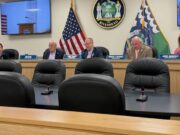
















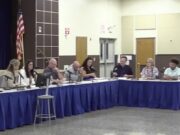






Riverhead Supervisor Tim Hubbard and challenger Jerry Halpin sat side by side Thursday night to answer questions from the community at the candidates forum hosted by the Greater Calverton and Wading River civic associations.
About 100 people attended the event at Riley Avenue Elementary School in Calverton. It was the first and only time the two candidates would be in the same room for such a forum this election year.
The session for the supervisor candidates immediately followed a session in which the four candidates for council seats answered questions.
See separate story: Riverhead Council candidates discuss the issues: highlights and audio from civic forum (Oct. 17)
After brief opening statements by the candidates, limited to three minutes apiece, Greater Calverton Civic Association President Toqui Terchun posed nine questions to the candidates. Each man was allowed three minutes to answer each question. A coin toss determined which candidate answered first. The candidates then alternated the order for each question.
Below are the candidates’ opening statements, followed by the full Q&A. Questions and responders’ names are in bold type.
You can also listen to the full audio recording here.
Opening statements
Halpin: So good evening, and thank you for being here. My given name is Jerome Halpin, but everyone has called me Jerry, except for my mother, since the day I was born. I was raised in Kentucky. I’ve been here for 25 years. The first time I came to Long Island was actually on my honeymoon with my wife, who’s from Ronkonkoma and I fell in love with Riverhead in the east end… Being from different parts of the country, it just felt right. We moved our family here, and we raised our two girls here. I think Riverhead is an amazing town, and I believe the proof of that is my children and our quality of life that we’ve had throughout.
My wife and I have been married for over 30 years. I grew up with a grandfather who was a farmer and a steel mill worker. My father was a United States military man, and then he was after he retired from there, became a full-time fire chief. My mother worked, sometimes two or three jobs between cleaning houses and working to make sure that we had so I like to work, enjoy working and working as part of my DNA.
My educational background is communication and faith. I did study religion and Christianity and Christian education, and so I came out with that dual degree, and I’ve been a pastor for the past 30 years. What it has taught me over the past 30 years is the dignity of people and listening to people. And so over the past 30 years, I’ve led churches, organizations, nonprofits and sustained programs for our families, both locally and globally. I know how to connect people from all different parts of life, and it helps me to bring people to the table that sometimes don’t agree. Being able to sit there through discussion and controversy and to come to a resolution that’s good for everybody.
I promise you that I will absolutely work every day for every resident to create a stable budget that is not dependent on the over taxation of you, the residents. I will create new opportunities for communication and community dialogue that are truthful and solution-driven. I will move to rescind the raises that the current supervisor gave to himself and the other board members every time that I have the opportunity. I will also move to bring back the voice of speaking longer and being able to represent those that can’t speak but are able to bring a sign into our our board meetings like everywhere else, except for two places in the state of New York. I will also work hand in hand with our fire, school district, our volunteer ambulance corps and our community development to make sure that we are not only developing but sustaining an infrastructure that works for every resident. And I will work with the current businesses who are CO’d to make sure that they are successful beyond their wildest dreams, because, as they say, more tax money that goes up to the state comes back to us. And I know I can do this because for 30 years, I’ve not only been a winner, but I’ve helped organizations to find fiscal stability, to erode absolutely any kind of problems that they’ve had, to make sure it gets to the state level, even the AG and I hope to earn your vote on Tuesday, November 4.
Hubbard: Good evening, everybody. It’s good to see so many familiar faces here. Toqui, I want to thank you and the Greater Calvin Civic Association and Sid Bail also for the Wading River Civic Association for hosting this tonight. We appreciate it.
My name is Tim Hubbard. I’m your current supervisor. I’ve been a supervisor for the past two years. Prior to that, I was your town councilman for eight years. Prior to that, I was a police officer here in the Town of Riverhead for 32 years. I’ve been on the school board. I’ve been on the Eastern BOCES advisory board. I ran the Police Athletic League here in town for 20-some odd years. I’m a fifth generation person from the town of Riverhead. I know this town like the back of my hand. I love this town almost as much as I love my wife and daughters and grandchildren. I really care for this town. I care for my job, and I do it because I want to do it, not because I have to do it. I want to make Riverhead the best place that it can be. We have so much opportunity here.
We’ve done so many things since I’ve been in office in the past 10 years to move Riverhead into the 21st Century. People don’t like change, and I understand that. It’s not 1965 when I sat at the Woolworth soda fountain at the counter with my dad having a cheeseburger and a milkshake. Times have changed. Riverhead has to change with that.
We need more tax base. I hear a lot of talk about the budget that I put up and, oh, my God, you pierced the cap? Well, let me tell you, the cap is antiquated. The cap was put into place in 2012. It no longer suits the needs of an economy in 2025. It just does not. And I hear people saying, well, you know, you’re using excuses for raising the taxes. These aren’t excuses. These are facts. It’s absolute fact. Do yourself a favor and look at the budget. It’s online. It’ll show you everything right there. I heard tonight we need a forensic audit. Our budget is audited every single year, every single year. We just got back this week, the auditing from 2024.
So I really think people need to understand things better before they try to throw their hat in a ring and run for for an office or run for a job. Do your homework. That homework was not done when I heard a couple people talking up here in the first round. Be smart, educate yourself, and you. The truth is refreshing. I say this all the time. The truth is refreshing. If you just want to say something up here because you’re trying to get elected, you’re doing a great disservice to the people of the Town of Riverhead.
I am an honest person. I’ve always been an honest person. I run on my integrity and I run on my past performances. Thank you very much.

In your view, why has the town needed to override the tax cap multiple years? What concrete spending cuts or revenue alternatives will you pursue and how will you provide tax relief or better value for tax dollars?
Hubbard: Actually, both of those things are needed, and both of those things have been put into this budget this year. And when I say that the pension system, healthcare insurance, salaries and contracts, those items alone pierce the tax cap without me ordering one more pencil for the Town of Riverhead. Those items. Do yourself a favor. Look at the budget. Educate yourself. The cost of living has gone up miserably. COVID drove us through the roof. Everything is now more expensive. You all know that. You all go to the grocery store, you all shop. You all go out to eat. You know how expensive everything is? Well, the town doesn’t all of a sudden get a big discount, because they’re the town. We still have to operate. We still have to operate a town for 36,000 people, and in doing so, I cut out about $600,000 worth of equipment out of this budget just so we could try to keep it as low as we possibly could.
Do yourself a favor. Look at the budget. Look at the figures. It’s all there. It’s all there in front of you. The costs have gone through the roof. We can’t control health care costs. We can’t control the retirement system. These things are automatically done, and they’ve gone up, just as everything else has.
In terms of the budget, we used an average price of $735,000 for a house in Riverhead. That’s an average house price. For that house, your taxes are going up $22 a month with this budget, with the big increase. Now, I know there are people in this town living and making decisions between medication and food, and I understand that, but I also understand that a lot of those people are not living in $735,000 houses, and their tax rate is going to go up a lot less than $22 a month. So for the package you’re getting with a police department, up to 100 sworn officers in a safe town, for $22 a month, you’re getting a good bargain.
Halpin: I absolutely believe that we can do better for our taxes and our budget. The last two piercings of the tax cap is one of the major reasons that I decided to run…Last time we heard about the budget, it was because we needed to have all of those things that have been kicked down the road, that they’ve been kicking the can down the road, kicking the can down the road, is what we were told. And now what we’re told is, because we’ve done all of those things now, we have to continue to sustain those things.
And so my problem with this is, is that for the past 10 years that you’ve been sitting on the board, we’ve not done enough to generate the income that would lower the impact on the taxpayer to our homes. And so we’ve been sitting there and during COVID, yes, everyone saw the writing on the wall.
Everything has gone through the roof. And yet, during that time period, our town board and our town leadership fought amongst themselves, within the entire Riverhead Republican Party, even saying, you know, that one of the reasons that I’m running now is for consistency. We removed that leadership because we didn’t think that leadership was good. We’re always having these constant problems. And the entire time, we’ve been left out to dry.
The idea that raising or getting rid of the tax cap, which you recommended to Newsday and tonight again, is just a way for people not to complain. The reason the tax cap is there is to protect us. Understand, it is to protect you. It’s to protect me, just to protect you when you retire. And so one of the things that we need to do is we need to have somebody in office that is that is making sure that those are protections that are done.
Last year we gave out raises to our legal department, which happens to be a relation, that got a dollar-amount raise, which was a merit raise, plus a CSEA raise, which is a percentage rate. Meanwhile, our labor workers are coming in and they work, and after just six years, they’re not making a sustainable salary to buy a house or to live here. So those things need to change across the board, in my opinion.

So on a related tax question, the town hall operating cost and budget is the next topic. The New Town Hall reportedly has utility costs of nearly $1 million per year if you are elected, what measures will you implement to audit and control operating costs?
Halpin: So with operating costs I would do is, we would look at and see what areas of the building that we could make difference. I see that they’re trying their best, but they, let’s face it, we over-purchased that building. That was more than what we needed at the time. We did it because we were trying to make sure that we could move our justice court and our police department to a safer place, which we all agree upon. So instead of looking for them to have a safe place, we move the town workers, which, again, is great and centrally located. There are a lot of positives of it, but we’ overbought in that area. And so what we need to do now is we need to make sure that our justice department and our police department are safe. But what are we doing? We’re borrowing more money. We’re borrowing another six and a half million dollars to do that project. So we’re continuing to dig ourselves into a deeper hole and a deeper hole.
The way to combat that is we’re going to have to generate new streams of income. It’s just absolutely what we’re going to have to do.
But oftentimes, I see the contracts that we have, and we need to have better contracts. The open-ended 7% contract that we have downtown right now with our master developer, God bless him he got the contract. But there is no time on it, nor no capital financially for that. And so we need to make sure that those things are there.
We also need to make sure that we’re having all of the fiscal impact statements filled out so that we can see those when they come to a resolution. We need to be good stewards of a dollar. A dollar is a dollar.
What Tim will say is, is that I don’t have experience managing a budget this large. And I can tell you one thing I don’t have Suffolk County recorded judgments against me, and I do have an absolute track record of being a good steward of every dollar that my company and the organizations that I’ve worked with had. In fact, I’ve helped an organization upstate weed out that kind of fiscal management and make it right.
Hubbard: Well, Jerry, since you brought it up, I wasn’t going to bring it up. But actually it’s very factual. And it’s one thing to want to be a supervisor, and it’s another thing to be able to be a supervisor. And if you walk in cold off the street, that has not fared well for anybody who has sat in that chair for the Town of Riverhead. The best way to do is to learn, educate yourself on the budget, because you didn’t read the budget. I can tell that already.
Also when you say we overpaid and we overbought on Town Hall, we had a choice of trying to get justice court into its own facility. The price tag came in to build a new Justice Court was at $31 million. So spend 31, get justice court. You still have an inadequate town hall for all the town hall offices, and we have offices spread all over the town. Or spend $20 million and get a building where you can put everything under one roof, and another $6 million to revamp the old town hall into a Justice Court complex. To me, it makes all the sense in the world, and that’s smart money and smart business, where I come from. The entire thought of putting $31 million into one building, it was incredibly wrong. So we made the right choice, and we now have, like I said, one-stop shopping for all of our residents. They come into town hall, they can take care of all their business in town hall, and it’s not too big, because we’ve got every spot filled currently as it is.

Do you genuinely believe Riverhead IDA benefits do not impact town finances negatively? Will you commit to revamping RIDA’s oversight to require more strict performance metrics, stronger bonds or guarantees, and better implemented default penalties before any developer receives tax breaks?
Hubbard: First of all, you have to understand that the Riverhead IDA is its own entity. The town board has absolutely no control over how they vote, what they do. They’re their own committee, and by law, we can’t tell them what to do. People need to understand that.
Secondly, in the Town of Riverhead, there’s 16,500 parcels of land. Out of those 16,500 parcels of land, 21 receive IDA benefits. Prior to 2023 there were 39 jobs given through IDA benefits. Now in 2025, we’ve increased 1,362 jobs to residents and people from the community through the IDA programs that had been developed and built. We went from $720,000 on those 21 properties, $720,000 total they were paying in taxes. In 2023 it tripled. We’re now at $2.2 million. And people say, well, I don’t get a tax break on my home. The IDA wasn’t designed to work for residential. The IDA was designed to bring in business and create jobs, and that’s what it does. If you give somebody a tax break, I will agree you must show you need that tax break. Everybody that comes in asks for a tax break or a sales tax break or a mortgage reduction rate. They don’t all get it, by any means. And that’s something the IDA, I think, has done a pretty good job with, and the money — you can’t lose it if you never had it. So when you say, well, the school district lost this money. They didn’t lose the money. They didn’t have the money. They never got that money. They were getting a lot less money. They’re getting more money now simply because of the IDA benefit.
Halpin: So with the IDA we need to review it. Everyone I’ve met with across the board, the unions, the Suffolk County unions, people all the way at the state level, they know that this is not working well. Unlike the tax cap that you mentioned, that you think is antiquated and out of whack, everyone agrees on this, and so it has to be reviewed.
We’re putting a lot of pressure on that board, which we don’t have any say once they’re on the board, but we do have a say in recommendations of who goes on that board as town leadership. So those aren’t complete truths in that way.
Plus, we need to push the state— our legislation that’s actually represented here tonight — to help them to succeed. You talked about why the IDA was created. The idea was created for blighted areas throughout communities, to bring new businesses, new style of businesses, and then fuse that type of growth into the community.
We have one of the most precious resources in the entire world on the east end of Long Island, and it’s called land. While we have those parcels of land, we need to begin to protect those. We need to work with the IDA to make sure that it’s going in those blighted areas and only those blighted areas, and then we’re not giving those continual renewals that are hurting our schools. And they are, because what’s happened is, over 25 years, it has become lopsided, absolutely that, because they didn’t have it, and it doesn’t grow at the same rate, and it grows at a slower rate. They’ve not had that, so they’ve fallen behind, just like if you missed the part of your rent payment, you would continually fall behind.
And lastly, when they say you have more because you have something rather than nothing, that argument will never fly with me, and it shouldn’t fly with you as a homeowner. That’s like someone who looks at you if you have nothing to eat and you’re starving and you’re hungry and they have a full plate of food or a full table, and they throw you a scrap and they say you should just be grateful I’m giving you something. That is no way for our community to be treated by the businesses that I believe actually love our community.

Riverhead now has a reputation where developers break the rules and build without permits, inspections till caught, even with some fines increased, they have become just a cost of doing business. What will you do to change this perception? Please explain in detail.
Halpin: So I said from the beginning of when I started that, from here on out, it’s going to be harder to ask for forgiveness than it is permission in the Town of Riverhead. I can’t change what’s happened in the past. I can’t go back and fix fees that were given out or reduced in those time periods. And so going forward, the businesses that are CO’d, we’re going to make them successful.
But from this point forward, from January 1, 2026 forward, we need to be working on codifying the comp plan. The comp plan is there, and it’s possible, but codifying it makes it a legal document. It gives all of our directors, it gives our code enforcement, our police, our planning, our building, our town board, all of those entities, the absolute opportunity to make sure that those things are followed and that we’re doing development in the right so we’re not doing an overlay in an area where we’re doing a special favor, or you, the resident, don’t feel like we’re doing that, because it’s explained very, very well to you. And so this comprehensive plan that we have is great, but right now, because it’s not codified, which is an extremely difficult and hard thing to do if you don’t begin it. So we just need to be, you can’t finish something if you don’t start it.
We also need to make sure that we’re being very clear with developers, and then we’re being very clear with people who have businesses, because what we do is we run people through the mud. If they’re larger and the fees are larger, it makes the headlines. But whether it’s a small business or a large business, they all need to be held to the same accountable scale, and what we need to do with that is first hold ourselves to scale. We built an ice rink. It’s there. After the ice rink was built, we realized there’s no fire hydrant. What was said was, we’ve always wanted a fire hydrant there. Well, if another business did that, we would be coming down on it. We need to make sure that as a town, we’re doing things right, because part of servant leadership is showing the way by the example that you lead. And so we need to do that across all avenues, and we need to call our people to the people that we have working in town hall are amazing, and they will do that because they want to.
Hubbard: Okay, it’s what we’ve already done. This has gone on too far, too long in the Town of Riverhead, where builders came in, did with what they wanted to do, and they would pay a small fine and continue on.
We have increased the fines to where the fines now hurt the businessman. The fines were strongly or greatly increased to stop this from happening. The money that we bring in from these fines is now income coming into the town. It needed to be revamped. It had been years since those fines were increased and they were brought up to modern times.
We’ve increased the code enforcement officers who also have gone out and instituted these code violations. We have more code enforcement officers now than we ever have, albeit we did just lose one to Southampton for a higher paying salary. We are in the process of deciding whether we’re going to hire hiring another full time one back or two part timers. And again, we cover the evening hours. We have people on standby and on call for things that happen in the middle of the night. If the police go into a situation and they need code enforcement, they have somebody available 24/7, every day of the week.

The Brookhaven landfill, where we pay to drop the ashes of all of our garbage once Covanta burns it, is closing approximately two years from now. What do you think the future of waste management is in the town of Riverhead? What does it look like with detail please?
Hubbard: I can tell you that when I go to the supervisor meetings of Suffolk County, it’s a it’s a great cause for concern for every supervisor that has a town that uses the Brookhaven landfill, the landfill is slated to close at the end of 2027. There are several options that they’re looking at to decide what to do with our trash, but I assure you none of them are going to be cheap. The trash is probably going to be trained off the island. The use of rail seems to make the most sense, and it will keep the least amount of trucks off of the road. But I’m telling you, it’s not going to be pretty when it happens, because it’s going to be trucked off the island, and that is an expense that everybody is going to have to pick up. It’s most unfortunate, but that’s reality.
Halpin: So absolutely, we’re gonna — Tim is correct. This is an issue that everyone is looking at all across Long Island. It is something that we hope that they do a really good job with their remediation of their landfill, because our environment is our economy, and so we do agree with that.
So as a town, we not only want to make sure that we’re doing the best for our residents price wise, we also want to follow up on that with our state and, you know, our legislation that goes to the state for us, at the state capitol to make sure that that what we’re sending off is going somewhere, being processed properly, so it doesn’t hurt the environment of someone else. Our trash can’t be someone else’s problem. And so as a responsible community, we want someone doing that to us. That just happened on Young’s Avenue, where someone was coming out and they were dumping their garbage in our area, and that became a big problem. And because we weren’t focusing on as a town leadership, it became a huge problem, and then it was remediated after that. So we need to make sure that we’re not making our problem someone else’s problem, but it is correct. It’s going to cost us. We need to be effective with it. I know our state leaders are aware of it, and it’s something that we will do together.

In light of recent storms that have flooded downtown and other areas of town, in preparation for the next category 3, 4 or 5 hurricane, regarding our town building codes, land use and zoning, would you consider creating a climate action plan for Riverhead to address not just mitigation, but also adaptation and smart building, landscaping to reduce our risk exposure?
Halpin: We’re doing this as a town, currently. We have remediation. The plan for downtown has remediation for it. I do not completely agree with everything, but every one of us in this room, if we sat across from each other, we wouldn’t agree with that. But it is something that the state is mandating, something that we are doing on our own. We are a building community. We are a developing community. We are a pro-housing community. So yes, we are going to be looking at those things, creating an action plan to make sure that developers, because if the water could land and stay where it is, we know that’s what’s best for the environment. And not only is our environment our economy, but our environment is our home. And we all moved out here or you stayed here, we live here because we love the beauty. When we make water run to a different place, we create avenues. We have some people in our town that are doing one of the most amazing things at the Meeting House Creek. They are working on technology. They are working on a program. They’re working on a plan that, if they are successful, could not just change the east end of Long Island, but it could actually change things in America. This is great. We have some of the smartest minds here.
So absolutely, we need to make sure that building codes, that things are matching the way that our weather is going. We have all of these effects. I know that I can do that. I’ve led, helped volunteer and lead the two shelters that we had during Irene and Sandy, then upstate with Prattsville, and helped massively to infuse and to raise capital for that community and then to bring in restoration, not only, you know, making sure that they were cleaned up, but I personally led groups, massive groups, up there, and infused over $300,000 into that community and their businesses to restore it. So I’ve seen the aftermath. We definitely want to stop that beforehand, if possible.
Hubbard: Jerry is absolutely right about that. That’s nothing anybody in this room is ever going to want to see and hit to the town of Riverhead. We have taken some action already, and climate action plans are in place. It’s in place with the new town square. This whole project is being built as a flood mitigation project, meaning that the East End Arts are going to be raised up, meaning that the town square is going to be raised up, meaning that the hotel is going to be built and raised up. And it’s going to, it’s going to be raised up to accommodate floods such as, maybe not Sandy, because Sandy was a 100 year storm. That’s that’s a completely different ball we’re talking about, but for everyday rains, or even a nor’easter like last weekend, the whole town square is being built with that in mind, with the assistance of the Army Corps of Engineers. We met with them in 2020 and 2021.They came up with a plan to raise when we talked to them about the town square. The plan was, okay, you got to do this. You got to do that. We actually listened to everything they said. We implemented that into the plan for the town square. And the Army Corps of Engineers couldn’t have been happier. They were so happy that we took their advice. They’re now offering to work with us to raise up the bulkheading and the docks on the backside by the river, and they have a plan they’re putting into place for us to work on that eventually down the road also. So yes, climate action plans are necessary and needed, and they’re very important.

Over the past six years, the residents across Manorville and Calverton have had to fight for acknowledgement and remediation of water contamination issues, especially in homes with private wells. Residents of New York State have had the right to clean water, clean air and a healthful environment for about two years now under the New York State Constitution. In regard to contamination and pollution, please describe your plan to ensure that this right is fulfilled within the town of Riverhead.
Hubbard: Well, the plan is very simple. We do what we did when we got the people, the good people of Manorville, water up there that they could drink. And that had been years, had been more than six years that it went back where we were trying to raise money, prior boards before me were trying to raise money. All the stars lined up. We were able, with a lot of help from Congressman Zeldin, we got some money. We got federal monies where we could split it with the town of Brookhaven, and 120 homes now have fresh, safe drinking water in the Manorville area. That’s something that could never have been done. And those residents up there were asking for so long, and nothing could be done because nobody could come up with the funds. But we were able to get those funds with the federal assistance and with the work with the Suffolk County Water Authority. Now 120 people up there have safe drinking water.
We’re also, let me touch base, we’re also holding the Navy to task. We’ve been going after the Navy legally because the water in Manorville, we believe, is tainted from when Grumman was in full operation, they had different fire training apparatuses in areas where they would use spray foam to put out a fire, and we believe that’s what eventually made its way down into the groundwater. The plume is traveling southbound, and we believe that’s where the tainted water came from. So we’re holding them responsible for it. They’re a big organization. We’re a little town of Riverhead, but we’re doing the best we can do, and we have a lot of people involved, and Congressman LaLota now is leading the charge with that also, and hopefully the Navy will be made responsible for a cleanup and for any damage that’s been done.
Halpin: So watering the town of Riverhead is a right. It is not a privilege. It is something that each and every one of us, like you said, it is state legislated, and I can tell you that we need to do a better job with that. Not only south of Manorville, which took way too long, and that is ridiculous. No one should have to bring in their bottled water. No one should have to go through we should never have to say the words we finally got the funds. You want to know who helped get those funds? The man was up here earlier. His name is Mark Woolley. He worked with Lee Zeldin. He helped make that happen with some of our state legislators. And we’re in this room tonight, and it was absolutely fantastic. And so he did a great job with that. And and I think that we need to continue to push that down the road.
And so clean drinking water up off Middle Road, we just, we just energized and brought together the water system up there. And so our water superintendent is doing a magnificent job to bring that to it. But yes, we need to make sure that people that are living there and that south are not having unclean drinking water. As Tim said, we need to have those testing wells in place so that we have people constantly making sure that the water around our town is clean and is accessible, and that the pressure is good, that we’re not every summer telling our residents that they can’t water, they can’t they can’t do things around their house, because we have businesses that are gobbling up. We have changed the rate on that, and changing the rate on it doesn’t conserve it for future use.
We also have the Suffolk County Water Authority that’s going to be running through our town, and they’re looking at community benefits for that. And what I’ve heard is we want to, we want to be able to hook up into it. We wanted to stay out of EPCAL. We’re going to need more from there, and we’ve heard that that will be coming. We need to make sure that that’s happening. They are a private entity. They are not a municipality. They are a private entity that comes through and does it. And our water and Riverhead is good, our water authority is good, and we need to continue to encourage, build that, and sustain that.

On the future of EPCAL, with the Triple Five deal terminated, what is your specific plan for EPCAL? How will you attract a qualified developer or alternative use that benefits Riverhead, what safeguards will you implement to ensure thorough vetting, to avoid repeating past mistakes?
Halpin: One of the things that we need to do at EPCAL is we need to get out of the lawsuit, we need to end that lawsuit, and we need to— as residents, hope that we don’t lose that lawsuit because of the situation that we are currently in. While we’re doing that, though, we need to be working to plan for what’s next, and we need to be communicating that with you, the residents, so you’re not sitting blinded In the dark, understanding and so that you can be brought along with the plan that goes and knowing what it is.
Once that is done, we need to subdivide it when we get it back. That would increase the value of our land. Mark mentioned it: TRACON. We need to bring in those. It’s not air traffic. It is air traffic sustainability. It is air traffic training. It is one of the places that — they’ve already said Westbury needs to be closed. They even mentioned it, in an article, that they would like to bring it to Calverton. So we need to do that. We have a 90-day approval process at EPCAL. There’s money for the TRACON from the one, big, beautiful bill. It talks about that. All of the things are in place, all the stars are aligning.
As you said, we also need to make sure that we’re looking at manufacturing and industry, AI development. But we, I think that one of the great things that we have at EPCAL is, some of the stuff that is already existing that, again, I didn’t put it there, but we have an ice rink, and it once it’s — we make sure that it’s secure, that they’re paying their own utilities, that we can bring a semi professional team there something that actually benefits our community, that we can the families can go to they can rally around, kind of like the Ducks. Jobs mean jobs, and people say, oh, that’s not enough financial brought back. Crumbs make loaves. Every tax dollar we send to Albany, a part of that comes back to us, and that adds up. And we have to add, and we have to ad. Also we need to look at those governmental contracts, whether it’s shiploading. We have a rail system that’s in EPCAL that we can utilize. There are so many things, but what we need to be doing is working on that and communicating that to you, the community, along the way, so you feel part of the plan, so you don’t feel like someone dumped trucks when it all comes to fruition.
Hubbard: Crumbs make loaves. Well, let me tell you, crumbs make loaves. Albany gets the loaves and we get crumbs back. Let’s be realistic. That’s exactly what happens. We don’t see near the money we should get back from the money that we dump into the state. And then on top of it, they send out a bunch of state mandates that are unfunded. So now again, it falls on the back of the taxpayer.
All right, with EPCAL. First of all, one of the things I said when I first got elected, I was going to put a committee together of citizens to talk about EPCAL, and learn what we can learn and do what we could do. I did that right away. Toqui, you’re on that committee. So you know what we’ve been doing. We’ve met with people. We’ve met with developers who wanted to come in and do things. A couple of them we told to walk right out the door and don’t bother, but we are meeting on a regular basis. We meet with town staff. We all sit down together. We work out different options, different scenarios, whatever goes into at EPCAL has to be something that’s going to create that economic generator that we when we got it for a dollar, that was the idea that property was going to be an economic generator for not only Riverhead, but for the community.
I will tell you that I have been in contact and had meetings with — and I won’t tell you who it was— but it was, it’s people with defense contracts where they’re are very high paying jobs, where they’re environmentally friendly, and where it would be a win-win for the Town of Riverhead. However, we can’t do that until the litigation is over and I keep hearing what we got to get out of the litigation. The only way you’re going to get out of the litigation is settle. And I would never settle with Triple Five. Never, ever, ever. You have to let the court do its due process, and that’s where we’re at right now.
TRACON, I’ve heard that mentioned a couple times tonight. TRACON, that train left the building years ago. They lost the funding for that. I don’t know where you guys keep throwing this out there and hope it’s going to stick. There is no TRACON, and there is no funding for it.
(Referencing the proposed agritourism resorts code) How is a 100-room luxury hotel with a 300-seat restaurant compatible with the North Fork’s, highly cherished rural character? And what is your vision for farmland preservation going forward? Will you commit to dropping this proposal entirely, or might it resurface after the election?
Hubbard: Well, first of all, the election has nothing to do whether it’s going to resurface or not resurface. The simple matter, and we heard this tonight. Everybody’s saying, well, our taxes are going up. We need tax base. We need tax base. Every piece of land that you preserve, you’ve lost that tax base. We have preserved over 17,000 acres in the town of Riverhead, between open space and farmland preservation. There’s not any tax money coming in for most of that property. So it’s a —I keep saying — it’s a double edged sword. You have to have development, but you have to preserve land also.
That scenario with the agritourism that you’re referring to, it did just that. It was a 70/30 presentation where 70% would stay preserved, 30% could be developed. You would have tax base come out of that scenario while you’re still preserving land. Those are ideas we have to look at. I’m not saying it’s that exact thing, but we have to be able to let some of it be developed, whether it’s cluster developing, where you can build more stuff closer together, but you’ve got to preserve the outlying land. That has to be done. That’s the only way you’re going to be able to build more tax base and still preserve farmland. We have about 6000 acres of farmland that are available for preservation. If we bought all or if we preserved all 6000 of those acres, I would hate to tell you how much that would cost and how much your taxes would go up, and then we wouldn’t have any tax base left over. So there’s got to be a even road taken, with development and preservation, and an idea like the agritourism project that you were talking about that’s getting the ball rolling. We need to think harder on that and make sure it works out best.
Halpin: So we need to codify the comp plan. I’ve said it before, and it needs to be repeated, because that will protect the areas that we have, and that will tell developers what exactly they can do, and they won’t be able to just come back in and won’t be able to be swayed. You, the public, we the taxpayers, will know exactly what’s going on.
Yes, development is going to have to continue once we put one shovel into the ground. Agritourism has definitely gotten a tremendously bad name because of the plan that continues to creep back up and creep back up. Farmers that do things that have tractors, you can take pictures on. Anything that creates a tourism. When I first moved to Riverhead, I saw one of the Gabrielsons that said, visit our dairy cows. I sent a picture of it with a Polaroid back to my cousin, and I said, you could be a millionaire— because he was a dairy farmer. And so agritourism has always been something on the east end. We need to make sure, again, that we’re communicating that with our our constituents, the taxpayers, helping you to understand what’s going on. To preserve the 6000 acres that we — as much of it as we can — within that thing, we need to do hamlet studies to see what people want. But the biggest drawback to the agritourism is the traffic. The people see constantly. You talk about the traffic. I can’t get anywhere. I can’t turn left, out of my road on Sound Avenue. And so we need to work with our farmers. We need to work with those people to make sure that we have traffic flow patterns, like we do at Harbes, but it needs to be spread out throughout the town, so that those farmers can be successful like they want to be where they are, and that we can continue to see streams of tourists, which we are a tourist town, come into our town and not continue to move west because of traffic. So we need to do that smart and sustainable, but also first and foremost, with the taxpayer in mind.

While telling us something positive about what you’ve done that voters may not know, and describing your leadership style, our question is, what do you consider your biggest accomplishments that relate to your effectiveness as a leader? Please be as detailed as possible.
Halpin: So my greatest accomplishment in life would be my children and my family. But as accomplished as it pertains to leadership, honestly, would be the planting and launching of our church. You actually sit in the place where we rented as a church when we first opened in Riverhead. I’ve been in ministry for 30 years. We met here, and immediately we were met with four people who didn’t like the idea of a church in a school, but we we knew what we were doing was good stuff. I met with a local reporter before our church opened, and they said to me, someone wants us to blow you out of the water because of the fact that we feel like if we blow you out of the water, you’ll leave town like other churches have. They chose to sit and listen to me, to talk, and we talked about the style of church that we would be and what we would be doing. What’s happened since then is probably what’s the greatest accomplishment, that North Shore Christian Church, the place that I’m a part of, is very much the fiber of the East End and Riverhead. We not only worked with both hurricanes and ran the shelter when the Red Cross walked out of the very first hurricane, Irene, but we also made sure that over 900 meals, 600-plus, easily, were brought to the fires in Manorville, because we bought bagels. Every week in Panera, when I went in, I said to the Panera manager, they’re over there and the Salvation Army is going to bring leftover soup kitchen meals from the city to feed our firemen. We don’t want that. Our church will pay for that. Now, mind you, I was like, that’s going to be a huge bill, but I decided that we would, we would do whatever it took. They then took it upon themselves to donate the meals, because they were sisters with with Applebee’s, they did the well. And so what I do is I bring people together, and that’s what I can do. I can rally people and make sure that the beautiful people, the wonderful people that work in our town hall, that do an amazing job every day are not only rewarded financially, but that collectively we are doing this and then speaking to you, the taxpayers, so you know what’s going on each and every day, not just at a town board meeting.
Hubbard: One of the greatest compliments I’ve gotten since I got elected as supervisor is that I run a very boring meeting. And if you ever watched our town board meetings years back, they were basically like a circus. There was roughshodding, it was name calling, it was back and forth. It was not a good situation. I was embarrassed to sit there as a councilman and be between people going back and forth with each other. We cleaned that up. We brought common sense and civility to the town board meetings. We don’t have people coming in and hijacking our meetings. We are the town board. We run the meeting, and we’ve taken that control back, and I have to tell you, it’s working out very well.
I have a board that I work with that is incredible. And I have — we are five very different people on that board, and as you heard from two of them tonight, they have great business sense. I have Councilman Merrifield, who’s an attorney. I have Joanne Waski, who’s an expert in planning and land use. It just all blends together so well. I’m so happy that I have them. We lean on each other and we lean on our department heads, our town employees have not been happier than since I’ve been the supervisor of the town of Riverhead. My door is wide open. I talk to them about their family problems. I talk to them about problems they have at work. I’m very calming. I work with them. They respect me. I certainly respect them, and that’s one of the greatest qualities I have as being a supervisor and dealing with the people, the 300-some odd employees that we have on a daily basis, and all the little fires that come up in a job with that many employees. I enjoy it. I love it, and I think I do an excellent job.
The survival of local journalism depends on your support.
We are a small family-owned operation. You rely on us to stay informed, and we depend on you to make our work possible. Just a few dollars can help us continue to bring this important service to our community.
Support RiverheadLOCAL today.
