























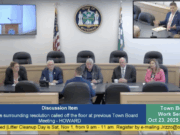

Riverhead’s “Police Reform and Reinvention Collaborative Plan” was unanimously adopted by the town board at a special meeting yesterday afternoon.
Comments made during the March 16 public hearing and written comments submitted after the hearing — the record was left open for 10 days for the submission of written comments — were attached to the plan as exhibits H and I.
Board members did not engage in substantive discussion of the comments made on the draft plan except to reiterate their support for body cameras and discuss the need to find funding to implement them.
In its section on “Accountability and Transparency,” the Riverhead plan includes a reform item titled “Establish Use of Body Worn Cameras by Police Officers.” The item is described as “Investigate types of body worn camera systems, and the best practices for use of body worn cameras.”
The plan says the timeline for completion of the body camera reform item is “long,” which the plan defines as 5-6 years.
The item includes five “action” items:
- establish a timeline for the implementation of body worn cameras;
- negotiate possible stipend with the PBA/SOA for wearing body cameras;
- research budget constraints, obtaining grants and additional funding if possible;
- develop and adopt rules and procedures regarding the implementation of body worn cameras;
- cameras will be implemented as soon as funds become available.
Supervisor Yvette Aguiar, a retired NYPD sergeant, said “most police officers” support the use of body cameras.
“Me being a former officer, two careers ago, I absolutely am a big supporter of it,” she said. “And we’re trying to put in for some grant. And I — even the police officers, they support it. So it’s —we should be moving forward in that direction. And I think the chief — you’re going to start preparing possibly a plan and implementing it. So the chief is going to be working on a plan that will be taking effect obviously once we get the funding. So we’re on our way.”
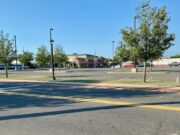
Police Chief David Hegermiller said he supports the implementation of body cameras, noting that the complaint of Ridge resident Denise McGraw, who submitted a written comment and spoke at yesterday’s meeting, was an example of a situation where a body camera would have been helpful. McGraw complained about being roughed up by an unnamed Riverhead police officer in a Route 58 parking lot five years ago.
Aguiar asked the chief if he remembered the incident.
“Yeah, not exactly the way Miss McGraw tells it. But, I think I emailed everybody on this incident. The officer was exonerated. And this is exactly why we want police cameras, actually,” Hegermiler said.
“Exactly,” agreed Councilman Tim Hubbard, a retired Riverhead Police detective.
Councilwoman Catherine Kent also voiced her support. “The cameras protect everybody,” she said. “I know it’s a budget issue. But I think this is an area that we need to try to find money.”
Another comment before the board vote was offered by Ron Hariri of Aquebogue, who questioned the effort the town has made to secure funding for body cameras.
“Although this town has found funds to hire new staff for Supervisor Aguiar, has found funds to create a new town square and has found funds to give out extra pay to those who actually showed up and work to do their job during the pandemic, you supposedly can’t find the funds for body cams. I don’t think you’re credible,” Hariri said. “I think you want to continue a cover up of potential misconduct” he said, without citing specifics, ‘and I think it’s shameful that this town board can’t protect its citizens as well as its police by finding the funds for body cams.”
Aguiar told Hariri he was wrong about town employees getting extra pay for working during the shutdown.
“The people who were here during the governor’s shutdown were essential employees and no one was getting extra pay,” she said. Essential workers who worked during the shutdown received compensatory time equal to the number of house worked, not cash payments. See prior story.
Connie Lassandro, co-chair of the committee that developed the plan, said the group “unanimously agreed that body cams are a necessity…we 100% support body cameras.”
The final plan presented to the board for adoption yesterday was substantially the same as the draft plan, the chief said, with the exception of minor “housekeeping” changes to correct spelling or punctuation. Hegermiller said there were “two content changes” but did not identify what they were. He said the two content changes were added to a spreadsheet distributed to the board that was not attached to the plan or made public yesterday. The final plan document itself does not indicate what was modified since the draft plan. (Editor’s note: A request to the chief for clarification is pending.)
The plan was developed at the direction of Gov. Andrew Cuomo, who issued Executive Order 203 on June 12, 2020. The executive order, titled “New York State Police Reform And Reinvention Collaborative,” requires every local government that has a police agency to “perform a comprehensive review” of police practices and policies for the purpose of addressing community needs and racial bias” and to “foster trust, fairness and legitimacy.”
It mandates the local government chief executive to “convene the head of the local police agency and stakeholders in the community” to develop a policing plan that includes “evidence-based policing strategies… studies addressing systemic racial bias… implicit bias awareness training… de-escalation training… restorative justice practices… community-based outreach and conflict resolution… violence prevention… model policies and guidelines promulgated by the New York State Municipal Police Training Council; and standards promulgated by the New York State Law Enforcement Accreditation Program.”
An adopted plan is due at the State Budget Office by April 1.
Riverhead Town created a committee called the Law Enforcement Advisory Panel, which was chaired by Lassandro, the former chair of the Riverhead Anti-Bias Task Force and NAACP representative Annette Totten. The committee, which included the supervisor, Councilman Frank Beyrodt, the chief of police, representatives of the police unions, district attorney’s office and criminal defense attorneys, as well as community members.
The committee meetings were not open to the public. The committee held two public “listening sessions” in January, and solicited input via a community survey. The town board held a public hearing on the draft plan on March 16. The written comment period closed at 4:30 p.m. Friday.
Read the final plan below:
Riverhead Police Reform Plan – Final by RiverheadLOCAL on Scribd
Riverhead Police Reform Pla… by RiverheadLOCAL
The survival of local journalism depends on your support.
We are a small family-owned operation. You rely on us to stay informed, and we depend on you to make our work possible. Just a few dollars can help us continue to bring this important service to our community.
Support RiverheadLOCAL today.
