

















Adele Wallach’s father was 32 years old when, on Nov. 9, 1938, Nazi paramilitary groups came to Vienna, Austria to round up the Jewish men and take them to concentration camps in a two-day series of violent attacks known as Kristallnacht, or the Night of Broken Glass.
The first act of widespread violence against Jews in Nazi Germany, Kristallnacht is now widely considered the start of the Holocaust. Modern historical analysis estimates that about 30,000 Jewish men were arrested and sent to Nazi concentration camps that night, and about 100 people were killed.
But Wallach’s father survived. “In the face of horror and death, he was saved by a brown-shirt-wearing Nazi,” said Wallach, who lives in Riverhead. “My father and the young man who saved him had basically grown up together. So in spite of the shirt [the man] wore and the life he now lived, he valued my father’s life more. So humanity won over evil.”
Her father was picked up by the man’s cousin and driven around the Austrian countryside in the trunk of a car until the violence subsided.
After that night, Wallach’s father and grandmother tried “every single avenue” to leave Austria, she said. But each time they applied for a visa, her grandmother’s application was denied due to a skin rash.
“In the end, she told him, he should go, save yourself, we don’t both need to die,” Wallach said.
And so he did. With the help of his two first cousins, he escaped to England and then to North America.

“My grandmother, Adele—the one that I was named after—was taken, and she was killed. And the rest of the family who lived in that building were also taken away to concentration camps. And for the rest of [my father’s] life, he had to live with the guilt of that decision,” Wallach said. “And I’m not sure anyone could.”
The journey of Wallach’s father, a man who lost his family at the hands of Adolf Hitler and his anti-semitic Nazi regime, was one of several stories shared during the Riverhead Anti-Bias Task Force’s Holocaust Remembrance Day event at the Riverhead Free Library Wednesday night.
Wallach and other speakers shared deeply personal stories about their Jewish families in Eastern Europe—both of how their families fled the persecution, as well as their own experiences growing up in families scarred by the horrors of genocide.
Baiting Hollow resident Maxine Kleedorfer described how her grandparents’ decision to leave Lutz, Poland in 1906 was due to her grandfather’s sense of the rising anti-semitism in the region. His remaining family in Europe believed he was “paranoid,” Kleedorfer recalled, but he didn’t want to raise children in that environment.
“He felt America, in New York, was the only place they could be safe and literally hide their Jewishness, I guess with a more diversified group of people,” Kleedorfer said. “They ended up going. My grandfather set up a home in Harlem, near a kosher butcher and a synagogue, because that was the only way he could get my grandmother to come.”
Lain Johanson of Sayville said her own grandparents faced similar doubt from extended family members over their decision to flee Europe. Her father was only 10 years old when her grandfather, anticipating invasion and persecution by the Nazis, decided they would leave Northern Holland for the United States.
“They begged [my grandfather] to stay,” Johanson said. “All the friends and relatives said, ‘no, it’ll be like World War One. They will never get to Holland, it will never happen.’ And they stayed — and they all perished.” Those family members, she said, all died at Auschwitz, the largest Nazi concentration camp where more than 1.1 million people were killed.
A common thread between each speaker was a shared sense of survivor’s guilt. Though their families’ decision to flee Europe before the Nazi invasion largely spared them the immediate atrocities of the Holocaust, the weight of the war still followed them to the United States.
After Hitler became chancellor of Germany, Kleedorfer said, her grandmother decided to change the family name to something less Jewish and more American. Similarly, after Johanson’s father reached the United States, he refused to speak his native tongue.
“He claimed not to remember,” Johanson said. “When he went to school, the first day he came home, his parents spoke Dutch to him. He said ‘if you speak to me in Dutch, I will not respond.’ He was going to be the most American American boy that was.”
The survivor’s guilt also brewed silence. Johanson and Wallach both revealed that they both never learned the full story of their families until they were much older — and neither of them from their fathers, who refused to speak about their lives before moving to the United States.
Johanson said survivor’s guilt affects her, too. “My cousins, my siblings and I always had a special kind of survivor’s guilt,” she said, “because we know that, had not the events taken place the way that they did, we wouldn’t be here,.”
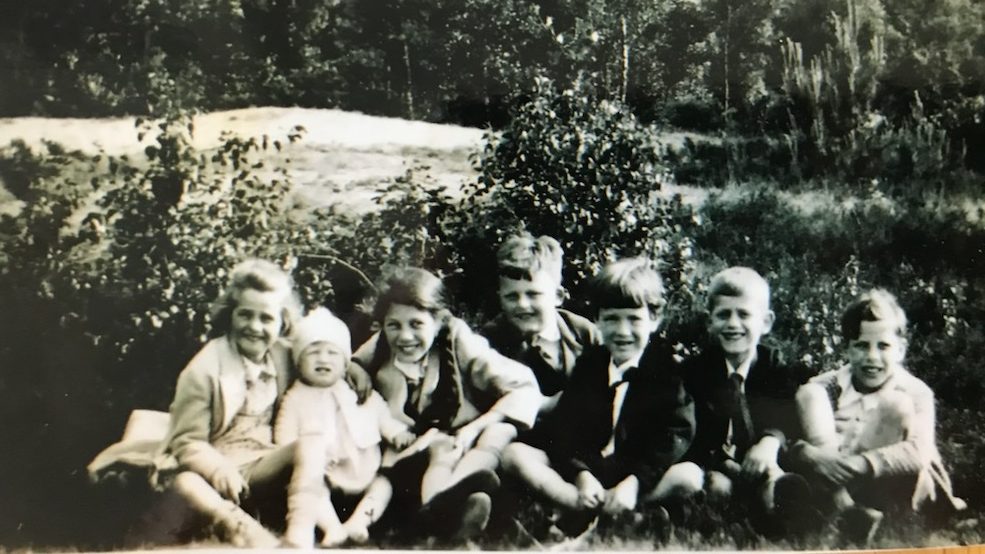
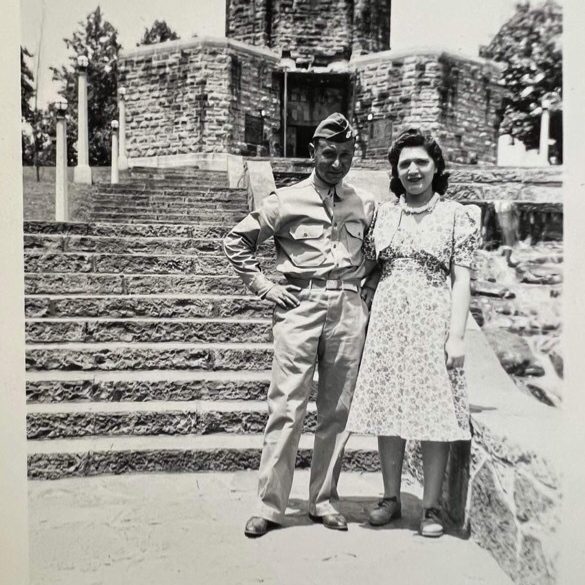
During their presentations, Wallach, Johanson and Kleedorfer shared old photographs of family members with the audience.
“All I know of my family is what’s in that picture,” Kleedorfer said. “I know no one else. I’ve tried [Ancestry DNA], but there’s nothing. Nothing about them. Because when Lutz was destroyed, so was everything.
“But I was lucky,” she added. “I was lucky because I’m here.”
Wallach said she has many pictures of relatives left to her by her father after his death, but “little knowledge of what most of it means, or meant to him.”
“It was important enough to carry from Vienna to London, from London to New York and New York to Florida, but not to share, because apparently he simply could not” because of his guilt, she said.
“It’s important that we remember that these were people,” Johanson said. “These were people and they died. Too young, too soon. And so we have to live for that, and we have to remember them.”
The speakers also shared their stories of the anti-semitism they’ve experienced throughout their lives — from crude jokes and discrimination to Holocaust denial — a sign of the continued persecution of Jews in the United States, even after Hitler and the Nazis were defeated.
Rabbi Michael Rascoe of Temple Israel of Riverhead recounted a violent incident in which he narrowly avoided being hit with a beer bottle that was thrown at him as he walked down a major road to his religious services.
“I thought that would probably be the worst thing that ever happened in life, and things are only going to get better,” Rascoe said. “And for a while, they did. But guess what? Now they aren’t. Those of you who’ve been following the news know that anti-semitism has gone up drastically around the country, around the world, and in particular, where large numbers of Jews live. Have things changed since Nazi Germany? You tell me.”
Correction: A previous version of this story incorrectly spelled Michael Rascoe and Lain Johanson’s names. A caption has also been amended for a spelling error.
The survival of local journalism depends on your support.
We are a small family-owned operation. You rely on us to stay informed, and we depend on you to make our work possible. Just a few dollars can help us continue to bring this important service to our community.
Support RiverheadLOCAL today.
