













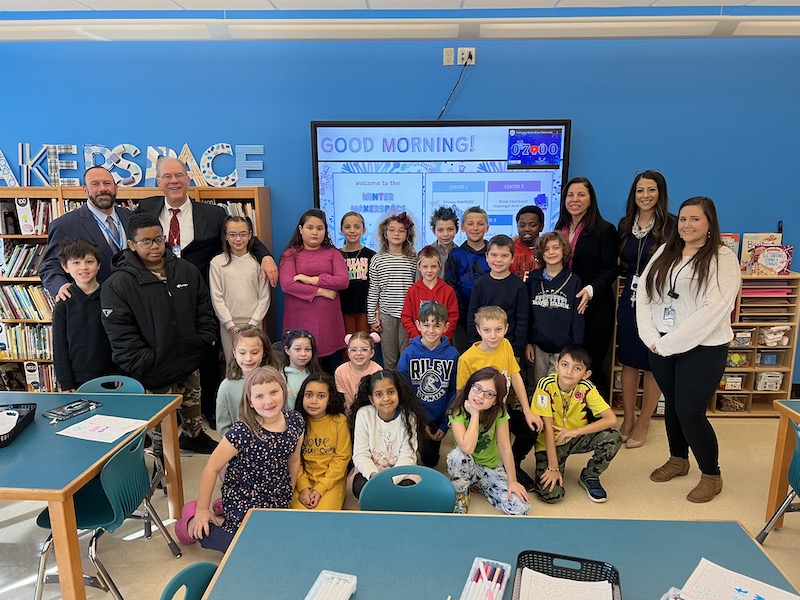
Jan. 24 was “crazy hair day” for students at Riley Avenue Elementary School. But for Tracy Martin’s third grade class, it was also their day that month to play in their library’s makerspace.
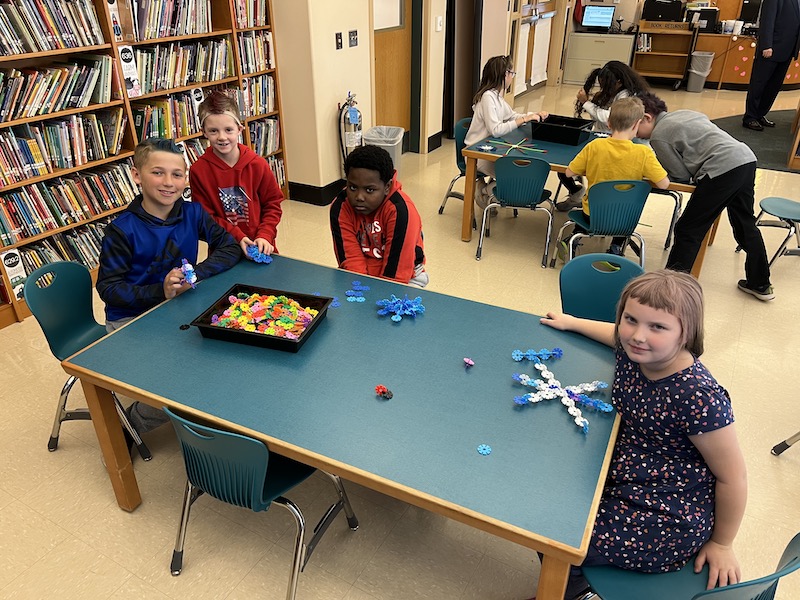
This month’s theme was winter. Students took a seat at several stations in front of what most would consider regular child toys, tasked with building using what was in front of them. Students made snowflakes out of K’nex and Brainflakes — two types of construction toys — and built shelters for plastic animal figurines using wood blocks and magnetic tiles.
Other books sit on the shelves of the library alluding to other elementary makerspace activities, using egg cartons, strings, straws, rubber bands. It seems like a typical arts and crafts session.
But educators see something more than just blocks and bricks. They see the future architects, engineers and roboticists of the world.

As the name suggests, a makerspace is a place where people can make things. A sort of umbrella term, Riverhead administrators pitching the idea for every building in the district described makerspaces as “a special lab-like space that is set up for tinkering and building and experimenting and inventing.” They are a way to develop a student’s skills rooted in constructionism, student-driven learning and collaboration with their peers.
This school year marked the first with a makerspace in all seven Riverhead public school buildings. The initiative was pushed by district administration, who said the workshop-like environments are necessary to develop a student’s skills in STEM fields. The Board of Education also hired a STEM director to oversee the launch of the program.
“We need more people in engineering. We need more people in these science based types of career paths,” Superintendent Augustine Tornatore said as students tinkered and toiled, rotating every seven minutes to a different activity. “So by exposing them at this age, it’s an important thing. And they work in teams and they learn how to work with one another, communicate with one another on how to separate the duties.”
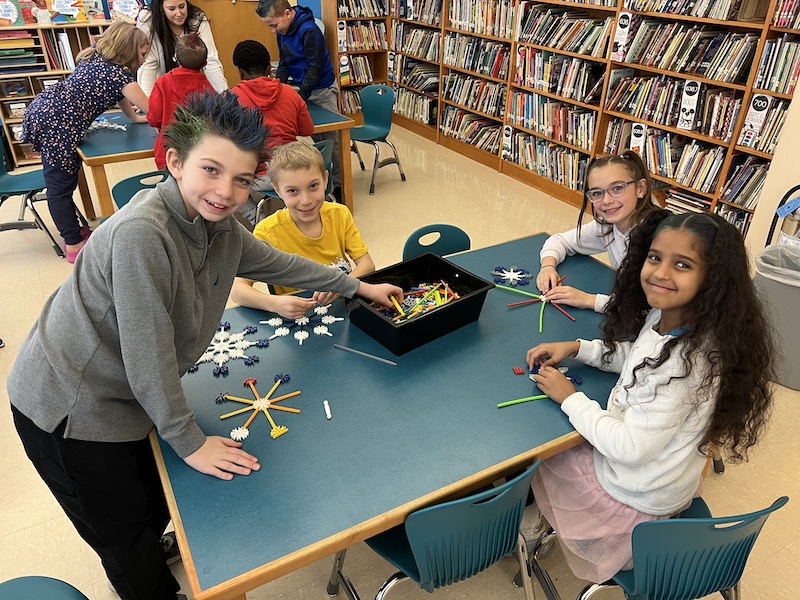
Students “love it,” Riley Avenue library media specialist Brooke Crescitelli said. “When they see the stuff on the tables when they walk in, they get so excited. Every week that we don’t do it, they go, ‘when are we going to do it again?’”
The broader educational and cultural shift towards creation as learning, coined as the “maker movement,” has been around for decades. In 2006, the novel publication Make magazine established the first Maker Faire in California; the events spread to New York City and around the world, and still go on today. In 2014, President Barack Obama held a Maker Faire at the White House.
Activities in makerspaces are “age appropriate,” STEM Director Jeannine Campbell said. The activities are run by library media specialists like Crescitelli. Tornatore said similar activities like those being done in the makerspaces have been going on in buildings throughout the district for a while, but there was no cohesive vision when he began as superintendent almost two years ago. “We wanted equity,” he said.
Elementary school students start small, but as students move into the middle and high schools, the level of sophistication and student involvement increases.
“We start it here,” Campbell said during an interview at Riley Avenue. “but with the vision that they’re going to carry it through to high school.”
Makerspace activities can also use more sophisticated equipment, such as 3D printers, which print three-dimensional objects using models made on the computer. Every building has a 3D printer, Campbell said.
“Cost wise, especially in the elementary level, creating a makerspace is really nominal, it doesn’t really cost that much money, it’s more the opportunities,” Tornaotre said. “It becomes a little more costly when you do it for middle school and high school kids, because that’s when you have the high level equipment.”
When students reach middle school, they start developing the coding behind 3D printing by learning and working with the 3D modeling program Tinkercad.
“We had our technology class actually work with makerspace to use a 3D printer to create cell phone holders,” Campbell said. She said the project started because the teacher had a broken cell phone holder. “And so they created something that held the phone up in the car. And then the kids use that as a model to create other things.”
There are at least four courses in the high school that use 3D printers as a main part of their curriculum, according to the school’s course offering booklet. The high school also has a 3D maker club.
A large part of using a 3D printer is coding and programming. The district offers seven computer science courses in the high school, according to the course offering booklet. Campbell said the district is looking to offer a coding class for students in the middle school, which already has a coding club.
Students in the middle and high schools are also using makerspaces to work on creating different kinds of robotics, Campbell said.
A goal of the makerspace program is to get students to the point where they can compete and gain recognition from prestigious science competitions like the Regeneron Science Talent Search, Torantore said.
The skill developed using makerspaces also branches out into “all different disciplines” beyond math and science, including into business, Tornatore said. For example, students can make products they would like to sell and can showcase in “Shark Tank” like competitions, he said.
“It’s always good to tap into different types of learning styles and assessment, as well,” Tornatore said. “New York State is looking to move that direction: portfolio based assessments and project based learning.”
Campbell said the future of makerspaces in the district is “endless.”
“This is the start. So we’re trying to find out what’s up and coming. What are the new things that are coming out that we can incorporate into makerspace?,” Campbell said. The library media specialists have a lot of freedom to create activities, she said. “It doesn’t have to be one thing. It doesn’t have to be just drawing. It doesn’t have to be just building. It could be imagination. It could be Legos on a table and build something. But the whole point is that we want it to be the kids’ creations and their ideas coming to life and how they see it.”
The survival of local journalism depends on your support.
We are a small family-owned operation. You rely on us to stay informed, and we depend on you to make our work possible. Just a few dollars can help us continue to bring this important service to our community.
Support RiverheadLOCAL today.
