

























It really is a shame we have to keep writing editorials like this.
The Riverhead Town Board has, again, fumbled the ball when it comes to crafting effective legislation. The most recent victim: the zoning code governing the location of recreational marijuana businesses within the town.
Riverhead’s cannabis code — specifically the requirement that recreational marijuana businesses cannot be sited within 1,000 feet of any residential use — makes it near impossible to site a retail marijuana establishment anywhere in the town. This violates state law and exposes the town to the possibility of having to defend yet another lawsuit at great taxpayer expense.
State law gives the town the right to regulate “time, place and manner” of adult-use marijuana dispensaries and on-site consumption lounges within its borders, but the law prohibits local regulations from making their operation “unreasonably impracticable,” effectively banning them.
Riverhead Town’s regulations do exactly that and must be fixed.
The town’s Business Advisory Committee recognized this, leading to the embarrassment that was the Town Board’s June 1 work session.
But before we get to that disaster, here’s a quick review of how the town got itself into this mess in the first place.
New York State legalized recreational marijuana in 2021. Among other things, the state law provides for the licensing of retail dispensaries and on-site consumption establishments, and allowed municipalities to opt out before the end of 2021.
The Riverhead Town Board considered a local opt-out law, but failed to adopt it. Supervisor Yvette Aguiar and Council Member Ken Rothwell were the only board members to support the opt-out law, and it failed to gain majority support in a 2-3 vote on July 7, 2021.
The town was then required by state law to allow these uses within its borders. Since the town was allowed to regulate “time, place and manner,” the supervisor tasked Rothwell, her fellow opt-out advocate, with overseeing the process of coming up with regulations
We were skeptical, to say the least, of Rothwell’s position as the lead on this. The person who did not want marijuana will oversee creation of the marijuana code? Sounds like the fox was given the key to the henhouse. But Rothwell promised to be fair and said he would host three forums to solicit public input to create the local law, which would also involve a committee made up of community stakeholders including the school district, Riverhead CAP and business leaders.
And it was fair — at least at first. The forums drew an interested and engaged crowd, including residents and potential marijuana business owners. Everybody seemed to be represented. It was decided by Rothwell that marijuana businesses would be just like every other retail business in the town, subject to distance buffers based on certain uses. This was an overly complicated way to make zoning, for the simple fact that landlords and potential tenants could not easily look at a zoning map and see where they were allowed. But it seemed most people were fine with the town’s unorthodox process.
At the last forum meeting, the general consensus was that the buffers were fair, the most strict being 1,000-foot buffers from schools.
That was until it went into limbo for a few months.
It wouldn’t be until June 30, 2022 — three months after the regulations were decided during the last forum — that Rothwell and the town staff working on the local law made a presentation to the board at a work session. The essence of their presentation: ‘We aren’t finished with the code yet. But we have this map to help visualize where the businesses can and cannot go under the parameters discussed during the forums.’ The map showed marijuana businesses would be allowed along Route 58, which the Town Board seemed fine with.
The 1,000-foot surprise
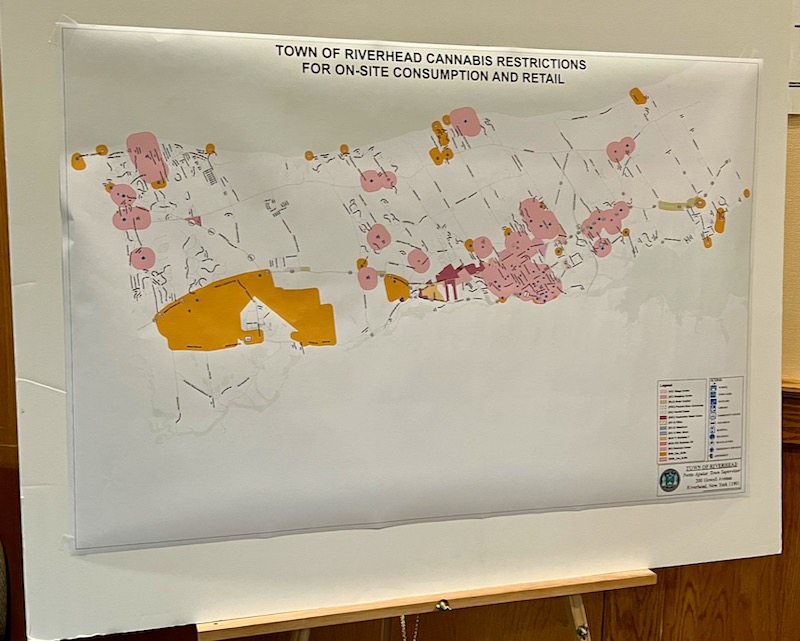
Then, the topic lay dormant for two months, until another work session. But the actual text of the code came with a surprise, for anybody paying attention. Under the proposal, marijuana businesses could not be within 1,000-feet of residential uses.
This was not agreed on during the marijuana forum. When asked about that aspect of the code, Rothwell first tried to gaslight a reporter — who had attended each marijuana forum — and suggested it had been discussed and agreed upon. While it had been briefly discussed, there was no agreement as to whether to regulate distances from residences. It was put there to protect people’s personal property, Rothwell said.
It is dishonest and inaccurate to say the law came from the town’s marijuana forums, which Rothwell has used to defend the code’s legitimacy and why it should not be immediately changed. The marijuana forum process was, in our opinion, a great way for the local government to engage the public in the lawmaking process. If we’re honest, we wish it happened more often with other topics.
At the public hearing held on the law, town officials presented the map created for the first work session on the marijuana code to the public — the one without the 1,000-foot residential buffer. Because of the map and the perceived fairness of the regulations, prospective marijuana entrepreneurs applauded the Riverhead Town Board’s regulations, with one speaker calling it the most “progressive” of its kind and most friendly to the emerging industry on Long Island.
Even after local realtor Ike Israel pointed out during the hearing that the map did not depict the setbacks from residential uses, board members incorrectly claimed he was wrong. Both Rothwell and the town’s GIS administrator, Jason Blizzard, confirmed in a post-hearing interview that the maps were inaccurate. Blizzard said that the number of residential parcels within the town would be too difficult to put on the map, and that the residential distance restriction would be looked at as marijuana businesses begin inquiring with the town for sites.
Even though the town presented inaccurate information during a public hearing — and with that fact known to at least one board member — the board adopted the code on Nov. 1 anyway.
This is not good government. You do not pull an additional regulation out of thin air and add it to the code without understanding the consequences first. You do not present inaccurate information — whether intentional or not — during a public hearing and taint the town’s official record. And you certainly do not make the decision, in willful ignorance, to pass that law and leave the town open to a lawsuit or state government proceeding that will cause even more taxpayer expense.
The net result is that only 36 parcels in the town can site marijuana shops, according to a document prepared for officials by the town’s engineering department. Of those identified parcels, all but six are already developed with other uses — including LILCO rights-of-way and major retail stores and restaurants on Route 58. Such long-established commercial and industrial uses are unlikely to be abandoned for a new marijuana dispensary.
When confronted with this fact, Rothwell stated that, although he believed 36 parcels was a reasonable number, the code’s rules may be too restrictive if most of those parcels are already filled with other uses.
“If too few parcels in the Town of Riverhead can be developed with cannabis uses, we need to revise the code,” Rothwell said in an April 18 interview. “That was not the intention. Our goal was to make it fair, not too restrictive.”
A cringeworthy display of ignorance

Fast-forward to the June 1 work session, when the topic next appeared on a Town Board work session agenda. It was a masterclass on how to give anyone watching second-hand embarrassment.
Members of the Business Advisory Committee appeared before the Town Board to request changes to the marijuana code, calling it far too restrictive and an impediment to potential dispensary owners from opening in Riverhead Town.
The Town Board was completely unable to have a coherent discussion of their concerns. Even though the supervisor herself sets the meeting agenda, no one seemed to have prepared for the meeting. A copy of the map showing the permissible locations for retail marijuana establishments was not available. Annemarie Prudenti, the deputy town attorney who worked on the code, was off from work — a long-scheduled day off, Town Attorney Erik Howard said, after he was summoned to the board room by the supervisor.
Even Rothwell, the very councilperson who led the effort to craft the town’s marijuana code, said he had no advance notice that this topic had been scheduled for discussion; board members, he claimed, only see the work session agenda at 5 p.m. the day before, the same time it is released to the public.
What the work session did do, however, was provide the supervisor the chance to beat her chest and loudly reaffirm her opposition to legalizing marijuana. (Including saying as a cop she “picked up those bodies off the street that were hallucinating and jumping off roofs”picked the bodies up off the streets.”)
Instead of apologizing for the lack of preparedness and inability to have a meaningful discussion — instead of quickly and politely asking the members of the Business Advisory Committee to return another day — Aguiar was argumentative, defensive and just plain rude.
And to make matters worse, she demonstrated, once again, both a complete lack of understanding of the subject as well as her willingness to expound on it at length despite her ignorance, making more false statements along the way.
Almost as soon as Business Advisory Committee member Lee Mendelson — an attorney who works in the cannabis industry — began addressing the board, Aguiar interrupted him. She again insisted, incorrectly, as she did the night of the Town Board’s vote on the code, that the state had taken away the town’s ability to “decide place and location.”
When Mendelson was attempting to explain what the state law actually says, Aguiar again interrupted to falsely insist that he was quoting from the state’s guidance, not the actual regulations.
Cannabis grower David Falkowski gently corrected the supervisor: “The [Marijuana Regulation and Taxation Act] is a law, a statute. So that is the law of the land.” He went on to draw a distinction between the law and the interim guidance released by the state to help clarify the law, pending the adoption of formal regulations by the Cannabis Control Board as mandated by statute.
The supervisor interrupted again. Growing agitated, she demanded the presence of Prudenti. “We have attorneys that worked on this — we can’t just have a conversation back and forth,” Aguiar said. “[Prudenti] was on the call with me when I called MRTA,” she added, incorrectly using the acronym for the Marihuana Regulation and Taxation Act when she apparently meant to refer to the state Office of Cannabis Management. “And if I need to have another conference with the governor’s office and MRTA, we will.”
When Falkowski again tried to interject some reason into the conversation, Aguiar again interrupted him.
“Where is our attorneys who worked on this? They must have known it was a hot topic,” Aguiar said, apparently insinuating the town’s attorneys failed to attend the meeting in order to avoid the discussion. She repeated her demand for Prudenti’s presence.
When Kern began to answer a straightforward question from Israel about whether any applications have been filed, Aguiar cut him off too.
“All right, hold on a second. We need our town attorney who I recently saw a few minutes ago, and we need Annemarie [Prudenti] who’s been working on this. Now you take the two new attorneys that came in and are sitting here — you guys can’t represent us on this,” she said.
Her voice grew louder. “So where are — can I just please ask where are our town attorney and Annemarie Prudenti? We spent extensive time working on this with public forums, with the public, with you guys. So we can have a conversation. If not, I’m going to cancel this particular discussion and bring it back when they decide that they want to be able to show up,” the supervisor declared. “I still can’t get an answer where they are.”
A member of the supervisor’s staff then informed her that Prudenti was off that day, and Town Attorney Erik Howard left the meeting room to locate the file.
“I’m sorry, guys. I’m going to have you come back when people don’t take off and people don’t start looking for files.”
When Howard re-entered the room, Aguiar told him: “We are talking about legislation. Annemarie took off. We can never have a conversation again in this town without having the town attorney, the deputy town attorney.“
Howard told the supervisor Prudenti had scheduled to be off that day “well over six weeks” before.
After publicly berating the town attorney, Aguiar didn’t bother to ask him a single substantive question, or even ask him to weigh in on the discussion. Instead, there was more unproductive conversation and a directive from the supervisor to reschedule the meeting — after the cannabis committee meets again.
“I can see this requires more work,” Aguiar said. But there was no resolution of the basic issues the Business Advisory Committee members brought to the table — changes the committee suggested in a letter to the Town Board in February.
And so, after a head-spinning 50-minute “discussion,” they were all right back where they started.
The five members of the Town Board are responsible for knowing what they’re doing, what the laws they adopt say, what they mean, and how they affect people.
Sadly, in this regard, the supervisor consistently falls short. Aguiar doesn’t seem to want marijuana sales in Riverhead Town at all. And while she is entitled to her opinion, the vote on this subject happened nearly two years ago. And — news flash — she lost.
In that same vein, Rothwell has been ineffective at handling the Business Advisory Committee’s concerns with the marijuana law. This conversation should have been brought to the marijuana committee four months ago, when the Business Advisory Committee first sent its letter to the Town Board requesting revisions.
Recreational marijuana is coming to the Town of Riverhead, whether Aguiar and Rothwell like it or not. Now their responsibility is to govern responsibly and help craft a law that is legal and fair to recreational marijuana businesses coming into the town.
The clock is ticking.
The survival of local journalism depends on your support.
We are a small family-owned operation. You rely on us to stay informed, and we depend on you to make our work possible. Just a few dollars can help us continue to bring this important service to our community.
Support RiverheadLOCAL today.
