




















County legislators last week again declined to move forward a pair of bills that would authorize a county-wide wastewater district and a voter referendum on a 1/8% county sales tax increase to fund sewers and advanced septic systems in Suffolk, killing any hope of a vote on the referendum at the November general election.
In a party-line vote July 25, legislators voted 10-7 to recess public hearings on the bills for a second time.
State Election Law requires a ballot proposal to be submitted to the Board of Elections at least three months ahead of the general election, which takes place this year on Nov. 7. That means the deadline for adopting the bill in order to meet that three-month deadline is Aug. 4. The legislature is not scheduled to meet again until Sept. 6.
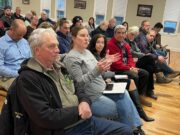
The County Legislature’s votes to recess the hearings followed hours of testimony by scientists, environmental advocates and residents, almost uniformly urging the legislature to close the hearings and allow voters to decide the fate of the 1/8% sales tax hike at the November election.
The Legislature previously voted to recess the hearings on June 21.
The Suffolk County Water Quality Restoration Act, which was signed into law by Gov. Kathy Hochul in April, authorized the county to increase its sales tax rate by an 1/8 of a cent beginning March 1, 2024 and ending Feb. 29, 2060 to finance the new water quality fund.
Republican legislators’ objections to the bills ranged from opposition to tax increases of any nature, to reservations about the advanced septic systems currently approved by the Suffolk County Department of Health Services and being installed across the county, to raising new doubts about the cause of pollution of Suffolk’s bays and estuaries, which have experienced toxic algal blooms and the collapse of local fisheries.
But the GOP caucus’ staunchest opposition came from legislators’ belief that the state law requires too much of the revenue raised by the 1/8-cent tax to be spent on advanced septic systems and too little on sewer projects.
The Water Quality Restoration Act allows up to 10% of the new tax revenue to be spent on administration of the wastewater district with the balance divided 75% to advanced septic system installation and 25% for sewer projects.
The county bills derived from the Suffolk County Subwatersheds Wastewater Plan, which was adopted unanimously by the County Legislature in 2020 after a years-long development and environmental review process.
One measure, Introductory Resolution 1573-2023, would authorize the extension through 2060 of the 1/4% sales tax for drinking water protection, in addition to the 1/8% increase for wastewater infrastructure. The 1/4% tax will otherwise expire in 2060.
Presiding Officer Kevin McCaffrey (R-Lindenhurst) said at last week’s hearing he is not opposed to the 1/8% sales tax increase but said the expenditure of Water Quality Restoration Fund monies had to prioritize sewers on the South Shore, where wastewater is impacting the health of the Great South Bay.
“As we are sitting here right now, I am working on trying to find that solution,” McCaffrey said. “And I am committed to finding a solution to this issue,” he said, echoing his comments during the June 21 hearing.
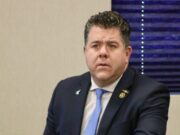
Other Republican legislators, including Majority Leader Nick Caracappa (R-Selden), said sewers were not adequately provided for in the state legislation, which limits allocation for sewer projects to 25% of the funds raised through the 1/8% tax increase — after up to 10% comes off the top for administrative costs.
“Both IA systems and sewers are important,” Caracappa said. “But sewers are the priority, without question.”
The state law’s mandate that 75% of the fund be allowed to advanced septic systems would “stockpile hundreds of millions of dollars that will be sitting there waiting for people to apply for IA systems while handcuffing our ability to address the needs of this county, our waterways… for years to come,” Caracappa said.
The language of the state law enacted in April must be changed, “so that it doesn’t handcuff us,” Caracappa said. He said the changes needed are “slight” and, “if the sponsor of this bill in the Assembly really wanted to do it, they can do it,” he said, apparently referring to Assembly Member Fred Thiele, who worked to push the bill through — and to have it include authorization for the sales tax increase. The bill was part of the governor’s executive budget proposal. In its original form, the bill had not money in it, Thiele said in a Feb. 10 interview. It would have been up to the county to impose property taxes to fund the effort.
Caracappa and other Republican legislators complained the the Republican caucus were not involved in drafting the language of the bill brought before the State Legislature.
“We were left out of this equation. We were not invited to the table,” Caracappa said. “We did not have the opportunity to bring points forward. We were not on the committee. We were not on the consensus panel,” he said.
“We are losing opportunities by stockpiling money that will not be used for years, if ever at all. We’re losing opportunities to clean up our coastal waterways, supporting our economic development, creating real jobs, while people are sitting around waiting to put sewers in the ground, while money is sitting there for IA systems never being used. That does not make fiscal sense,” Caracappa said.
Democratic legislators, sporting blue water droplet pins on their clothing, pushed back on the Republicans’ complaints about funding for sewers.
“To be clear, implementation of this Water Quality Restoration Act relies on the use of not one but two funding sources, in addition to the Water Quality Restoration Fund,” Legislator Bridget Fleming (D-Sag Harbor) said. The bill before the Legislature extends the Drinking Water Protection Program and “provides clear authority” for the use of the county’s aAssessment Stabilization Reserve Funds for sewer construction, Fleming said. That was done at the request of the Republican caucus, she said.
In addition to the stabilization reserve funding for sewers, Fleming said, changes were made to require that 25% of the new sales tax must be used for sewers as well.
Fleming noted that funding from the Drinking Water Protection Program can be used for sewer systems only — not for the advanced septics.
“There is an equal balance struck,” Fleming argued. “The eighth of a percent has a higher percentage …for the advanced septics because the DWP (Drinking Water Protection Program) cannot be used for those critically important pieces of this overall plan,” she said.
The sub-watersheds wastewater plan ranks and prioritizes water bodies in designated management areas, Fleming said. The two sources of funding together will allow the goals of the plan to be realized and allow communities that have been “waiting decades for sewers” to finally get them.
“Please don’t fool yourselves or try to fool the voters by saying that, you know, we can do this at a future date. Now is the time to act,” Fleming said.
Legislator Kara Hahn (D-Setauket) argued that the sales tax funds will position the county to access state and federal funding for wastewater treatment.
“Suffolk County taxpayers cannot shoulder the multibillion dollar burden, the cost of sewers, alone,” Hahn said. “The sewer money in this plan is a match for more money that is limited, that is available now, and everybody else wants it — wants it bad, wants it just as bad as us, wants it for just as important things all around the state, all around the rest of the nation,” she argued.
Hahn said the money to be raised by the new tax is only a portion portion of what’s needed to do the job — “just a 25% match,” she said. The county needs more funding from the state and federal governments that is available now. “We need to act now. If we wait, our water gets dirtier. If we wait the money gets allocated elsewhere. If we wait Albany may not give us permission again. Why should we wait for clean water?”
Legislator Rob Trotta (R-Fort Salonga) said he would not vote to approve the new tax.
“All this passion is really great,” Trotta said. “I just wonder where it was two years ago when this body voted to steal $200 million from the Clean Water Fund,” he said.
“We now have a $700 million surplus. We could repay it back tomorrow,” he said.
Trotta slammed lawmakers for failing to support a bill he sponsored in 2020 to amend county charter law to require nearly a third of the county’s 1/4% sales tax revenue to fund sewer district development and expansion. Currently the law requires 31.15% of the county’s sales tax revenue to be used to reduce or stabilize county property taxes and/or police/public safety property taxes.
“It’s just sort of hypocritical that we stand here and we’re advocating for raising taxes. How about out of the quarter-cent — you know, the 35% goes to the general fund, we have a $700 million surplus. Let’s take that 35% and put it back in for sewers, which would almost match what we’re doing here,” Trotta said. “Stop taxing the people and run the government more efficiently. I will never support any tax increase,” Trotta said.
Legislators again heard from dozens of speakers, as they did during the June 21 meeting, with all but a handful urging them to close the hearing and pass the bills.
The bills have drawn support from virtually every environmental advocacy and conservation group in the region, the Nassau-Suffolk Buildings and Trades Council, the Long Island Builders Institute, organized labor, civic associations, the League of Women Voters, and current and former elected officials, including Southampton Council Member Tommy John Schiavone and former longtime Assembly Member Steve Englebright, who served as chairperson of the Assembly’s environmental committee.
Legislators had the most questions for Stony Brook University Professor Christopher Gobler of the university’s School of Marine and Atmospheric Sciences and co-director for its Center for Clean Water Technology, who testified on the impacts of nitrogen pollution on groundwater, surface waters and human health.
“High levels of nitrate in drinking water have been epidemiologically linked to elevated rates of many types of cancers,” Gobler told legislators. “High levels of nitrate in our drinking water is also linked to birth defects and adverse birth outcomes,” he said. These impacts occur at levels far below the EPA drinking water standard of 10 milligrams per liter and even below the 5 milligrams per liter standard used by the Suffolk County Water Authority, Gobler said, “which essentially means that presently residents in Suffolk County are being exposed to levels of nitrate in their drinking water that have been epidemiologically linked to cancers and to birth defects.”
After Gobler used his three minutes of comment time, legislators questioned him intensely for about 40 minutes, with some members of the Republican caucus asking questions that indicated they were having doubts about the conclusions in the sub-watersheds management plan adopted by the legislature in 2020, including whether Suffolk County actually has a nitrogen pollution problem.
“In fact, when it comes to nitrogen levels and drinking water, it’s not even in the top 20 concerns of Suffolk County Water Authority,” Caracappa said. “I can tell you it’s a fact. I worked there for 34 years,” he said.
Gobler said the average nitrogen level in Suffolk County is 3.8 milligrams per liter, less than the water authority’s action standard “but unfortunately in that danger zone that’s been epidemiologically linked to both elevated risk of cancer and elevated risk of birth defects,” he said.
Hahn brought up the potential for sewer expansion to allow for greater development density and asked Gobler what the impacts of that are.
“More density does lead to a higher nitrogen load, but that needs to be examined on a case by case basis,” Gobler said.
Under questioning by the presiding officer, Gobler said the basis for priority zones should be, first, public health, and second, protecting coastal ecosystems where the nitrogen load is high and tidal flushing rates are low. Protecting public health would be accomplished by protecting wellheads, he said.
McCaffrey also questioned Gobler on whether an advanced system would be as effective and efficient as connecting to a sewer system that is already in place. Gobler was noncommittal, saying “It’s very site specific…It depends how close you are to that sewage treatment plant. The further away you get, I’m sure we can all appreciate it, the more pipe you have the lay down and the more expensive it gets.” McCaffrey pressed with specific hypothetical examples, but Gobler still wouldn’t commit either way.
“You’re not going to answer my question,” McCaffrey said. When Gobler tried to reply, McCaffrey cut him off. “I didn’t interrupt you,” he told Gobler. “The point is that we have priority zones that are laid out in that sub-watershed wastewater plan that you are familiar with,” McCaffrey said, his voice rising. “And those plans call for sewering. Everybody — the engineers say it, the environmentalists say it, we should be sewering those areas.”
“Yes, downtown areas that are densely populated,” Gobler said.
“Can you say that or you can’t say that,” McCaffrey pressed.
“In areas that are densely populated,” Gobler reiterated. “Yes, connecting to sewers makes sense,” he said.
“So one, South Shore of Long Island, low-lying areas already close to an STP, you believe that they should be sewered and sewered first that have a biggest impact on our bays and tidal waters,” McCaffrey said, driving home his point.
The Nature Conservancy’s Kevin McDonald also found himself fielding numerous questions from legislators.
“This fund would be available to help approximately 200,000 property owners and small businesses in Suffolk County as the county finally matures to a cleaner water future,” McDonald testified, and “it would capitalize a sewer fund,” he said, because it “would likely unlock matching federal and state funds,” he told legislators. “The first few years of funding would generate almost a billion dollars for sewers alone,” McDonald said.
McDonald said he considered the bills before the legislature today would be, together with the creation of the Drinking Water Protection Program under former County Executive Michael Lo Grande, “would be the two most significant policy decisions that Suffolk County will have ever done that altered the fate of its water resources for hundreds of years in the future,” McDonald said.
In response to a question from Minority Leader Jason Richberg (D-West Babylon), McDonald said he and other advocates attempted five times prior to the state law’s passage this year to get state lawmakers to consider a bill to create a permanent revenue stream for modernizing the wastewater infrastructure. “The sixth time was a victory,” he said.
“So what do you think is the likelihood of going up for a seventh time to get it changed?” Richberg asked.
“I don’t think it ends well, because nothing about this has been easy, to be blunt,” McDonald replied. “I just wish you’d pass this,” he said.
Legislative staff in Albany would say,“We worked on two bills and we gave you a bill and you want to talk about another bill. How do we know you ever gonna do anything?” McDonald said.
“You know, I like the strategy that if somebody gives you just about all you’ve asked for, and you have evenly split money between two critical needs that serve the population of the county really well, that’s good enough to say, ‘Let’s declare victory and move on,’” McDonald said.
The survival of local journalism depends on your support.
We are a small family-owned operation. You rely on us to stay informed, and we depend on you to make our work possible. Just a few dollars can help us continue to bring this important service to our community.
Support RiverheadLOCAL today.
