
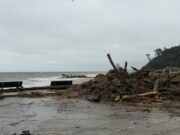























Riverhead Town is looking to reopen East Creek in Jamesport to residents for shellfishing for the first time in almost two decades.
Shellfishing could start as soon as this month, officials said. The town is considering a local law to regulate shellfishing specifically in East Creek, which has been closed from shellfishing since August 2004, according to the Department of Environmental Conservation. No commercial fishing would be allowed in the waters.
Residents are required to obtain a no-cost annual permit to shellfish — and the activity will be closely regulated. Shellfishing would be limited to weekdays between 9 a.m. and 3 p.m. during a four-month period designated by the town in consultation with the DEC, town officials said.
Residents may only harvest half a bushel of individually combined shellfish, of which no more than 100 shall be hard clams, per day, according to the proposed local law.
The Town Board hopes to adopt the resolution changing the code on Jan. 17, the same meeting as its public hearing, to give residents the opportunity to start shellfishing as soon as possible. This year’s shellfishing season would take place between Jan. 17 and April 30, according to DEC spokesperson Samantha Rosen.
“To authorize a cooperative program, DEC performed several data analyses examining rainfall and stormwater runoff effects on East Creek and evaluated potential pollution sources. Results of the water quality analyses show this area has acceptable water quality and low fecal coliform values when there are low daily amounts of rainfall during the cold weather months of January through April,” Rosen said in an email. “Based on these factors, and in coordination with the town, DEC determined this area could support a special conditional shellfish harvesting program under limited rainfall amounts.“
Fishing will be dependent on rainfall, which affects the creek’s water quality. A half-inch of rain closes shellfishing for a week, Town Engineer Drew Dillingham said at a recent Town Board work session. A dedicated phone line will be established to provide a daily message to the public prior to the start of harvest each day that states whether fishing is open or closed.
No boats will be allowed in the town’s marina during the harvest season, Rosen said.
“It’s a good thing,” said David Lessard, a shellfish farmer who administers the town’s seed clam program. “I’m curious to see how everything works out and I hope that everybody participates.”
East Creek was open to shellfish harvesting in 1965, according to an email by DEC marine biologist Matt Richards shared with a reporter by Dillingham. In 1983 the area was classified as year-round “uncertified” — the official term used by the DEC that means an area is closed to shellfishing. East Creek’s classification was changed in November 1994 to open up fishing from May through November, according to Richards’ email. The area’s classification was last changed to year-round uncertified in August 2004, and has remained that way since, Richards said.
Throughout the last four decades, the Peconic Bay has experienced water quality issues that have harmed its shellfish population. In 1985, the first of a series of brown tide algal blooms occurred in Long Island waters, decimating bay’s scallop population, according to the Peconic Estuary Partnership, a nonprofit aimed at protecting the Peconic Estuary System.
Riverhead’s waters experienced quality issues due to a myriad of factors, one of which was the presence of Riverhead’s sewage treatment plant, which discharges wastewater into the Peconic River. Excess nitrogen, which is present in wastewater in high amounts without proper treatment, can cause overstimulation of growth of aquatic plants and algae, depriving the water of oxygen and killing aquatic life, according to the U.S. Geological Survey. Riverhead Town upgraded its sewage treatment system in 2016 to reduce the nitrogen in its treated wastewater.
State and Suffolk County officials have been tackling the nitrogen problem in groundwater throughout the county by encouraging the development of sewer systems and the replacement of on-site septic systems with advanced systems.
The town’s seed clam program started in 1984, the year after shellfishing first became prohibited in East Creek, according to town records. Lessard, the seed clam program administrator, said the program has been putting approximately 300,000 seed clams a year into Riverhead’s waters in the Peconic Bay. Seed clam is a term used to describe juvenile clams, which can be “planted” into waters to boost the shellfish’s population in a particular area..
Allowing only residents to harvest shellfish in East Creek is important, Lessard said. “When we used to open up seasonally or conditionally in the past,” he said, “the commercial guys would come in and kind of decimate, because there’s just a lot of clams in a small area, and they would just come in and kind of clean it out.”
Lessard said he hopes the town could grow the shellfish population in East Creek and its Peconic Bay waters even further by investing more into the seed clam restoration program. “It’s a good program and there’s really no downside. Hopefully they can expand it a little bit,” he said.
The proposed code change also increases fines for violations of the town statute, and would add a provision doubling fines for violations committed by non-residents and commercial entities.
The survival of local journalism depends on your support.
We are a small family-owned operation. You rely on us to stay informed, and we depend on you to make our work possible. Just a few dollars can help us continue to bring this important service to our community.
Support RiverheadLOCAL today.
