


















Calverton sits on something rare. Not just open land, but functioning land. Fields that still breathe. Wetlands that still filter. Aquifers that still remember what clean water tastes like.
That was the promise behind the Agricultural Protection Zone. It was never meant to be decorative. It wasn’t created so the land could be technically preserved while being functionally transformed into something else. The APZ was supposed to protect farming that fits the land, not override the land itself.
Now we are told that a massive, year-round cannabis operation — tens of thousands of square feet, artificial lighting, mechanical ventilation, security fencing, industrial water use — is just a “greenhouse.”
That word is doing an awful lot of work.
A traditional greenhouse supports farming. It extends a season. It helps seedlings survive a cold night. It works with sunlight, soil, and time. What’s being proposed in Calverton works against all three. This is a controlled environment, sealed and powered, operating continuously. It doesn’t respond to weather; it overrides it. It doesn’t depend on the land; it imposes itself on it.
Call it what you want. But function matters more than branding.
This isn’t about cannabis versus corn. It’s about intensity, permanence, and precedent. It’s about whether the APZ remains a place where the land sets limits — or whether it becomes a blank canvas where anything can be built, so long as the right word is used in the application.
Because here’s the question no one wants to answer out loud:
If this is allowed here, why not everywhere in the APZ?
If a large, industrial-scale facility can be approved because it grows plants, then every parcel becomes eligible. Wetlands nearby? Still eligible. Conservation land next door? Still eligible. Deep recharge areas feeding our drinking water? Still eligible.
At that point, the APZ stops being a protection zone and becomes a loophole zone.
The original goal of the APZ was simple and wise: protect agriculture by protecting the land that makes agriculture possible. That meant preserving open space, safeguarding groundwater, maintaining wildlife corridors, and keeping development compatible with the limits of soil and water.
It did not mean encouraging factory-style operations that rely on heavy infrastructure, constant energy use, and industrial systems more commonly found in manufacturing districts.
Calverton already knows what happens when we get this wrong. We live above groundwater that still carries the memory of past decisions — landfills, solvents, promises made too easily. We know that once contamination enters an aquifer, it doesn’t respect property lines or zoning maps. It moves slowly, silently, and forever.
That’s why the APZ mattered in the first place. It was a line drawn in defense of what can’t be replaced.
This proposal isn’t being evaluated as a turning point, but it is one. Once the door is opened, it doesn’t close easily. The next applicant will point here. The one after that will say the same. Each project will be framed as reasonable, contained, manageable — until the cumulative effect becomes impossible to ignore.
And then it will be too late to ask what the APZ was supposed to be.
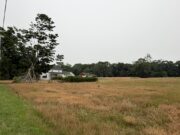
No one is arguing against farming. People moved to Calverton because farming still exists here. Because fields still break the horizon. Because the land still feels like land, not a staging area.
What’s being challenged is the quiet redefinition of farming into something that looks less like agriculture and more like production — something that wears familiar clothes while behaving in unfamiliar ways.
There’s a difference between stewardship and substitution. Between nurturing land and using it.
Riverhead doesn’t need to pretend this choice is small. It isn’t. It’s a signal. About what we protect. About whether words are allowed to outrun reality. About whether conservation means something when it’s inconvenient.
The APZ was meant to guard against exactly this moment — the moment when pressure arrives dressed as progress, asking us not to look too closely.
We should look closely. We should name things honestly. And we should remember that once land is lost in practice, no label can save it later.
The survival of local journalism depends on your support.
We are a small family-owned operation. You rely on us to stay informed, and we depend on you to make our work possible. Just a few dollars can help us continue to bring this important service to our community.
Support RiverheadLOCAL today.
