
















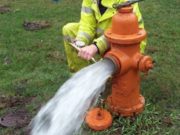










Downtown developers are pushing back on the Riverhead Water District requiring payment for infrastructure improvements the district says are needed to serve the new development.
Some developers spoke out at the town’s business advisory committee meeting Tuesday afternoon at Town Hall. They complain it’s unfair for the water district to require them to pay for the installation of hundreds of feet of new water main, in addition to being charged “key money” fees to tap into the new main.
Suffolk Theater owner Bob Castaldi, who recently received site plan approval to construct a five-story residential addition on the north side of the theater building, said he’s been told he has to pay about $400,000 for 800 feet of water main and three fire hydrants.
Castaldi, as well as architect Martin Sendlewski, who is working for the developer of another multi-family mixed use building downtown, raised questions about the management of water district finances and what they say has been longstanding neglect of district infrastructure.
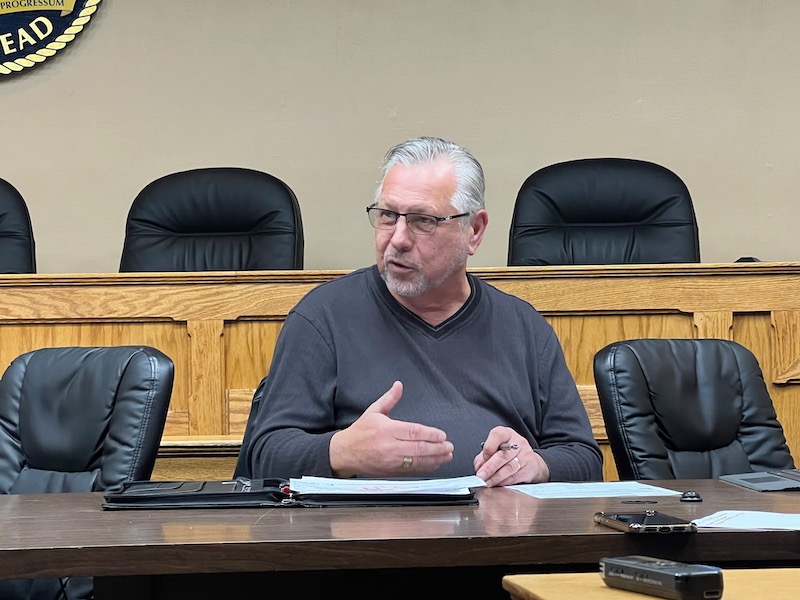
Both men questioned how the district has spent “key money” collected in the past from developers throughout the town, including key money for major commercial development on Route 58.
“They’ve collected the key money, according to this report, for 37 years,” Castaldi said during the meeting. “So my question is, how much money was collected? All those box stores on 58 — they all paid in — all of that money. How much money was collected? What was it spent on? And how much is left?” If the water district wasn’t upgrading its infrastructure, he asked, what was the money spent on??
Business advisory committee member Connie Lassandro, who is a consultant to developer Georgica Green Ventures, which built the Riverview Lofts apartment building on McDermott Avenue and has two other downtown apartment buildings in the application stage, said the developer paid $818,000 for the installation of water mains and appurtenances for Riverview Lofts.
Committee member Lee Mendelson, who is also on the board of the Riverhead Industrial Development Agency, called that required payment “outrageous.”
“And to add insult on top of injury, after I spend $400,000 to run an 800-foot main which I don’t own, they’re gonna charge me 50-60 grand to tap into my own pipes. It’s nuts,” Castaldi said.
“You can’t change the rules on people,” Castaldi said, complaining that the water district didn’t notify him of this requirement when he first applied for site plan approval five years ago.

Sendlewski said the committee is “very fortunate,” because its liaison Council Member Bob Kern is also, by law, a commissioner of the Riverhead Water District, as are the other members of the Town Board. “So they are the bosses of the Riverhead Water District,” Sendlewski said. Turning to Kern, he said, “So as our question to you as the water board, is what is the water board going to do to look into this matter and address it?”
“Taking notes,” Kern replied.
Sendlewski suggested the committee write to the Town Board and ask it “to investigate how come all these fees are being charged, where the previous key money went and all this stuff, because we get a lot of people that are trying to business in Riverhead.”
Mendelson said this policy will affect every developer that comes into downtown and learns, “that in addition to the cost associated with putting up the building and everything else, it’s going to cost them a million dollars to run a pipe now —that’s a million dollars they didn’t plan on,” he said.
“It’s wrong,” Castaldi said. “But this was hold my project hostage. You want to hold the theater hostage? You want to extort the theater?…They’re making their problem my problem,” he said.
Lassandro said she believes the town is asking too much. “We had to go all the way down McDermott, all the way down Heidi Behr and up Peconic,” she said.
Kern said he doesn’t understand why every developer who builds after a main is installed “shouldn’t be paying into the pipe.” He said he was told the water district can’t do that.
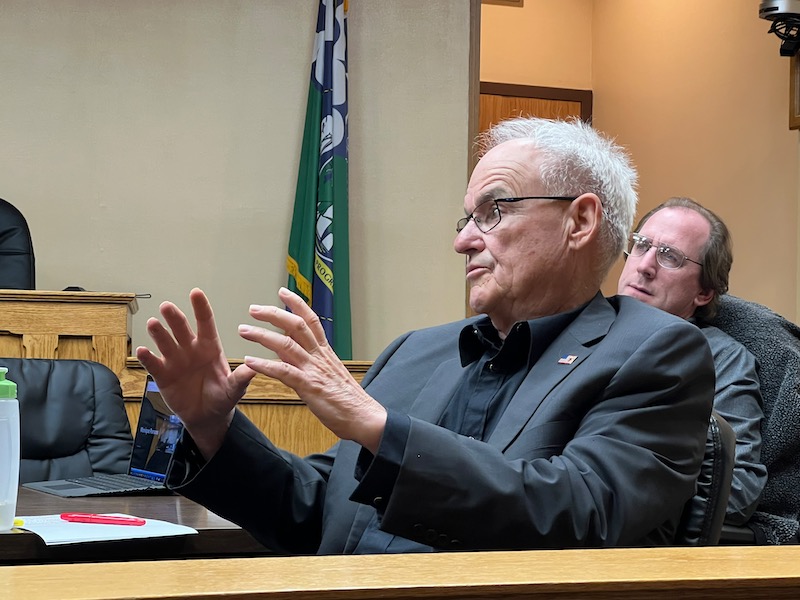
Riverhead Water District Superintendent Frank Mancini said in an interview yesterday what Kern suggested isn’t legally feasible for a small water district like Riverhead.
“A special taxing district is dictated by the New York Sate Constitution,” Mancini said. “I wish we could do that too. I’ve talked to all different types of attorneys. If the main is 10 miles away from you, you’ve got to pay to bring it 10 miles,” he said.
“That’s the difference between a special taxing district and a public authority,” Mancini said. “A public authority is much more flexible financially,” he said. “It can hold that massive amount of debt. And then every parcel pays the authority back, with interest, when the developer of the parcel needs to connect to the new main, Mancini said.
A special taxing district like the town water district can only bond for improvements that benefit the public, he said. It can’t bond for improvements that benefit a particular group of parcels and have all district taxpayers pay for it, and it has no legal way to charge it to the parcels that will benefit in the future, he said. The rules that govern special districts in the State of New York prevent that, Mancini said.
“If someone can come with a legal way to do that, they would make my life a lot easier,” he said. “We’re a small, tiny little water district. We barely have any help from anybody. And we’ve got a massive amount of work going on in the Town of Riverhead,” Mancini said.
The water mains downtown are the oldest mains in the district’s system. They are failing in some places and overall just not big enough to handle the type of development the town wants to see downtown.
“So we have 100-year-old pipe that was designed for single-family homes and small structures. Now 100 years later, it’s past its life expectancy and we’re putting five-story buildings on it all over the place,” Mancini said.
“These investments in the surrounding infrastructure truly do benefit their parcels…the value of these properties and they will gain value from them,” he said.
“The town had 100 years to figure out how to pay for and replace the water main in the downtown area to support the development they wanted. They did not. And this is the only recourse we have right now,” Mancini said.
Castaldi’s remarks about key money collected by the water district are not accurate, Mancini said.
“We know what we’ve collected,” he said. “And we know how it’s been spent.” Currently the district has roughly $2 million in key money and about $7.5 million in fund balance. The money is spent on water district improvements and infrastructure projects that benefit the district, he said.
Mancini said some of that money was paid from the district into the town’s general fund since the town began charging special districts fees for shared services, a practice begun during the Cardinale administration. Over the last 15 years or so, Mancini said, the district has paid the town over $10 million for shared services. The town was charging the district $800,000 or $900,000 a year, Mancini said. His predecessor, former Superintendent Mark Conklin, got that cut in half, he said.
The Office of the State Comptroller in 2013 after an audit of the town’s shared services chargeback policy, concluded that the town had been improperly charging special districts and certain special funds for administrative costs.
MORE COVERAGE: State comptroller faults Riverhead Town’s controversial administrative chargeback policy
The comptroller said the town’s practice of applying a flat percentage to the annual budgets of 11 special districts and funds to determine chargebacks for administrative costs is improper. Instead the town should calculate administrative cost allocations based on the actual services being provided by the town to the special districts.
The state audit came after then-Highway Superintendent George Woodson complained that the town’s adopted 2012 budget required the transfer of nearly $769,000 from the town’s highway fund to the general fund as an administrative chargeback.
MORE COVERAGE: Highway chief renews complaint about $769,000 transfer to general fund
Mancini said key money charges are assessed according to the type of use. Developers of single-family homes are charged over $6,000 per home, he said. Charges for other types of development are based not he Suffolk County Sanitary Code, which sets forth expected water consumption for various types of uses, Mancini said.
“They (key money fees) are directly related to the size of your project and the amount of gallons you need,” he said. The one-time charge is assessed at $9 per gallon of anticipated usage, based on the county sanitary code. The per-gallon charge hasn’t changed since 2006 and needs to be reviewed and updated, Mancini said.
Alek Lewis contributed reporting for this article.
The survival of local journalism depends on your support.
We are a small family-owned operation. You rely on us to stay informed, and we depend on you to make our work possible. Just a few dollars can help us continue to bring this important service to our community.
Support RiverheadLOCAL today.
