




























“This is not your grandfather’s warehouse.”
That sentence gets to the heart of the fact-packed and thoroughly researched presentation given by members of the Greater Calverton Civic Association Friday night dubbed “Warehouse Breeds,” attended by 92 people in-person at Riley Avenue Elementary School and by 30 who joined on Zoom.
The presentation, researched by a team of community residents, described the differences between traditional warehouses and the modern versions built to accommodate evolving needs in logistics, distribution, package-handling and order fulfillment.

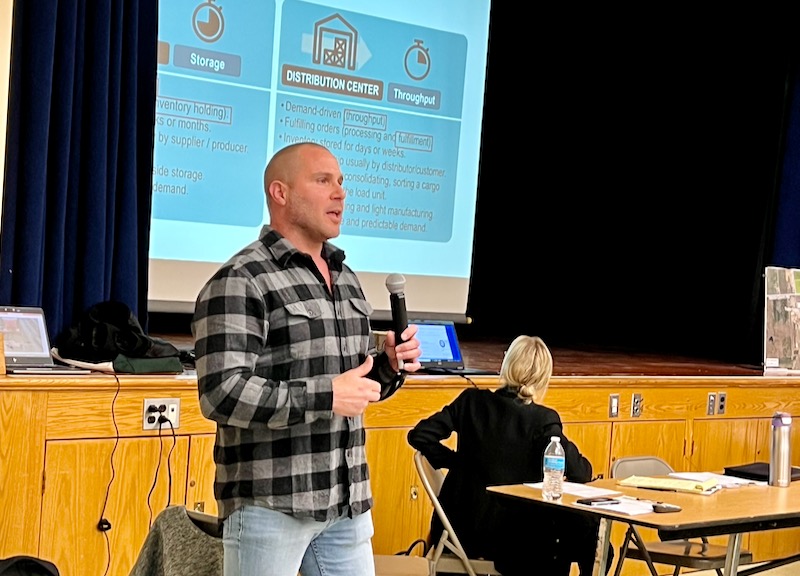
Traditional warehouses were built for storage and holding inventory, while distribution centers focus on “throughput” — fulfilling orders, explained Steve Gessler of Calverton, one of six presenters at Friday’s meeting. They’re more high-tech, he said, focusing on getting goods to customers more quickly.
“There’s a lot more materials coming in, flights landing at nearby airports, giant tractor-trailers, going to these huge buildings, unloading it, putting it into smaller trucks to go to your house and drop off the socks that you didn’t want to buy at the store yourself. And we all do it. So we’re all part of this,” Gessler said. “But this is what happens when we have this new generation of shopping.”
There are about six types of “smart warehouses,” which are designed to get goods to customers more quickly, Gessler said.
“For most people on the East End, it’s three days out for delivery. And people want now same day delivery or next day delivery. And there’s a price to pay for that — the price of the putting these things up in our neighborhood,” Gessler said.
“A smart warehouse uses automated systems and wifi technology to receive orders, pick the products and put them on trucks to get it out to your house before the sun’s up,” he said.

Gessler showed satellite imagery of the western Riverhead/Calverton with the NorthPoint’s proposed 641,000-square-foot Riverhead Logistics Center depicted at its Middle Road property, located at the terminus of Manor Road. Also highlighted on the satellite image, for comparison purposes, Gessler said, is the 150,000-square-foot Costco warehouse on Route 58. “Costco is tiny compared to this,” he said.
The Riverhead Logistics Center proposed in April 2022 by Kansas City-based NorthPoint Development is a 50-foot-tall, 641,000-square-foot warehouse facility on 39.7 acres of currently vacant, wooded land on the west end of Middle Road at the terminus of Manor Road. The site, purchased by NorthPoint for just under $7 million in November 2021, is in the Industrial A zoning district which allows “warehouse” as a permitted use.
“We don’t know who it is. It’s something they’re building on speculation.”
Gessler showed a photo of a 650,000-square-foot Amazon facility in Idaho for context.

Presenter Vinny Schiavone of Calverton remarked that the community’s turnout on a Friday night “goes to show how important it is, and how passionate we all are about what’s happening in this town right now.” See a PDF of Schiavone’s PowerPoint presentation below.
Schiavone, who said he previously worked in the logistics industry as part of a team setting up large-scale distribution centers, said as soon as he saw NorthPoint’s plans he knew “that is no warehouse. Based on my background and experience, I knew, that is no warehouse.”
A warehouse and distribution center are two very different structures, built with very different intent, serving very different functions, Schiavone said, citing “The Geography of Transport Systems,” a book written by Hofstra Prof. Jean-Paul Rodrigue.
“When you think about warehouse, think long-term storage,” Schiavone said. “When you think about a distribution center, think throughput. They’re about speed. They want to get packages in, cargo in and out as quickly as possible. That speed, that efficiency, that generates more traffic coming in and out of that facility. So, two very different concepts,” he said.
Schiavone described the cross-dock design of distribution centers, which have docks on opposite ends of the building, one set of docks for unloading cargo from large trucks and the other set, on the opposite side, for loading cargo into, typically, smaller trucks.
He also discussed how traffic generation estimates are calculated by traffic engineers using data from Trip Generation Manual published by the Institue of Transportation Engineers. The manual provides data for different types of land uses — including warehouse, high-cube trainload/short-term storage center, high-cube fulfillment center, high-cube parcel center, and high-cube cold storage center.
The ITE manual defines a “high-cube” facility as: “A building that typically has at least 200,000 gross square feet of floor area, has a ceiling height of 24 feet for more, and is used primarily for the storage and/or consolidation of manufactured goods prior to their distribution to retail locations, other warehouses or end users, Schiavone said.
The manual identifies five types of high-cube facilities with distinct characteristics, he said. Each has potentially different traffic impacts, Schiavone said, noting that there is a relatively small volume of study data relied on for the ITE trip generation estimates for high-cube facilities.
Schiavone presented a timeline depicting the publication of various editions of the ITE manual with information relating to modern warehouses that service online shopping — editions that go back to 2016 — as well as other significant events such as the release of the iPhone in June 2007, the advent of “Cyber Monday” in November 2005 and the launch of “Amazon Prime” in February 2005. He then added the date the town’s current comprehensive plan was adopted: November 2003. (When planning first got underway for the current document, in 1999, Amazon was just expanding from selling only books, music and videos to offering home-improvement products, software, video games and gift items. See: 20 years of Amazon’s expansive evolution.
Schiavone quoted the Riverhead Planning Board in its Nov. 3, 2022 resolution, advocating for a moratorium: “The 2003 Comprehensive Plan did not envision the proposed large scale high cube warehousing, distribution centers, nor the scope and magnitude of impacts that these proposed uses will have on the residents, infrastructure, and community character of Hamlet of Calverton and the Town as a whole.”
Riverhead, like many municipalities, has outdated and general terminology in its code, Schiavone said.
The vision statement in the 2003 comprehensive plan is something we can all agree with, Schiavone said. He displayed the vision statement on a slide. It reads:
Riverhead has a distinctive scenic and historic character, comprised of farmland, open space, historic hamlet centers (including downtown Riverhead), historic structures and sites, and unique natural resource areas such as the Pine Barrens. Because these resources play a key role in maintaining Riverhead as a desirable tourist destination and as an attractive place to live and work, these resources should be protected and carried forward into the Town’s future, as development continues to occur.
“It’s a really good vision,” Schiavone said. “The question is, are the actions we’ve been taking aligned with that vision statement? And the answer is no,” he said.
Gessler gave a brief presentation about Calverton Aviation & Technology’s development plans for the Calverton Enterprise Park, as described in the company’s joint application with Town of Riverhead to the Riverhead Industrial Development Agency for financial assistance in the form of mortgage, sales and property tax exemptions for phase one of its proposed development. He urged people to attend an informational meeting with representatives of the developer on Wednesday evening at the Hotel Indigo.
Some residents who attended the meeting complained that they were unaware of the warehouse proposal or CAT’s plans at the former Grumman site and asked if the civic association has been posting about these things on social media and whether the civic has contacted TV news outlets and other regional media. GCCA President Toqui Terchun responded that the civic reaches out to all media outlets and also maintains a Facebook page where notices and information are posted.

Group for the East End President Bob DeLuca spoke to the audience about the State Environmental Quality Review Act.
“First I just want to point out, number one is, this is a huge crowd of people. So while it may feel like nobody’s listening — and I heard somebody say, you know, we went to the town board and they don’t want to do a moratorium — Well, not yet they don’t. I’ve been at this a very long time and it’s multiple, repeated messages, over and over again, until the dam breaks,” DeLuca said.
“In 1975, the New York State Legislature commanded citizens and their elected officials to act as stewards of the environment. And the tool they created to do it was the State Environmental Quality Review Act that every major project has to go through, before you get an approval, that process has been turned upside down, hidden under the rug, you name it, it doesn’t get followed unless you have an army of folks like this, that demand it take place,” DeLuca said.
“The crafters of that law basically understood that you would have situations where you had multiple projects in a common geographic area, with similar environmental impacts that needed a common type of mitigation or assessment. And the tool that they gave us was called the generic environmental impact statement.”
DeLuca explained that the “generic environmental impact statement is the tool that allows you to take a moratorium and turn it into something. It’s the tool that allows you to look at all of this, look at your zoning code and prevent any approvals from happening while you’re doing it. So they go hand in hand,” DeLuca said. “In the moratorium, you pick the specific type of use you want to look at — the very specific problem we have here is the warehouse distribution center, the outdated code. And if you think that the comprehensive plan is going to help, it won’t — unless you stop what’s happening now,” DeLuca said.
He explained what a generic environmental impact statement, also known as a GEIS, is and how it works. It can clarify what future land uses are allowed, establish criteria for future projects, he said.
“The mistake that elected officials make sometimes is they say, ‘Well, geez, the moratorium, developers are gonna get mad, you don’t know what’s gonna happen.’ What they want is certainty,” DeLuca said. “Like, they may not be happy with the outcome, but certainty tells them whether to make the investment, whether they keep pushing the project, whatever it is, they know what the rules are,” he said.
“Intelligent developers are nervous about towns that don’t know what they’re doing and screw up the SEQRA process, which gives us all an opportunity to sue the town — and you have five years, 10 years, going down that line of attack. I’d rather not do that. I think most people wouldn’t. But the bottom line is, if you don’t do planning right in the first place, that’s what you’re left with,” DeLuca said.
“And I’m sorry to say that in this particular case, that the town board of this town…they can’t see this crisis and can’t use the tools that they’ve had since 1975 to fix the crisis. It’s a catastrophe,” DeLuca said.

“It’s amazing that this many people are this informed about something this complicated. Own that,” DeLuca said. “That’s the power that you have and the town board, whoever your elected leaders are, eventually the dam will break if the message is consistent, and you give them the tools,” DeLuca said. “Keep going with this. The town has to put a moratorium on this. They have to do a generic environmental impact statement. And for all the belly aching and crying and carrying on about all typical reasons they can’t do it, they have to do it if they really care about the future of this town,” he said.
Terchun said people in attendance know what the civic was doing last fall, “educating ourselves and getting ourselves to Town Hall and getting our feelings heard and our thoughts heard, but not acted on.” She said she was very disappointed by the town board’s response, which was basically “just to say no to us” rather than come up with alternatives a board majority could live with.
“The trick is to stop it before it’s a runaway train,” DeLuca said. “And every single applicant who comes in says, ‘Hey, look, that guy got an approval. You can’t do this to me, and not do it to them.’ And then you get into politics of it and everybody starts crying. And before you know it, the board members are like, ‘What are we gonna do? This guy’s upset that one — and they end up doing,” he said.

“So bottom line is somebody may sue the town, if they get caught up in the moratorium and they feel like their project should not be. That’s their right, they can make an argument to a judge that says, ‘We were too far along and this is an undue hardship.’ And they can make that case. And I will tell you, towns like East Hampton and others that have decided to put their natural resources first, have taken those cases on and they haven’t winced and said, ‘We give up.’ They fought and the public has supported him in that fight,” DeLuca said.
Towns will say they don’t want to get into litigation, he said. “I get it. But when you’re talking about the future of the town, and what it’s going to look like, people are pretty supportive if you’re defending that vision statement about what people want this town to look like,” he said.
“Moratoria are not that big of a deal. Other towns do them all the time. This town just did one on the solar code,” DeLuca said. It has to be fair and it has be for a limited time and it has to have a goal and an outcome, he said.
DeLuca urged the civic and local residents concerned about these issues to stay involved, keep going to Town Board and Planning Board meetings, keep voicing the community’s concerns and keep demanding that the town act as stewards of the environment.
Council Member Tim Hubbard, who attended Friday’s Calverton Civic meeting via Zoom, said in an interview yesterday he found the meeting “very informative.”
He said the people who did the research for the presentation really put a lot of work into it and he learned some things he didn’t know.
“I think some of what they presented was a little bit over the top,” Hubbard said. “I’ve done a little bit of reading on this and I don’t necessarily agree that what they presented is actually what’s trying to come in, to a certain degree.” He noted that no one is proposing logistics buildings that are over 100 feet tall, like some of those highlighted in the presentation.
Hubbard, who was the only Town Board member to attend the meeting, said that after watching the presentation on Zoom, he decided to try again to get two other Town Board members to agree with him on a moratorium on industrial uses in Calverton. Hubbard attempted to advance a six-month moratorium, but was unable to secure three votes to schedule a public hearing on the measure. Council Member Frank Beyrodt was the only other member to vote yes for a hearing. Hubbard said he believes Beyrodt will support it and said he wants to speak with Council Member Bob Kern and Supervisor Yvette Aguiar to see if either of them will change their mind and agree to vote for a hearing.

“I think the experts in this area are the consultants that we hired. And I strongly feel we need to let them handle this,” Hubbard said. “To me, it’s such a common sense thing to let the comp plan do its job and finish up on this. And if it’s 14 months, it’s 14 months,” he said.
“And you got to always keep in mind, too, the property owner’s, right to do what they can do. And it’s a fine line you got to walk here sometimes,” he said. “But at the end of the day, you’ve got to look and say, is this going to be better for Riverhead, or not better for Riverhead. To me, that’s how I always have to approach this and say, is this something we really need? Or is it something some developer’s telling us we need? And you know, there’s a big difference between the two,” he said.
“So let’s look at this holistically through the eyes of the comp plan, and then make a decision that’s right for the people in the town,” he said. “It’s obvious to me that the people are growing in numbers, coming out to speak. It’s not the usual 10 people that we hear from. And that’s concerning for me as a board member and as a resident of the town,” Hubbard said.
“Tying right into this — goes hand in hand with a cargo port at EPCAL,” Hubbard said. “That’s definitely not anything I’m interested in seeing or supporting. That’s never what was discussed. That’s never what was presented to us in the original [qualified and eligible sponsor hearing] in the original talks. That was not part of this. And that’s not that’s something I don’t think I can support that,” he said.
Hubbard, a Republican first elected to the Town Board in 2015, and whose term as a council member expires Dec. 31, is running for town supervisor this year. Aguiar, the incumbent supervisor, chose not to seek a third two-year term.
Hubbard voted against approving the $40 million contract of sale to Triple Five affiliate Calverton Aviation & Technology. The contract was approved 3-2, with then-Council Member Jodi Giglio also voting no. About a year later, after a public hearing and vetting process, both Hubbard and Giglio voted to approve the firm’s “qualified and eligible” status.
His opponent in the supervisor’s race, Democrat Angela DeVito of South Jamesport, was present in the audience at Riley Avenue Elementary School Friday night. She said the meeting was inspiring.
“It was extremely exciting to see so many people in our community engaged,” DeVito said in an interview today. “The information provided are tools people can use. Hopefully it will make a difference and people in Town Hall will begin listening to the residents, so the Riverhead we all know and love will not become a thing of the past with all of these warehouses,” she said.
“It underscores the fact that our local government for decades has basically just said, ‘OK we’re going to do this.’ They never evaluate it. They never evaluate policy. They didn’t look at the 2003 plan as a dynamic instrument,” she said. “The leadership appears to be happy with the same old, same old. They need to wake up down in Town Hall. Did they really think the residents wouldn’t notice? I took great joy in seeing people who are saying, ‘No. The status quo is not acceptable.’ We need to be thinking differently.”
DeVito said she sees “a shift” occurring in Riverhead town.
“The demographics are changing. People who moved here or retired here, or made this their year-round home when in the past they were summer or weekend residents. So there’s a shift occurring and how we go about doing our business has to change,” DeVito said.
“We’re not a tiny town anymore. We have grown. We are more diverse. And we’ve been static for the past two decades. We have not acknowledged any of these changes,” she said. “But we have not done that as a town.”
The survival of local journalism depends on your support.
We are a small family-owned operation. You rely on us to stay informed, and we depend on you to make our work possible. Just a few dollars can help us continue to bring this important service to our community.
Support RiverheadLOCAL today.
