

























While discussion of a proposal to allow private schools in industrial districts dominated Monday night’s comp plan update hearing at Town Hall [read prior story] there were plenty of other topics on the minds of speakers at the podium, who focused on several hot topic land-use issues like agri-tourism resorts, downtown apartments, farmland preservation, nonconforming uses, industrial zoning in general — and warehouses, distribution and logistics centers, in particular.
The 209-page comprehensive plan update is a “document that we hope represents where the community wants to be or should be in the next 10 years and beyond,” said Noah Levine, a principal at BFJ Planning, the firm hired by Riverhead to work on the plan. It is a “public policy guide for various initiatives, plans, investments, and so on,” the biggest being the town’s zoning and land use.
The new comprehensive plan could be adopted by the Town Board as soon as August, Levine said.
It would then be up to the Town Board to implement its recommendations with revisions to the town code.

Industrial development: Is potential more than town can bear?
A key aspect of the plan is the changes it proposes for industrial zones. Most of the town’s undeveloped industrial land is in Calverton, along the south side of Middle Country Road (Route 25). The plan proposes rezoning that land to a new zoning district called “Calverton Industrial,” which would decrease the density of future development and impose additional setback requirements and design guidance.
Jen Hartnagel, director of conservation for the Group for the East End, called the proposed changes “peanuts” in the context of what currently exists in Calverton.

The town’s six-month moratorium on industrial development in Calverton was “granted on the notion that the forthcoming comprehensive plan would analyze this situation and propose changes that would mitigate this disastrous amount of development.”
Instead, the reduction in development density in the proposed Calverton zoning district decreases the current 12 million square feet of buildable industrial space by only 166,000 square feet, assuming developers utilize the transfer of development rights program to increase industrial development density, Hartnagel said.
Hartnagel asked the town how the changes to the development density for industrial buildings were chosen. “This is very important information and it’s not justified in the document or qualified anywhere,” she said.
“The environmental review of the plan did not contain an overall assessment of the need of warehouse space to help determine the appropriate amount that the area can handle — like a carrying capacity — in terms of traffic, air pollution, economics, community character and the environmental justice issue,” Hartnagel said.
“Absent additional information to the contrary, it appears that the reduction in [floor area ratio] was arbitrarily chosen. The DGEIS should address this issue in detail,” she said.

Logistics and distribution centers: Speakers urge a harder look
Toqui Terchun, president of the Greater Calverton Civic Association, said the comp plan should take a closer look at Calverton and Middle Country Road. “If you were to increase density there or increase projects there, it would only hurt us. And things like warehousing need to go up at EPCAL,” she said.
Terchun said there needs to be “more attention paid to the language of warehousing.” Draft chapters of the comprehensive plan published by the town earlier this year did not mention different types of warehouses. The current draft now includes a recommendation that the town specifically define warehouses and distribution centers.
“[T]hese uses have important differences that affect building design, transportation and truck traffic, and employment and should be defined in the code,” the plan says. “The Institute of Transportation Engineers provides definitions for warehouses, types of high cube storage, and high cube fulfillment centers that could guide the town’s zoning.”
What the town might do with these uses — if they are defined — is unknown.
Terchun said that the plan “does not effectively discuss growth management.” The plan proposes a revision to the transfer of development rights program — which allows developers to purchase credits used to preserve land in exchange for bonuses to development in another part of town.
“TDRs are a good tool, however, there’s a negative side effect: open space in one area is preserved to the detriment of another area,“ Terchun said.
Calverton resident Barbara Rippel said the town needs to consider the consequences of warehouse development on town roads.

“I now live with Middle Road in my backyard, as a number of people do all along Middle Road. And there’s a big sign that says trucks can only be eight tons. I don’t know what that is — I’d love to be able to measure it,” Rippel said. “But there’s a very big rolling noise frequently coming down that road.”
“Big trucks wear out the road,” Rippel said. “Are you going to make the road wider? How are you going to enforce that rule if you have warehouses at the end of the block where people want to get in and go out, etc. Who knows, maybe planes dropping overhead, etc.,” she said.
“If you do these things, you need to be very clear about the enforcement to protect the people who live there, not the people you want to come there,” Rippel said.

What about EPCAL?
Tied into the future of the town’s industrial land is the development of the Calverton Enterprise Park, also known as EPCAL. Several speakers said it was important that the town study the future of development at the site, which contains an already subdivided “industrial core” and town-owned land and runways.
The land owned by the town at EPCAL is currently the subject of litigation between the town and company previously in contract to buy and develop the property, Calverton Aviation and Technology. The lawsuit was filed by CAT in January after the town canceled its contract in October.
Due to the uncertain future of the town-owned land at EPCAL, the plan says little about it, though officials agree significant development at the site is vital to the town’s economic development. The plan recommends the town “Reassess the development strategy for EPCAL to ensure the economic and community benefits of proposed projects align with local needs and that impacts are proactively addressed.”
Janice Scherer of Baiting Hollow said knowing the future of EPCAL is important to “understand the growth-inducing impacts of anything that happens there, to then understand what all the other changes are going to lead to.”
“So I know it’s excluded. But it really doesn’t make a whole lot of sense to exclude that because of the fact that this could change the direction of the entire town,“ Scherer said. “And so we don’t know what’s going to happen, and so how can you let all these other things happen when you don’t know what’s going to happen there?”

Opposition to agri-tourism resorts on L.I. Sound
Several speakers also opposed the plan’s recommendation to allow agri-tourism resorts north of Sound Avenue. The town was considering a zoning change earlier this year to allow resorts on more than 100 acres of land if 70% of the land was preserved and used for agricultural production. The proposal was shelved in April after disagreements between the town and the Long Island Farm Bureau.
“[I] feel like there has been an attempt to conflate agri-tourism with agri-tourism resorts in an effort to allow such resorts on the sound,” said Kathy McGraw of Northville. The agri-tourism resorts do not fit within the state’s definition of agricultural tourism, she said.
“Once these things are built, they’re going to be just flat-out resorts. And I don’t think the people of Riverhead want resorts on the bluffs of the Long Island Sound, which is one of the historic scenic advantages of Riverhead,” McGraw said to applause from the audience.
The Group for the East End also opposes allowing agri-tourism resorts. “Without having the specifics of the impacts of what this could potentially do in the area, we respectfully request that it be removed from the comprehensive plan as suggested and as a zoning amendment,” Hartnagel said. “In our view, the core value of farmland preservation is agricultural production, not resort complexes offering farm activities.”

Is ‘vertical farming’ a good thing for Riverhead?
Some speakers commented on the future of farming in Riverhead. Rob Carpenter, administrative director of the Long Island Farm Bureau and a member of the town’s comp plan update steering committee, thanked the town for the revisions to the transfer of development rights program. Carpenter, who led a subcommittee on the transfer of development rights program, said farmland preservation is a “key thing here in Riverhead.”
Carpenter said the Town Board must support the town’s farmers, not just farmland preservation. Farmers being able to thrive is “going to be really important,” he said.
“And there are a few things that we’re going to have to continue to have conversations on to make sure that we both understand each other, particularly with things such as vertical farming, which is a new technology that’s emerging in agriculture, things like agri-tourism, which is also an important economic factor to keep the farmers economically viable, and a few other conditional permits that were also talked about in the plan,” Carpenter said.
The comp plan suggests allowing vertical farming — the practice of growing crops on vertical surfaces and indoors rather than traditionally — in both industrial zoning districts and the Agricultural Protection zoning district. A large amount of the town’s farmland is within the APZ district and is the target of its farmland and open space preservation efforts.
Other speakers said vertical farming should not be allowed in the Agricultural Protection zoning district. “Don’t put it on top of good, clean, pure, really valuable soil that we need here,” said Phil Barbato, an organic farmer in Jamesport.
Hubbard told Barbato that he hasn’t “talked to a farmer yet that would want to do it, actually. It’s very expensive to do. It uses a lot of electricity. It’s not the best looking when they stack container on top of container,” he said.
Scherer said the town should commit to making payments in lieu of taxes to the Riverhead Central School District for the farmland it preserves through the transfer of development rights. Land with development rights acquired by the town are taken off of the tax rolls and the town can use community preservation fund revenues generated by a real estate transfer tax to pay for the lost revenue, she said.
“Why don’t you just ask to borrow some from Southampton, since you have so much you don’t know what to do with,” Hubbard said, referring to Southampton Town’s CPF revenues, which dwarf Riverhead’s revenues. His comment also alluded to Scherer’s position as Southampton’s planning and development administrator.
“Well, I live here,” Scherer said, “so that would be nice and I would welcome that as well.”
Riverhead officials last April hired Scherer, who lives in Riverhead, as a consultant for the comp plan update after the Town Board suspended planning director Jefferson Murphree and filed disciplinary charges against him, seeking termination of his employment.
Accessory dwelling units debated
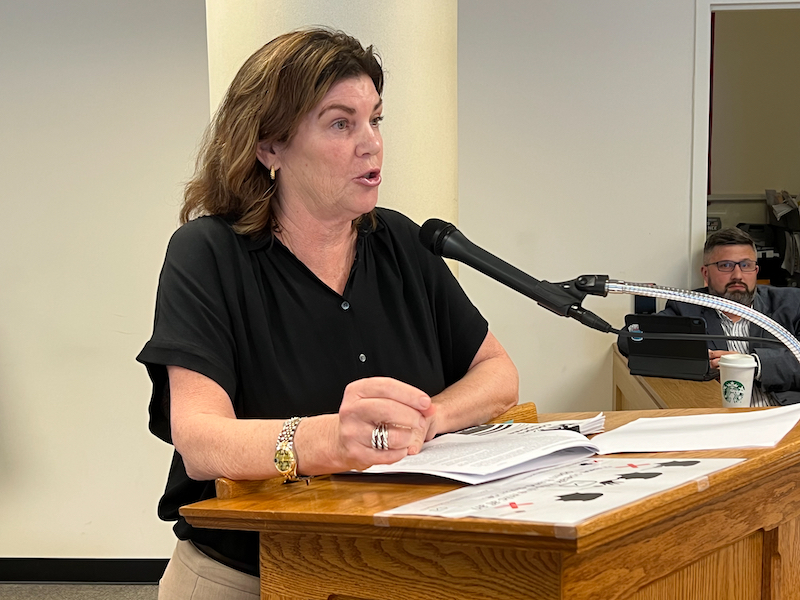
Another aspect of the plan discussed by several speakers was its recommendations to make it easier for residents to create apartments in accessory structures located on single-family properties. These apartments, also known as accessory dwelling units or ‘ADUs’, are currently allowed in the town, but restricted by Riverhead Town Code in several ways.
Michael Daly of Housing Help Inc., a nonprofit housing counseling organization, said the town is going in a “really terrific direction” in its recommendations to change rules surrounding accessory dwelling units. The plan recommends eliminating several current requirements to make accessory dwelling units easier to legally establish, such as the requirement that homeowners possess a certificate of occupancy for an accessory building for three years prior to applying for an accessory dwelling unit permit.
“We support the efforts to increase the opportunity for homeowners to add accessory dwelling units or accessory apartments,” Daly said. “It’s important because ADUs are a fiscally and environmentally responsible way to add housing without adding heavy density, it just adds light density.”
“But more importantly, especially with the rise of foreclosure cases on Long Island — and we’re seeing them everywhere — it provides a critical strategy for homeowners struggling with costs to remain in their homes,” he said. “It’s also an important option for first time homebuyers to be able to afford today’s home prices.”
Greater Jamesport Civic Association President Laura Jens-Smith said the civic group is opposed to the change to the three-year certificate of occupancy requirement. She said the group would like the town to study how many dwelling units changing the town’s ADU policies might generate.

Short-term rentals in some areas proposed by plan, opposed by residents
Cindy Clifford of Riverhead, president of the Heart of Riverhead Civic Association, said the group is opposed to the plan’s proposal to allow short-term rentals in tourist areas. She said the change could prompt out-of-town investors to buy up housing in the downtown area — raising home prices and removing opportunities for first-time homebuyers in the area.
“It would also be detrimental to the character of established neighborhoods with group rentals, weekend parties and temporary renters coming and going,” Clifford said. “It’s suggested the short term rentals could be monitored, but is it reasonable or realistic to think that our six-person code enforcement team will be able to add this to their already heavy workload?”
Rippel told the Town Board that she out of Cutchogue because it became “a great tourist place” and the rules surrounding short-term rentals were not enforced.
“It changes the whole neighborhood. In fact, that killed our neighborhood,” Rippel said. “It’s now a war zone and people are not speaking to each other, there’s a suit going on. It’s really depressing to me…”

Downtown apartments: The controversy continues
Clifford said the civic group is opposed to lifting the 500 dwelling unit cap for mixed-use buildings in the Downtown Center-1 zoning district, which governs properties along East Main Street in the core downtown area. The plan proposes evaluating an increase to the cap, which has been “essentially reached,” and says the town anticipates even more development in the downtown area.
“We wonder if this comp plan addresses how much growth we want or need or will permit,” Clifford said. “And where is the benefit for residents in adding all these apartments, especially if the IDA continues to grant tax abatements on additional buildings?”
Scherer said the impact of lifting the 500-unit cap needs to be studied in tandem with the surrounding zoning districts, including the transit-oriented development district around the Long Island Rail Road Station. There are over 900 apartments being proposed in the downtown area, she said.
Ike Israel, a real estate broker and developer with property on Main Street, took a contrary view. He questioned why the town still needs to study the 500-unit cap when studies conducted by the town have concluded that there’s more demand for housing.
“The town’s investing a lot of money with the town square and we should be able to encourage the development that’s compatible with the rest of Main Street so we could finish revitalization,” he said.
Clifford and McGraw also raised in their comments possible changes to the Riverhead Industrial Development Agency. The agency provides incentives, including tax breaks, to new development.
“We wonder if this comp plan includes a realignment of the IDA, perhaps the appointment of an oversight team that would weigh in on businesses applying for benefits, recommending apprenticeship programs, training and placement, enticing specific businesses that will bring in better paying jobs for residents,” Clifford said. “And if not, could any of these suggestions be added?”
McGraw said the IDA needs to be “on board and in sync with this comp plan and not operate in their own little world.”

Greater Jamesport Civic: Don’t change status of nonconforming marina uses
Jens-Smith raised her civic association’s opposition to the plan’s suggestion that the town reevaluate the zoning for non-conforming uses around the town. Non-conforming uses are established uses that, due to changes to certain zoning districts, no longer conform to the current zoning district. They may continue to exist, but need special permissions to expand.
Marinas along the Peconic Bay are a common nonconforming use in town. These marinas are currently in residentially zoned areas, according to the plan. “It is important to support these nonconforming uses, which are key stakeholders in the local economy,” the plan says. “It is recommended that the Town work with property owners to help them establish conformity should they wish to do so.”
Another nonconforming use in town is the United Riverhead Terminal, a petroleum bulk storage and distribution facility in Northville. McGraw, who lives in Northville, said the plan should mention the business.
“It is a great big nonconforming use on the bluffs of the sound,” she said. “And I think there should be some consideration in the comp plan, because there have been requests for expansion of that. And I just think it should not be totally ignored in our comp plan.”
A video recording of Tuesday’s hearing is available on demand on the town’s website here.
Written comments on the draft plan will be accepted into the record of the public hearing until June 10, Hubbard said. Comments should be emailed to the town clerk or sent by U.S. Mail to Riverhead Town Clerk, 4 W. Second St., Riverhead NY 11901.
A separate hearing on the draft generic environmental impact statement for the plan, which assesses its environmental impacts, will take place on Wednesday, May 29 at 6 p.m. at Town Hall, Hubbard announced.
Editor’s note: This article was amended to correct an editing error that resulted in the misstatement of the number of pages in the draft comp plan update document.
The survival of local journalism depends on your support.
We are a small family-owned operation. You rely on us to stay informed, and we depend on you to make our work possible. Just a few dollars can help us continue to bring this important service to our community.
Support RiverheadLOCAL today.
