




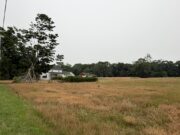























Homeowners in the Willow Ponds condo complex on Sound Avenue are considering allowing the prospective developer of a resort hotel on adjacent Soundfront property to hook up to their sewage treatment plant in exchange for a cash payment and shared costs going forward.
Representatives of Alfred Weissman Real Estate, based in Harrison, New York, met with Willow Ponds homeowners Friday evening to pitch the idea of connecting their proposed development to the condominium complex’s sewage treatment plant.
The developers had a prior meeting with the HOA’s board of directors, who set up Friday’s membership meeting so the Westchester-based real estate development company could present the idea directly to homeowners.
Alan Weissman, principal and CEO of the development company, told the homeowners he did not know how much capacity their sewage treatment plant has available, or how much wastewater would be generated by the resort and spa his company is proposing to build on the site immediately east of the condo complex.
“We just pitched it as an idea of something that might provide a big fat payment up front to the HOA, and ongoing payments going forward,” Weissman said. “And again, if it doesn’t work, it doesn’t work.”
He said if sharing the sewage treatment facility meant it would have to be expanded the developer would pay for the expansion, share operating costs going forward and split any future major capital expenses with the HOA.
The idea is to “pay you for the opportunity to tie into it, pay for the cost to improve and expand — whatever would be needed for our use — and then pay for the ongoing expenses going forward and sharing those expenses with you and hopefully being a benefit to both of us, bringing your costs down and saving us the time and effort of having to go through a bigger approval to get a newer, a brand new facility,” Weissman said.
The proposed development plan sketched out by Alfred Weissman Real Estate would require an expansion of the condo’s sewage treatment plant, according to Willow Ponds’ wastewater discharge permit issued by the Department of Environmental Conservation, which expires next July, and Suffolk County’s standards for wastewater treatment facilities.
The county health department’s chart spelling out wastewater design and construction standards by type of use indicates that a 100-room hotel and 250-seat restaurant — the numbers under discussion Friday night —would require 22,500 gallons per day of treatment capacity combined. This does not include the proposed spa. Wastewater flow for the spa would be calculated based on its square footage at 0.3 gallons per day per square foot. The developers did not say what the size of the spa building would be.
The plant’s permit allows for the treatment and discharge of 70,000 gallons per day and the condo complex is generating an estimated 50,353 gallons per day, according to town documents, leaving available capacity of less than 20,000 gallons per day. The amount being used is estimated by applying county health department design standards of 225 gallons per day per condo unit (600 to 1,201 square feet) and wastewater generated by the recreation building (15 gallons per day per parking space).
It is not known whether the treatment plant, which was completed in 2007 according to town records, will require any major upgrades, either as a result of age or by regulatory mandates. The plant currently discharges treated sewage effluent to groundwater.
The developer’s representatives did not discuss details of any proposed financial arrangements with the HOA. Rather, they said, they were there to gauge interest from the homeowners.
If it doesn’t make sense, or if the community is unwilling, Weissman said, the developer would build its own sewage treatment facility on its own site. “We don’t need it to make our project work,” he said, referring to the condominium’s treatment facility.
Though sharing the condominium’s sewage treatment plant was the topic of the meeting, questions from homeowners were mostly about the nature of the proposed development and uses.
Residents expressed concerns about potential traffic, noise, beach and recreational uses, and future use of the site’s existing farmland as well as setbacks, buffering and screening from the condominium residences.
“We think it’s a great use. We think it’s a quiet use for being your next door neighbor,” Weissman told the residents. He stressed that the company is planning to build a high-end luxury resort, where rooms would rent for $600 to $1,200 per night (at the current going rate, he said) with a five-star restaurant.
The developer is not planning to have every use that would be allowed under the proposed “Agri-Tourism Inn & Resort” code that’s set for a Town Board public hearing next week, Weissman said. For example, the 70 acres of farmland being acquired would not be used for hay rides and festivals, horseback riding or vertical farming, even though State Ag and Markets Law and the proposed zoning may allow those uses, he said. Those types of uses are not compatible with the type of luxury hotel the company is planning to develop, Weissman said.
MORE COVERAGE: Agri-tourism resort code back in play
He said the company does not manage the hotels it builds, but is “very involved in day-to-day operations.”
“We bring in a professional management company that specializes in luxury boutique hotels to manage the hotel,” Weissman said.
Once the zoning is approved, he said, “we come back to you and talk to you, not just about the sewage treatment plant, but also about what our development is, what it’s going to be, what kind of screening we’re going to have” and the like.
Weissman said the company’s goal is to have everyone’s questions answered before their permit application goes to a hearing. He and the company’s head of acquisitions, Michael Cohen and its president and general counsel Joseph Genzano, fielded questions from residents at the meeting, which took place in the condo complex’s clubhouse.
“In all our developments … wherever we do these projects, our goal is to have nobody show up at the public hearing or at the vote, because all your questions have been answered in advance and you’re happy with it, or at least content with what’s going on, or at least you know you’ve been listened to and heard from,” Weissman told the residents.
Willow Ponds residents attended a Town Board meeting late last year to object to putting a hotel adjacent near their homes. Reaction from Friday’s audience was mixed, with both expressions of support and skepticism.
Among questions posed Friday night was whether the developer would seek tax breaks from the Riverhead Industrial Development Agency. The answer was no.
“We’re not going for any tax exemptions. We’re going to be full taxpayers. We’re not going for IDA loans or any kind of reduction. We’re going to be full taxpayers from day one,” Weissman said.
Some residents questioned the adequacy of the water supply to serve the new development, because they already have problems with poor water pressure in their community, they said.
Water for farm uses will draw from an on-site private well, Weissman said. The rest of the water will be from the public water supply, he said.
Genzano said the developer will have to demonstrate that there is enough water capacity to serve the new development. “That’s part of the site plan,” he said.
HOA board member Ellen Hoil on Monday expressed concern that the community may have no legal commitment from the developer “that says they’re going to keep their word. The code as drafted lets them do a lot of things that right now they’re promising not to do.”
“I thought it went fairly well,” HOA president Bill Wanderling said Monday. “I thought that the people were going to be very negative. They didn’t seem to be. So I thought it was pretty good.”
“I think what they wanted to do was make sure that the homeowners here were a little more comfortable with them,” he said. “That was basically the whole gist of the meeting.”
Wanderling said nothing will happen until the Town Board approves the proposed zoning code change.
The proposed “Agri-Tourism Inn & Resort” code is scheduled for a public hearing at Tuesday night’s Town Board meeting.
The code will allow the development of hotel-resorts in the RA-80 zoning district, which takes in much of the land north of Sound Avenue from Jamesport to Baiting Hollow, by special permit. Development sites must be a minimum of 100 acres. Seventy percent of the site must be preserved for agricultural production, according to the proposed code.
The resort can provide up to 150 guest rooms on the developable portion of a site, along with accessory uses such as a restaurant, spa, gym, pool, tennis courts and other recreational uses customarily associated with inns and resorts, according to the code.
Allowed uses of the preserved farmland include crop production dependent on agricultural soils as well as crop production not dependent on agricultural soils, which is limited to 5% of the lot coverage for the portion of the land dedicated to agricultural production, as long as the latter is done within “traditional barn structures” that are suitably screened from Sound Avenue. Farmworker housing is also allowed on the site.
Alfred Weissman Real Estate’s attorney, Eric Russo, and planning consultants, VHB Engineering, worked with the town to draft early versions of the currently proposed code, according to emails obtained by RiverheadLOCAL earlier this year.
MORE COVERAGE: Hubbard, town staff defend developer’s involvement in agri-tourism zoning code proposal
Town officials said that the developer did not have input on recent drafts of the code — including the code that is going to public hearing.
Weissman had featured the proposed North Fork Resort, a “luxury resort and spa” on the Long Island Sound, in the “new development” section of its website last summer. The proposal came to light through an examination of the campaign finance disclosure statements last year. The firm, a company associated with the firm, and one of the firm’s executives made contributions to Supervisor Tim Hubbard’s and Council Member Ken Rothwell’s campaigns.
The proposed code has been praised by most Town Board members and other town officials as a farmland preservation and economic development tool. It has met opposition by some residents, civic groups, and the Group for the East End, a local nonprofit environmental advocacy group.
Southold Town has also raised concerns about the legislation and held a joint work session with the Riverhead Town Board last month to discuss it. Read more here.
Editor’s note: This article has been amended to clarify language used to explain the permitted capacity of the sewage treatment plant, current usage by the condo complex and estimated potential demand by the hotel and resort development.
The survival of local journalism depends on your support.
We are a small family-owned operation. You rely on us to stay informed, and we depend on you to make our work possible. Just a few dollars can help us continue to bring this important service to our community.
Support RiverheadLOCAL today.
